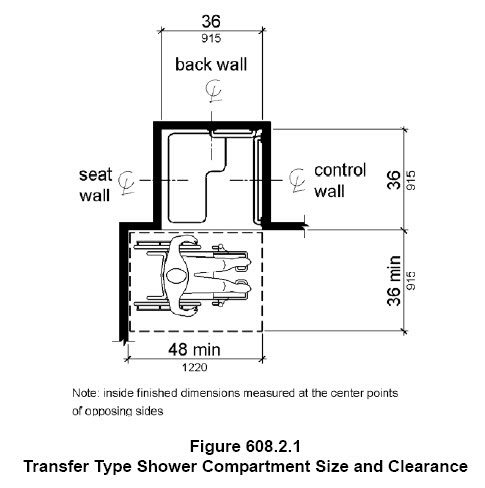
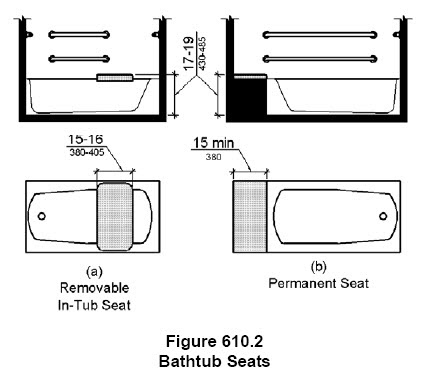
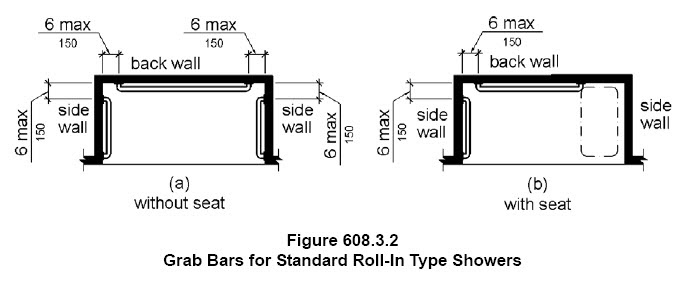
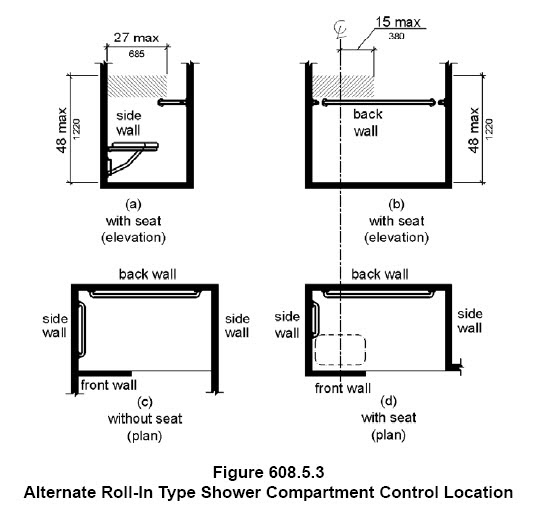
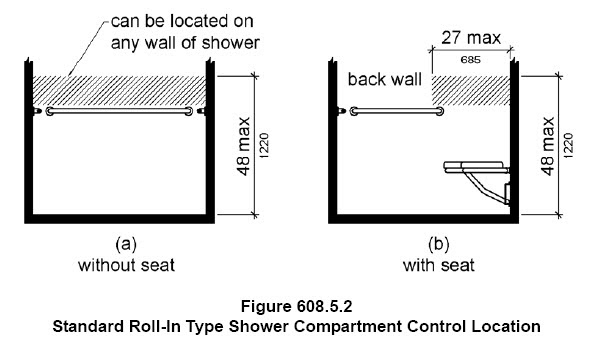
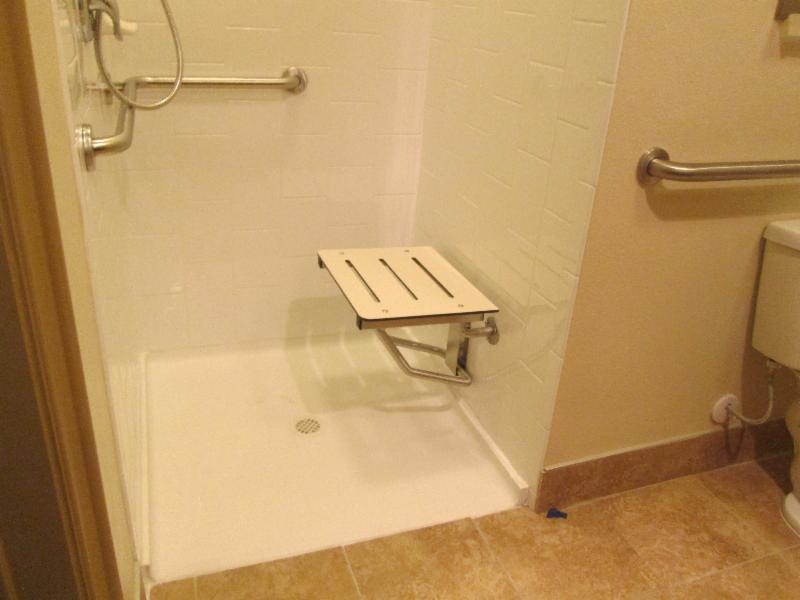
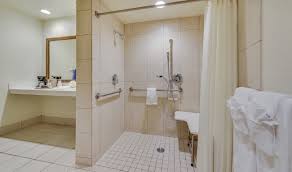
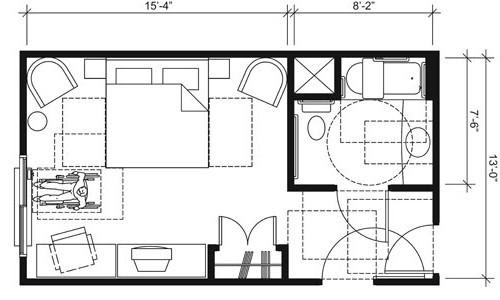
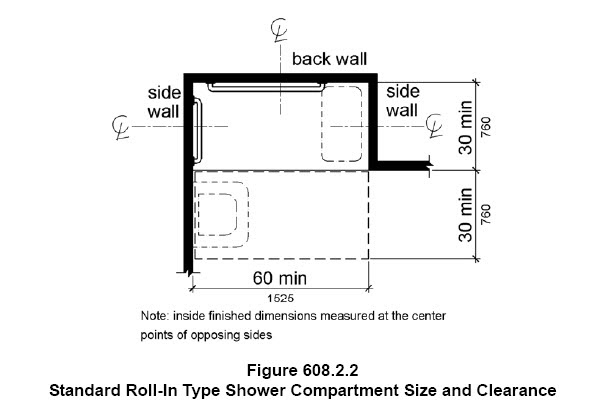
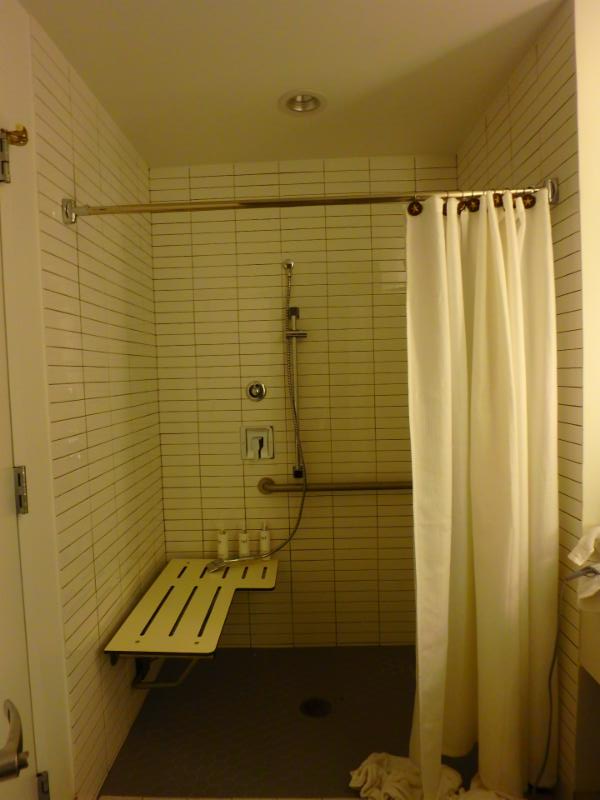
Showers are not all the same. There are three types that are described in the ADA standards for showers: transfer showers, roll in showers and alternate roll in showers (which is like a hybrid between the transfer and the roll in shower). Their requirements also vary depending on where they are located.
Below are the requirements in showers, and specifically in a transient lodging facility.
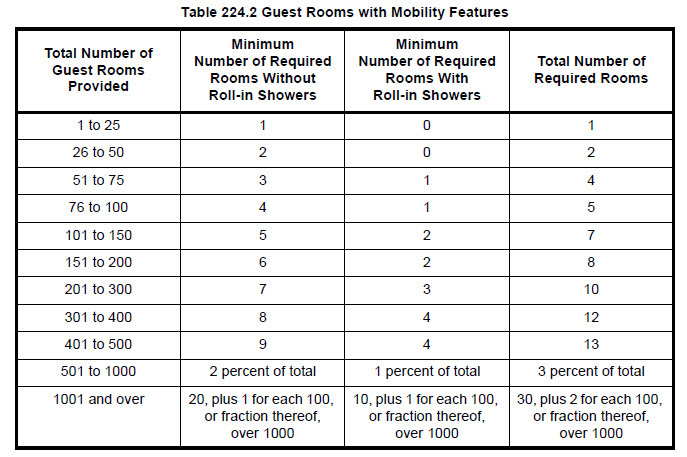
There are requirements for rooms with mobility features (for persons with mobility disabilities) and there are requirements for how many rooms with communication features (rooms for persons that are either hearing impaired or visually impaired). When designing rooms with mobility features one of the requirements is to provide a minimum number of rooms with roll in showers and without roll in showers.
If you notice the chart above, note that if you have less than fifty rooms in a transient lodging facility, then you MUST provide rooms WITHOUT a roll in shower. So that would mean either a tub or a transfer shower must be provided in a certain number of rooms. All your bathing facilities cannot be roll- in-showers.
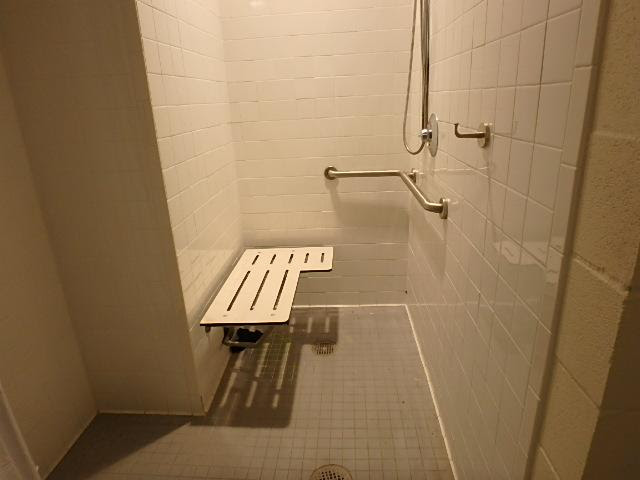
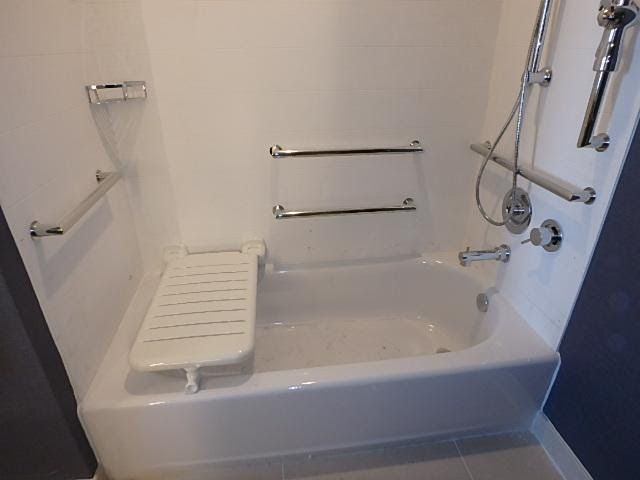
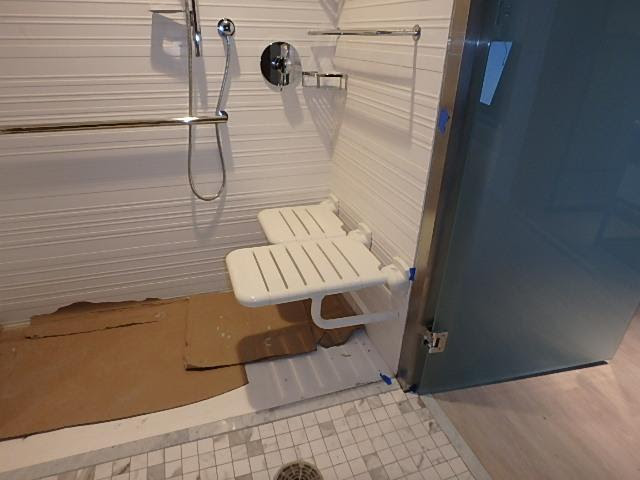
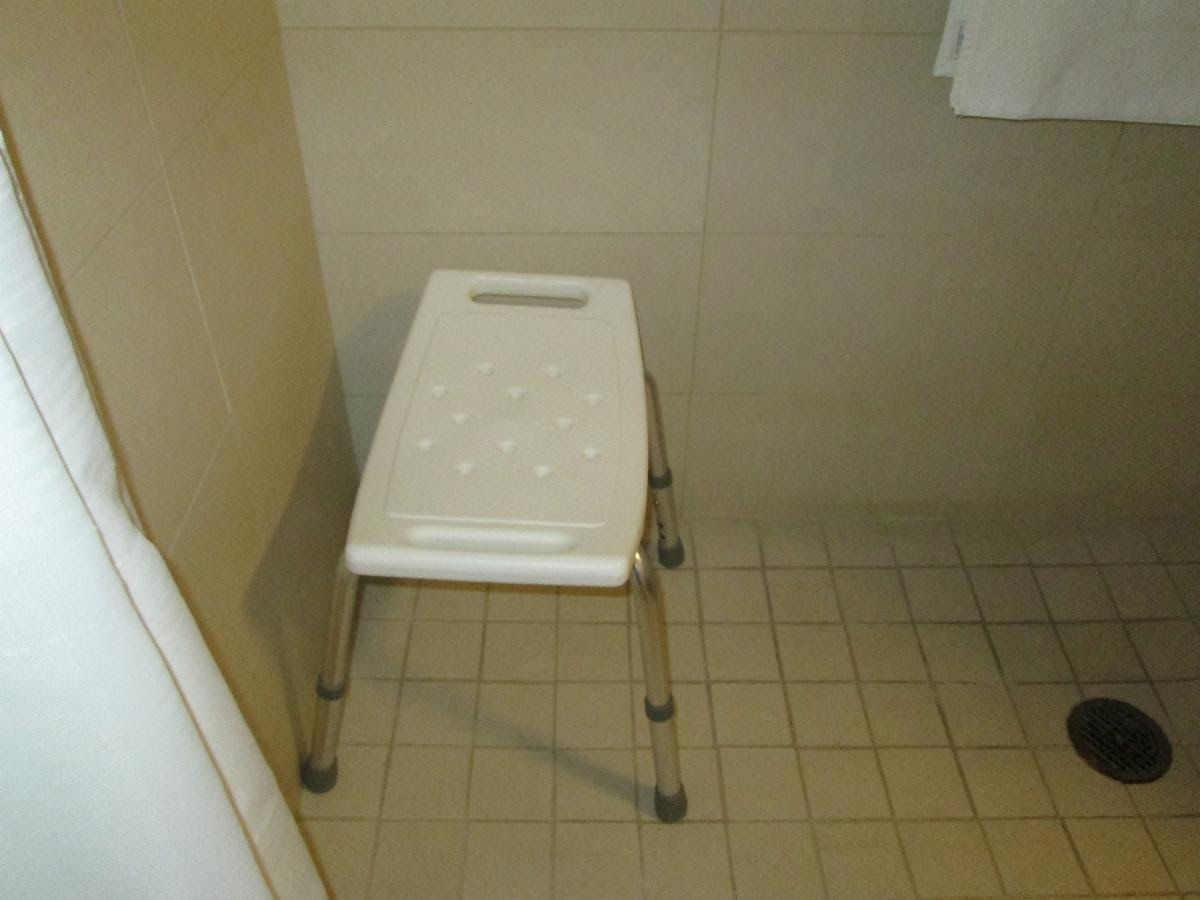
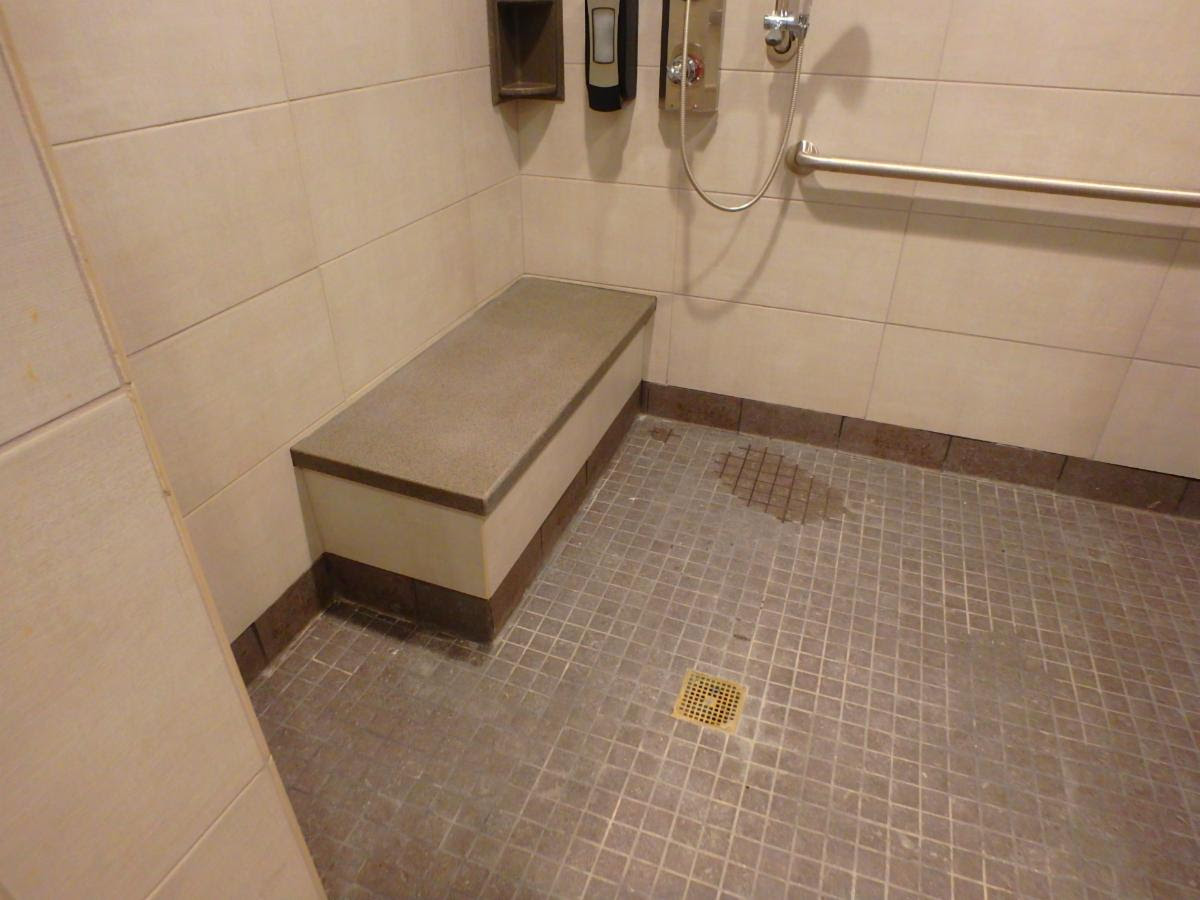
The photos below show you two bathing facilities that are not roll-in-showers:
Transfer Shower
Tub with a fixed and folding seat
If you would like to also provide roll in showers for persons with disabilities you could, but you must first provide the rooms without the roll in showers as stated in the chart. Any additional rooms provided with mobility features beyond the amount on the chart can have a roll in shower.
Transfer shower
Fixed Shower Seats
There are also requirements for seats in showers. In a typical installation that is not located in a transient lodging, the only shower that requires seats are the transfer showers. If you provide a roll in shower or an alternate roll in shower, having a seat is optional. If you do provide them then you must locate the shower controls close to the shower seat.
But in a transient lodging you MUST install a shower seat no matter what type of shower you are providing.
Part of the requirement is that the seat be fixed and either folding or non-folding, EXCEPT in a transient lodging room with a roll in shower.
608.4 Seats. A folding or non-folding seat shall be provided in transfer type shower compartments. A folding seat shall be provided in roll-in type showers required in transient lodging guest rooms with mobility features complying with 806.2. Seats shall comply with 610.
So what that means is that if you have a roll in shower that is not located in a transient lodging facility you can provide a seat that is fixed but not folding.
Safe Harbor is a provision that was adopted by the Department of Justice as well as the Texas Department of Licensing and Regulation where it allows an existing element that meets the original Standard to remain as it is even if it does not meet the new standards. It can only remain a safe harbor as long as it is not touched. Once it is remodeled, removed or relocated then it must comply with the new standards.
Our newsletter gives a couple of examples of safe harbor provisions in restrooms.
Toe clearance at toilet compartments
The 2010 ADA Standards for Accessible design (and the 2012 TAS) requires that a 9″ high toe clearance be provided on two sides of the toilet compartments so that a person in a wheelchair can maneuver inside the stall and be able to exit.
But the 1991 ADAAG (and the 1994 TAS) only required a toe clearance if the “stall” was less than 60″ deep.
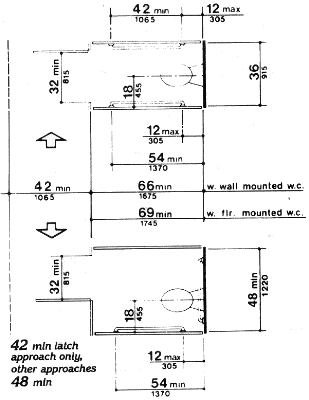
4.17.4 Toe Clearances. In standard stalls, the front partition and at least one side partition shall provide a toe clearance of at least 9 in (230 mm) above the floor. If the depth of the stall is greater than 60 in (1525 mm), then the toe clearance is not required.
If you have a hard wall toilet compartment built prior to 2012 that is more than 60″ deep and 60″ wide, but no toe clearance, it is allowed to remain narrow. It does not require the additional 6″ of width as the 2010 ADA does.
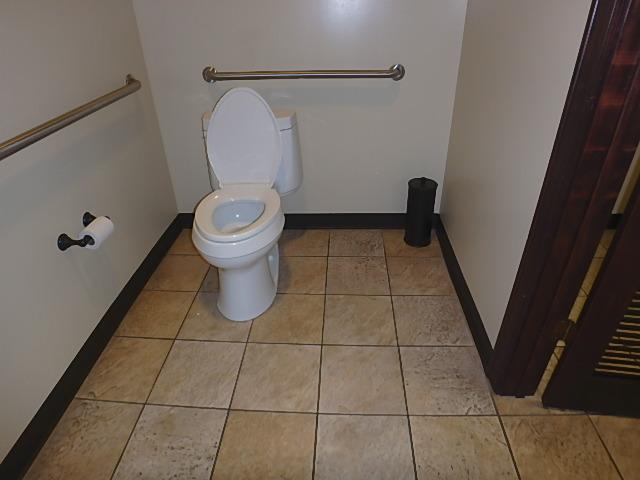
This toilet compartment is 60″ wide but because it is longer than 60″ it does not require toe clearance
“Alternate” Toilet Compartments
There was a term in the original ADA standards that is no longer used: “Alternate stall”. This was what we now call an ambulatory compartment but it was allowed to be used instead of a standard wheelchair accessible compartment if there was not room and only in alterations.
4.17.3 EXCEPTION: In instances of alteration work where provision of a standard stall (Fig. 30(a)) is technically infeasible or where plumbing code requirements prevent combining existing stalls to provide space, either alternate stall (Fig. 30(b)) may be provided in lieu of the standard stall.
These are the “alternate” stalls allowed in alterations
The word “technically infeasible” is meant to imply that a variance would be required where a AHJ like The Texas Department of Licensing and Regulation is involved. So in order to determine if the compartment is a “Safe Harbor” the variance that allowed it to be used would need to exist.
“Ambulatory” Toilet Compartments
In the 1991 ADAAG the “ambulatory” stall is described as a stall required when six or more stalls are provided.
4.22.4 Water Closets. If toilet stalls are provided, then at least one shall be a standard toilet stall complying with 4.17; where 6 or more stalls are provided, in addition to the stall complying with 4.17.3, at least one stall 36 in (915 mm) wide with an outward swinging, self closing door and parallel grab bars complying with Fig. 30(d) and 4.26 shall be provided. Water closets in such stalls shall comply with 4.16. If water closets are not in stalls, then at least one shall comply with 4.16.
So only restrooms with toilet compartments are required to also provide “ambulatory stalls”. So if a mens’ restroom has three urinals and three toilet compartments, that would not add up to six “stalls” therefore an ambulatory stall would not be required.
But in the 2010 ADA changed the wording to say:
213.3.1 Toilet Compartments. Where toilet compartments are provided, at least one toilet compartment shall comply with 604.8.1. In addition to the compartment required to comply with 604.8.1, at least one compartment shall comply with 604.8.2 where six or more toilet compartments are provided, or where the combination of urinals and water closets totals six or more fixtures.
So now, when a restroom has three urinals and three compartments, then one of the compartments would have to be an ambulatory compartment.
So an existing pre-2010 ADA restroom with three urinals and three compartments and no ambulatory stall, is a safe harbor and can remain this way until it is remodeled.
I am still getting questions about work areas. So in honor of Labor day, let’s revisit what is required. I think one of the things that confuse people is what is a work area.
This newsletter will give an overview of what requirements exist in the ADA and TAS about work areas and when the ADA Standards apply.
—————–
Work Areas
According to the ADA the definition of an employee work area is:
Employee Work Area. All or any portion of a space used only by employees and used only for work. Corridors, toilet rooms, kitchenettes and break rooms are not employee work areas.
Work Area Equipment. Any machine, instrument, engine, motor, pump, conveyor, or other apparatus used to perform work. As used in this document, this term shall apply only to equipment that is permanently installed or built-in in employee work areas. Work area equipment does not include passenger elevators and other accessible means of vertical transportation.
Per the 2010 ADA Standards for Accessible Design:
203.9 Employee Work Areas. Spaces and elements within employee work areas shall be designed and constructed so that individuals with disabilities can approach, enter, and exit the employee work area.
An example of a work area that only requires an approach, enter and exit would be a janitor’s closet. Elements within the janitor’s closet such as the faucet for the mop sink will not be required to comply.
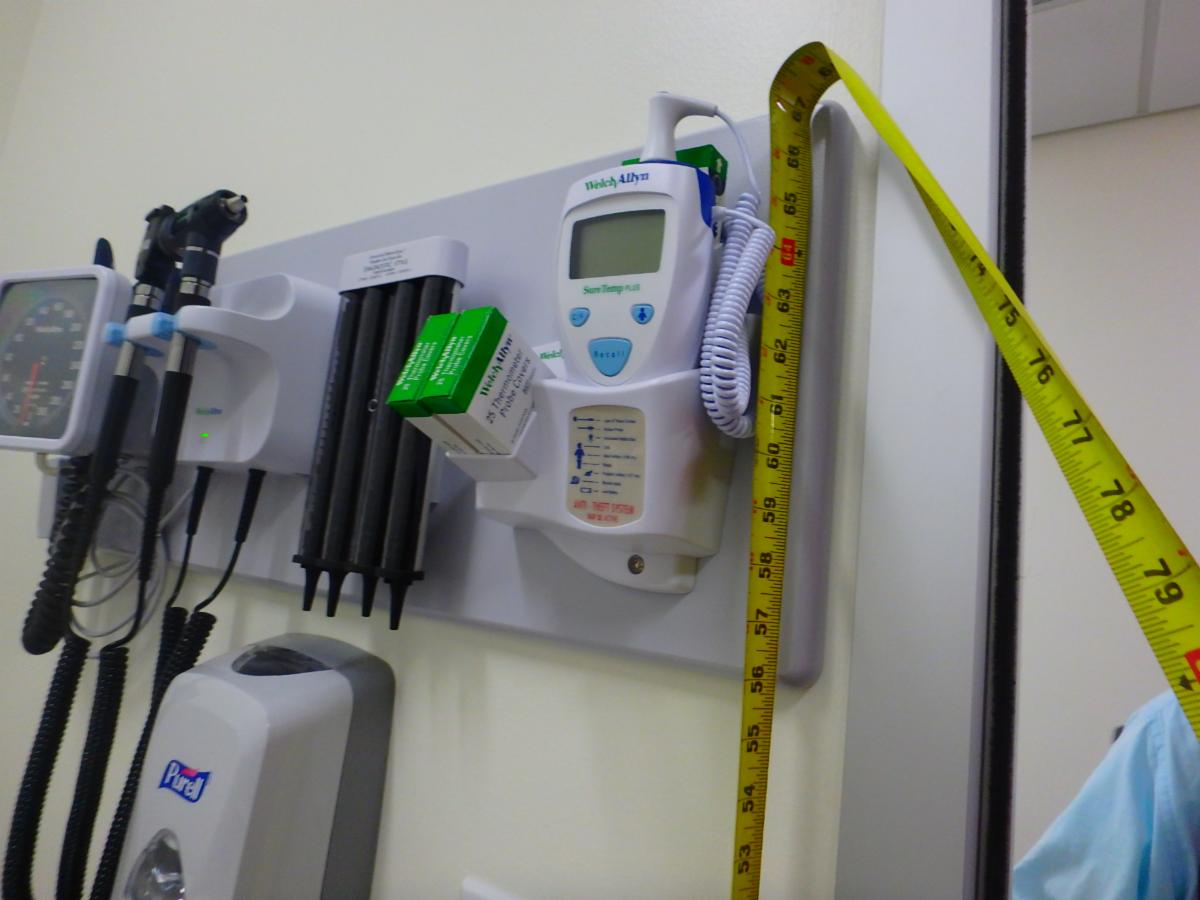
An exam room is partially a “work” area and partially a “patient” area. The area that is only used by the doctor (the sink) will be exempted from having to comply.
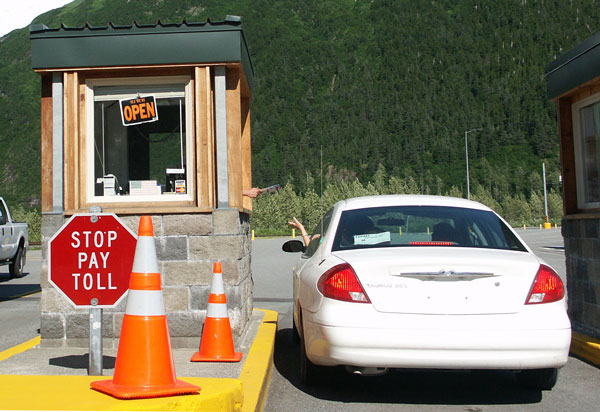
Employee work areas, or portions of employee work areas, other than raised courtroom stations, that are less than 300 square feet and elevated 7 inches or more above the finish floor or ground where the elevation is essential to the function of the space shall not be required to comply with these requirements or to be on an accessible route.
This toll booth is less than 300 s.f. and elevated more than 7″ a.f.f. and therefore do not require an accessible route to it or the ability to approach it and enter it.
What happens when an employee is disabled?
The Standards sometimes provide additional guidance through “advisories”. These are NOT requirements, but they are suggestions that might make your design a better one. Below are some of the advisories on work areas:
Advisory 203.9 Employee Work Areas. Although areas used exclusively by employees for work are not required to be fully accessible, consider designing such areas to include non-required turning spaces, and provide accessible elements whenever possible.
Under the Title I of the ADA, employees with disabilities are entitled to reasonable accommodations in the workplace; accommodations can include alterations to spaces within the facility. Designing employee work areas to be more accessible at the outset will avoid more costly retrofits when current employees become temporarily or permanently disabled, or when new employees with disabilities are hired.
Circulation within a work area
In addition to approach, enter and exit, if the employee work area is larger than 1,000 s.f.. then a common path within the work area to common use spaces shall be provided
206.2.8 Employee Work Areas. Common use circulation paths within employee work areas shall comply with 402.
Section 402 states that a minimum 36″ width shall be provided along the circulation path.
EXCEPTIONS:
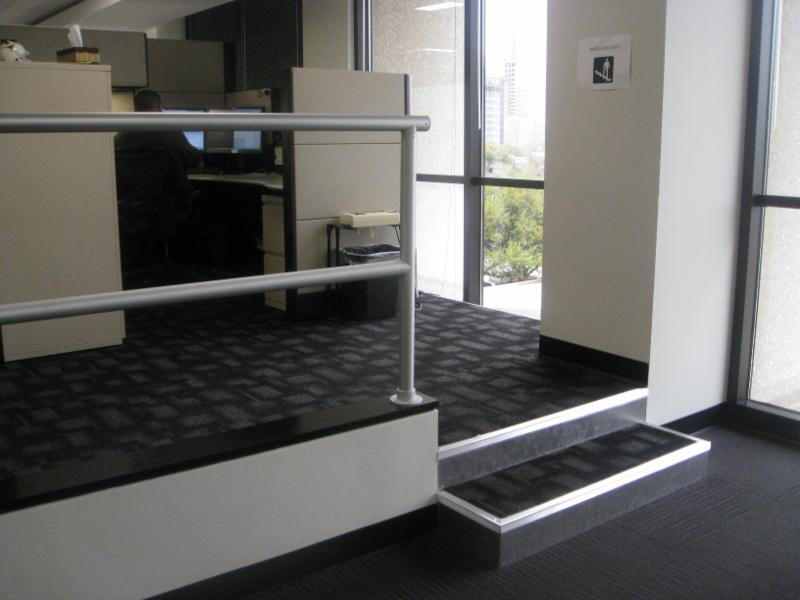
1. Common use circulation paths located within employee work areas that are less than 1000 square feet (93 m2) and defined by permanently installed partitions, counters, casework, or furnishings shall not be required to comply with 402.2.
This employee work area is less than 1,000 s.f. and therefore the step is allowed
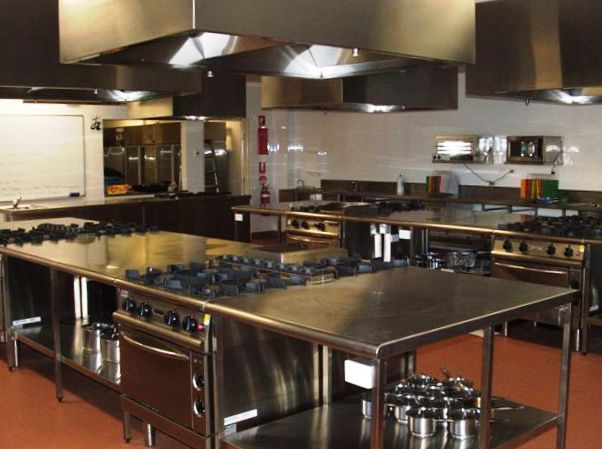
If the path is around work area equipment, then it will not have to comply with the 36″ clear width.
This commercial kitchen has equipment that is an integral part of the work area. The 36″ min. circulation path in this space is not required to comply due to the location of the work area equipment.
Common use circulation paths located within exterior employee work areas that are fully exposed to the weather shall not be required to comply with 402.
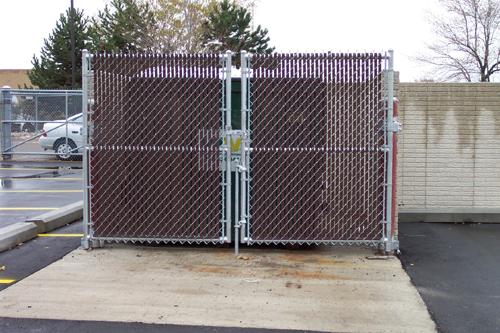
A dumpster is considered an extension of a work area. Although a circulation path within the work area might be required, because the dumpster is located on the exterior and fully exposed to the weather, a circulation path will not be required.
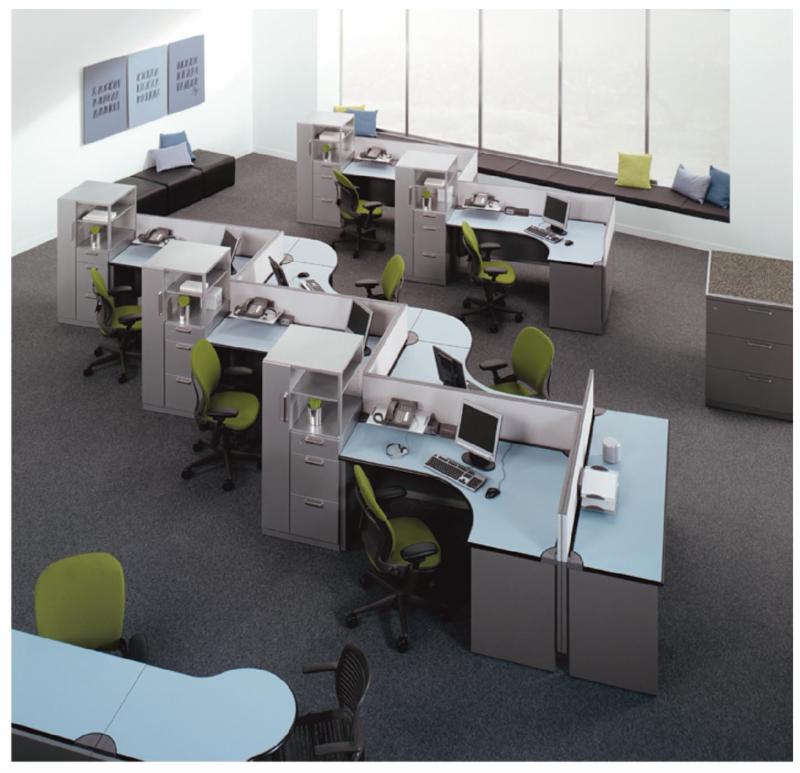
Modular furniture that is not permanently installed are not required to comply. This is for any furniture in general. They also do not require knee clearances, heights of counters etc. (according to Advisory 206.2.8 Employee Work Areas Exception 1)
The modular furniture in an open office is not required to be installed so that there is a minimum 36″ width is provided. They are essentially exempted from having to comply (unless they are permanently attached to the ground or wall)
Employee areas that are not work related
The requirements thus far have been for areas that are considered part of the “work” areas in a space. But there are other areas that are also part of an employee area, but are not related to the work they perform. Those areas that are NOT related to their job description will not be exempted and must comply. Below are a few examples of areas that might be for employees only, but must be fully compliant with the Standards:
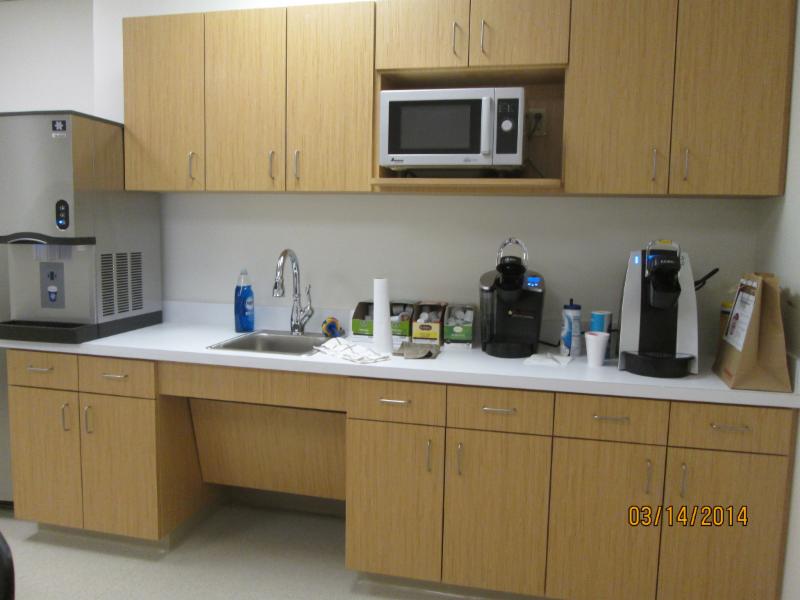
Break Rooms
The sink in this break room and the height of the counter are required to comply. The microwave shown in this photo is not permanently attached and therefore the reach range is not required to comply.
LEED Showers for employees
Some showers that are accessed through a private office have less requirements. But if it is a common use shower for all employees to use, then they must comply with section 608
Employee Restrooms
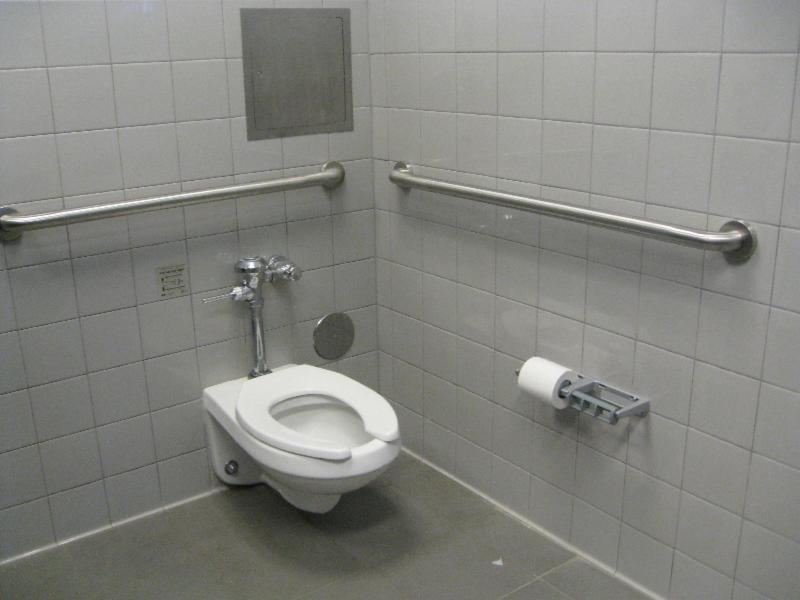
All restrooms including employee restrooms must comply with the requirements in Sections 603-606
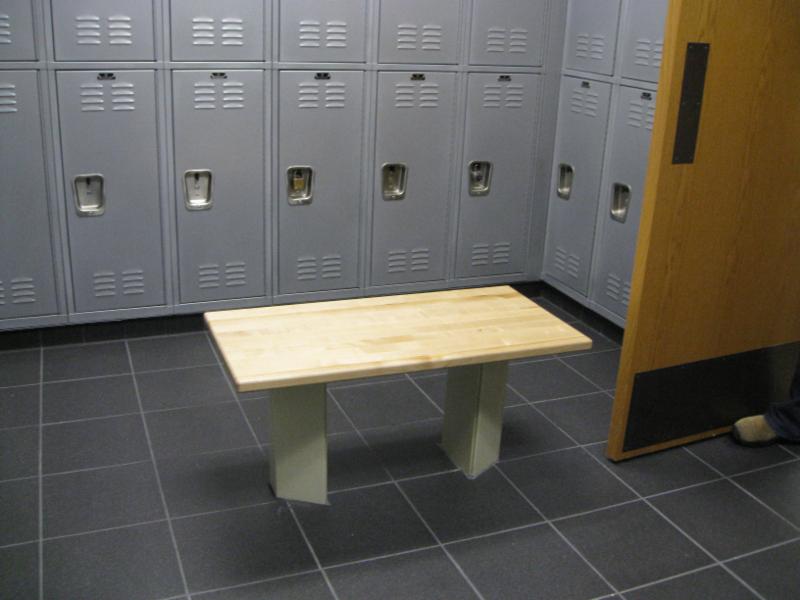
Employee Locker Rooms
The lockers as well as the bench in this locker/dressing room must comply with the Standards
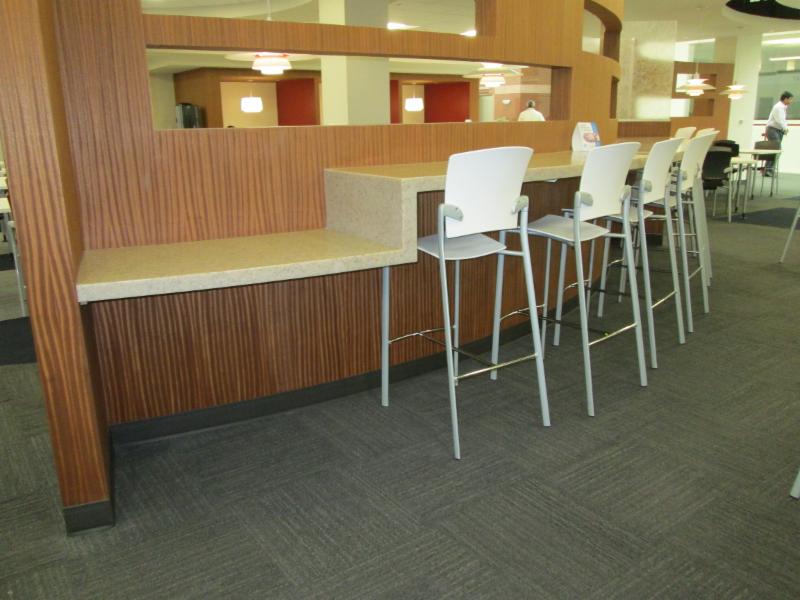
Employee dining counters
5% of the dining counter is required to be between 28″-34″ a.f.f. and provide a knee space like the photo above.
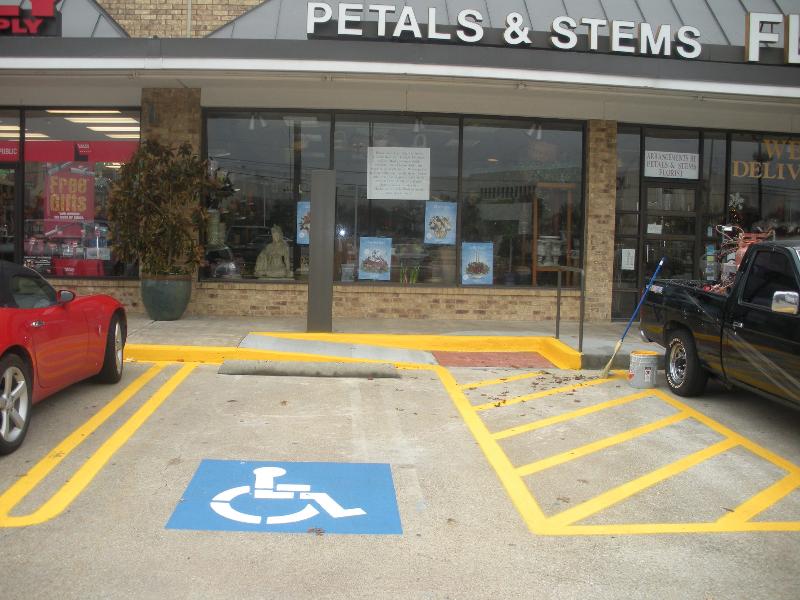
Employee parking
Parking that is designated for employees should have accessible spaces as well.
Vocational or Professional schools
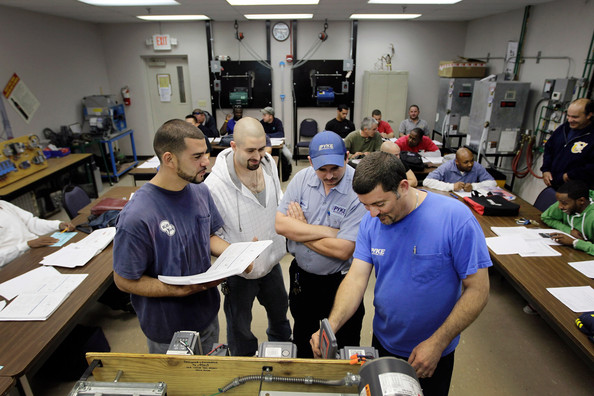
Vocational schools and professional school, such as nursing school, dental school, or medical schools, and culinary schools, where they teach how to use certain “work area equipment” is not exempted. Because it is considered a “public accommodation” , the equipment or access to it will have to be provided.
One example that I have encountered lately is a nursing school with “Exam” rooms that they use to simulate being in a Dr. office examination room. In the real work area the sinks and counter and equipment in those rooms would be exempted. But in a school setting, because you cannot discriminate against a student who might be disabled, and must provide the opportunity to attend the course, accommodations will have to be available.
The number of exam rooms that must be accessible is not scoped. So in escense all teaching exam rooms would require that everything within be accessible. Sometimes that is not reasonable, and at that situation, the school will have to get a variance from TDLR or provide reasonable accommodations for the students with disabilities
medical equipment in a nursing school will have to be within reach
Equipment in a teaching mechanic shop would have to comply
It’s been a while since I shared with you some of my findings at my inspections. Hope this newsletter assists in learning some of the pitfalls so we don’t repeat them.
Washer and Dryer
The ADA standards and the 2012 Texas Accessibility Standards section 611 requires that a washer and dryer have a 30″x 48″ clear floor space that will be centered on each unit.
611.2 Clear Floor Space. A clear floor or ground space complying with 305 positioned for parallel approach shall be provided. The clear floor or ground space shall be centered on the appliance.
When I get drawings and see laundry areas, I make sure to note that the clear floor space must be centered. Which means that from the center of the appliance there should be 24″ on each side. Below are some examples of drawings where it was not clear that the clear floor space was provided. And after construction, the inspection also did not provide the space.
This drawing showed a guest laundry room with a dryer next to a wall which does not provide 24″ from the center line of the dryer to the wall.
This drawing shows a closet for the washer and dryer. The doors reduce the ability to have a clear floor space that is parallel and centered on the appliances.
Here are some examples of the laundry rooms after construction:
The doors in this laundry closet were in the way of the clear floor space
Some solutions for this would be to make the doors open 180 degrees if possible, or there is a new type of washer/dryer that is all in one. Here is a photo of a washer and dryer combo
This is a washer and dryer combination unit. It still does not have the clear floor space of 48″ centered and parallel, but this would fit in the closet
Fair Housing Requirement #4: Accessible Route into and Through the Covered Unit
The Fair Housing Act which deals with multi-family housing requires that there be one accessible 36′ wide route throughout the apartment. This would include a path to the closet. This layout had a toilet in front of the closet. But the distance between the toilet and the tub reduced the path to 32″
This unit has the toilet next to the closet door. The distance between the front of the toilet too the tub should be no less than 36″ in order to allow access to the closet
The distance between the front of the toilet and the tub is less than 36″
The distance between the tub and the front of the toilet is less than 36″ which reduces the accessible route to the closet
.
31 1/2 inches clearance
Bottle fillers
It has been very popular to add bottle fillers near or above drinking fountains. At one of my inspections they installed a bottle filler above the wheelchair accessible drinking fountain. This would be acceptable but in this case they mounted it too high and the operable part (or the sensor) was mounted higher than the 48″ a.f.f. allowed
This bottle filler was mounted higher than 48″ a.f.f. to the sensor
The sensor was mounted at 54″ a.f.f.
Sometimes the bottle filler is mounted next to the drinking fountains which is also acceptable but might create issues with protruding objects. Since the bottle filler is located inside the recessed niche where the drinking fountain is located it does not provide a cane detection. The drinking fountain is located on the circulation path to the door into the restroom beyond.
this bottle filler was next to the high drinking fountain and did not provide a cane detection at the high drinking fountain
Thanks to my friend Mike Griffin from Dallas Texas who suggested this great topic. Hope you enjoy
July 26, 2019 will be 29 years since the ADA was passed into law. Since its first publishing there was one revision that happened in 2010. When it was revised there were certain changes from the original. But they added a provision that stated that when doing a renovation, the original requirements are still valid for existing conditions. In other words if the elements are existing and compliant with the previous version of the ADA Standards, they may remain as they are and they will be considered compliant. This is called a “Safe Harbor”. This newsletter will explain the concept of a safe harbor and when you can apply it.
Examples of a Safe Harbor
The ADA defines a safe harbor as:
(d) Relationship to Alterations Requirements of Subpart D
(2) (i) Safe harbor. Elements that have not been altered in existing facilities on or after March 15, 2012, and that comply with the corresponding technical and scoping specifications for those elements in the 1991 Standards are not required to be modified in order to comply with the requirements set forth in the 2010 Standards…
Some examples of the things that changed that if left the way during a renovation will be considered compliant are:
Side approach reach
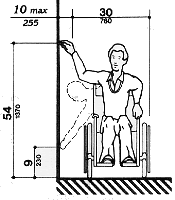
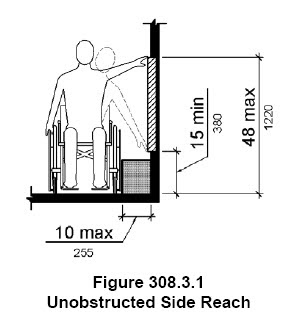
In the 1991 ADAAG, the unobstructed reach range to an operable part that is approached on the side was between 9″ to the lowest operable part to 54″ to the tallest operable part
The 2010 ADA Standards raised the bottom reach to 15″ and lowered the top reach to 48″ a.f.f.
So in an existing restroom, for example, if the paper towel dispenser operable part (the part you operate to dispense the paper towels) was mounted at 54″ a.f.f. , it would still be counted as compliant today. It would even be counted as compliant when you remodel said restroom but do not touch the paper towel dispenser.
Water Closet Clearance
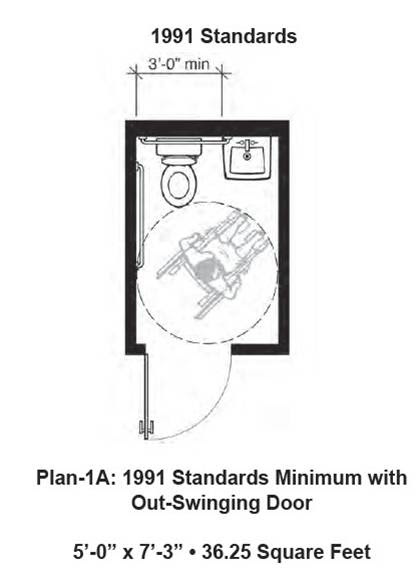
In the 1991 ADAAG, there were several ways that you could approach and transfer onto the water closet. The figure below showed you the choices you had:
As shown above, the lavatory was allowed to be inside the floor clearance of the water closet as long as it was 36″ from the side wall and it had a knee space at the sink.
The new standard you are required a 60″ clear at the water closet floor space. A lavatory or any other fixture is not allowed to overlap.
So if an existing toilet room has the 1991 layout it will be acceptable and will be considered a safe harbor. If the restroom is remodeled, then part of the new standards takes each element into consideration for requirements, and a change in one element will not trigger that the entire restroom be upgraded. If all the fixtures are removed, then you would have to make it comply with the 2010 Standards, or file a variance if it is not technically feasible.
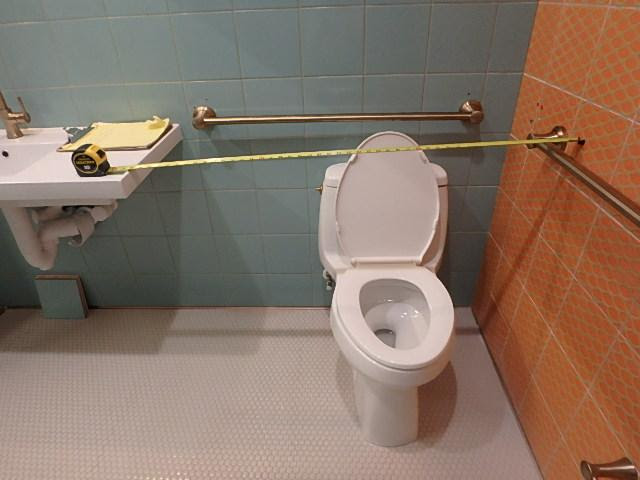
This toilet room was built prior to 2012 and it has a 46″ clear floor space at the water closet. This is an example of a safe harbor.
Drinking Fountains
In the 2010 Standards it is required to have a forward approach knee clearance for drinking fountains designed for people who use wheelchairs. In the 1991 ADAAG it was allowed to have a parallel approach for the drinking fountains.
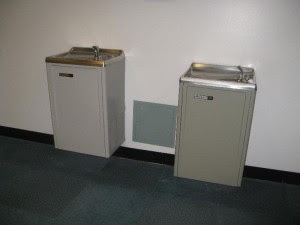
So if there are any drinking fountains without a knee space, but the spout is no higher than 36″ a.f.f. then it is a “safe harbor” and compliant with the 2010 ADA Standards
These drinking fountains don’t meet the requirements for the 2010 ADA Standards, but because they meet the 1991 ADAAG they are a safe harbor and are deemed compliant.
What is NOT a Safe Harbor
When the ADA Standards were revised, they included requirements that were not covered in the original document. Those new requirements will not be part of the Safe Harbor provision. In other words, if you have an existing element that was not covered in the original standard it is not “grandfathered” and it must be brought up to the new standards.
Some of the examples are listed below:
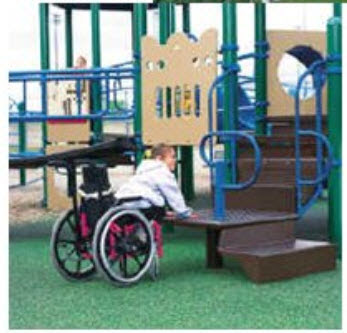
Playground equipment
Existing playground equipment at parks or schools were never covered in the 1991 ADAAG. Therefore existing playground equipment must be brought up to compliance “as it is readily achievable” according the the DOJ.
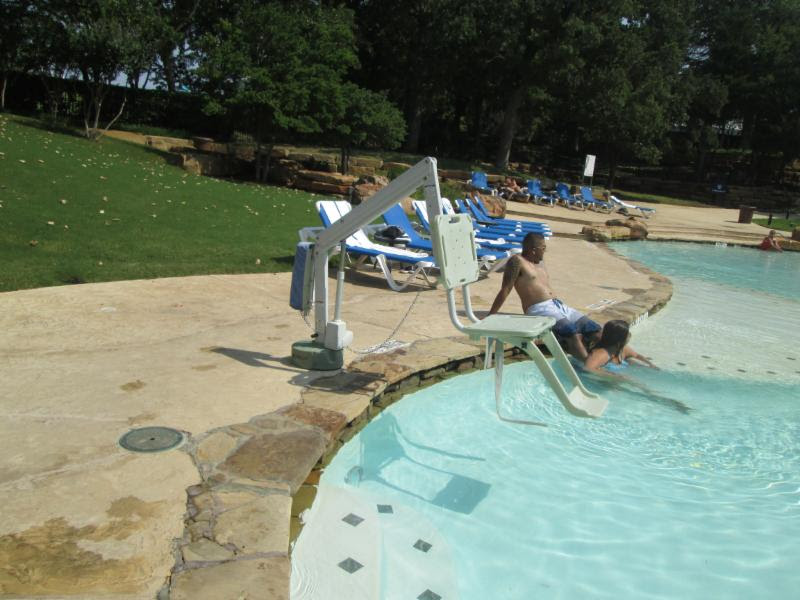
Swimming Pools
Another new element that was added in 2010 was swimming pools. Again, existing pools are not “grandfathered” and will be required to be brought up to compliance.
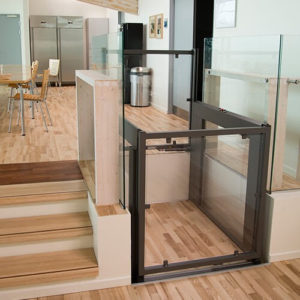
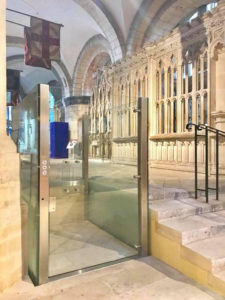
The ADA requires that different levels and floors within a facility be connected by an accessible route. An accessible route is a continuous and unobstructed way to travel from any point in a building or facility. Some ways to achieve an accessible route is through ramps or elevators. A method that is confusing is the use of a platform lift, wheelchair lift or chair lift. Those, even though they help to achieve access in some cases, are not always allowed as part of an accessible route. This newsletter will explain when they are allowed and when they are not.
Existing Buildings
New Construction
But in new construction projects, you are only allowed the use of platform lifts in certain situations. Here are the only circumstances where you can use them as part of an accessible route:
206.7.1 Performance Areas and Speakers’ Platforms
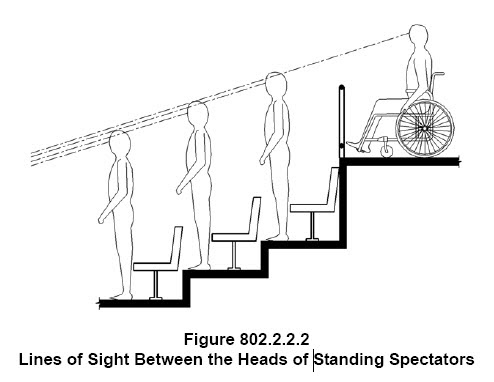
206.7.2 Wheelchair Spaces: Platform lifts shall be permitted to provide an accessible route to comply with the wheelchair space dispersion and line-of-sight requirements
206.7.3 Incidental Spaces which are not public use spaces and which are occupied by five persons maximum.
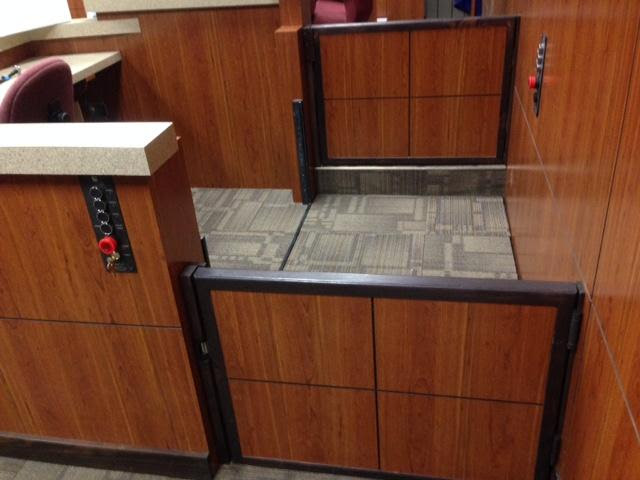
206.7.4 Judicial Spaces: Platform lifts shall be permitted to provide an accessible route to: jury boxes and witness stands; raised courtroom stations including, judges’ benches, clerks’ stations, bailiffs’ stations, deputy clerks’ stations, and court reporters’ stations; and to depressed areas such as the well of a court.
206.7.5 Existing Site Constraints: Platform lifts shall be permitted where existing exterior site constraints make use of a ramp or elevator technically infeasible.
When you see the word “technically infeasible”, you may need permission (variance) from the State agency with jurisdiction of the Standards
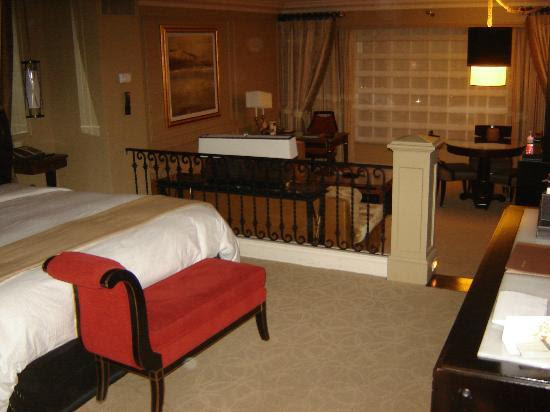
206.7.6 Guest Rooms and Residential Dwelling Units: Platform lifts shall be permitted to connect levels within transient lodging guest rooms required to provide mobility features or residential dwelling units required to provide mobility features
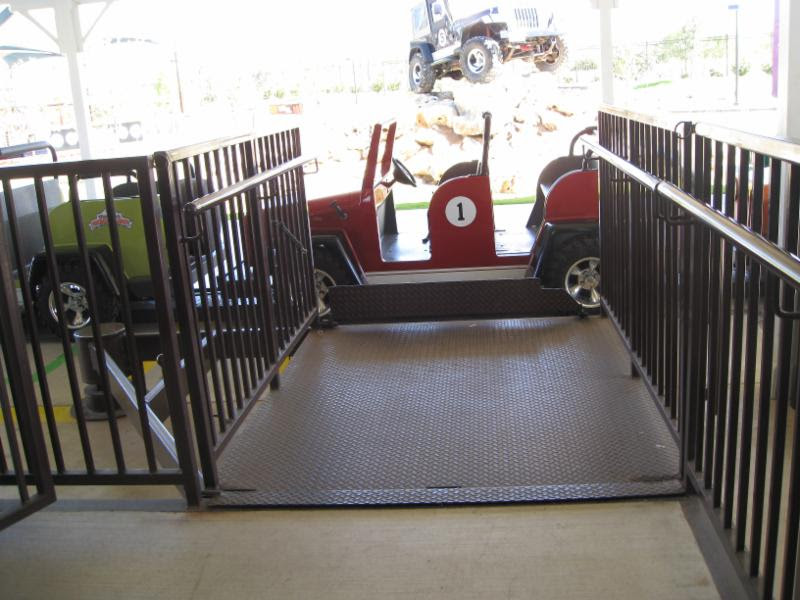
206.7.7 Amusement Rides. Platform lifts shall be permitted to provide accessible routes to load and unload areas serving amusement rides.
206.7.8 Play Areas. Platform lifts shall be permitted to provide accessible routes to play components or soft contained play structures.
206.7.9 Team or Player Seating. Platform lifts shall be permitted to provide accessible routes to team or player seating areas serving areas of sport activity.
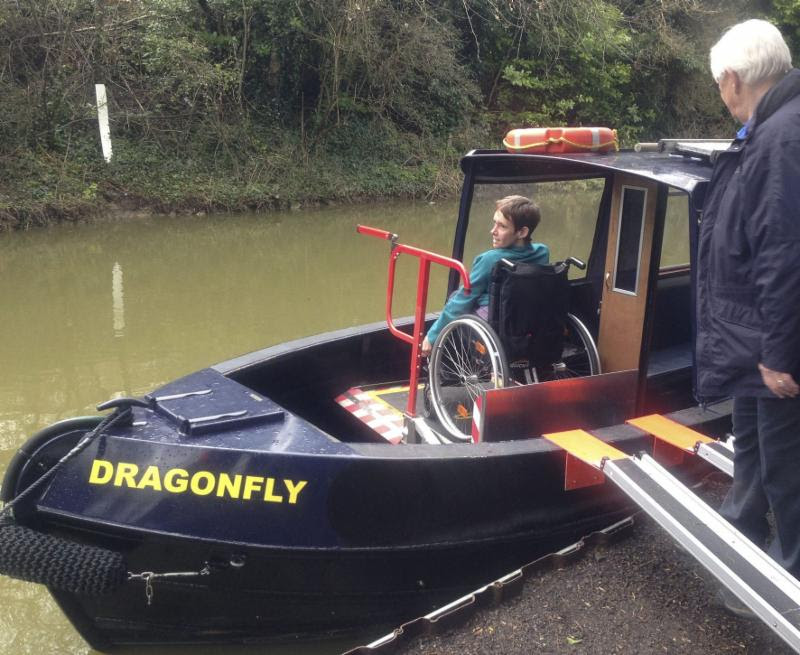
206.7.10 Recreational Boating Facilities and Fishing Piers and Platforms. Platform lifts shall be permitted to be used instead of gangways that are part of accessible routes serving recreational boating facilities and fishing piers and platforms.
And as part of an accessible means of egress as mentioned in 207.2
207.2 Platform Lifts. Standby power shall be provided for platform lifts permitted by section 1003.2.13.4 of the International Building Code (2000 edition and 2001 Supplement) or section 1007.5 of the International Building Code (2003 edition) (incorporated by reference, see “Referenced Standards” in Chapter 1) to serve as a part of an accessible means of egress
What constitutes a platform lift?
The scoping section of the 2010 ADA mentions platform lifts. But what about chair lifts? Are they allowed? what is the difference?
According to the technical standards 410
410.1 General. Platform lifts shall comply with ASME A18.1 (1999 edition or 2003 edition) (incorporated by reference, see “Referenced Standards” in Chapter 1). Platform lifts shall not be attendant-operated and shall provide unassisted entry and exit from the lift.
ASME A18.1-1999 and ASME A18.1-2003 address the design, construction, installation, operation, inspection, testing, maintenance and repair of lifts that are intended for transportation of persons with disabilities.
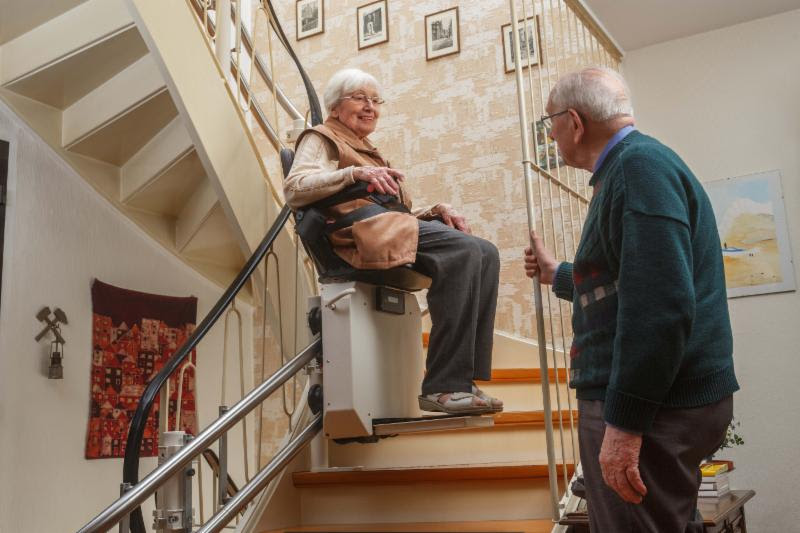
This document [The 2010 ADA Standards] does not permit the use of inclined stairway chairlifts which do not provide platforms because such lifts require the user to transfer to a seat.
This type of lift is not reccommended
The advisory explains the different types:
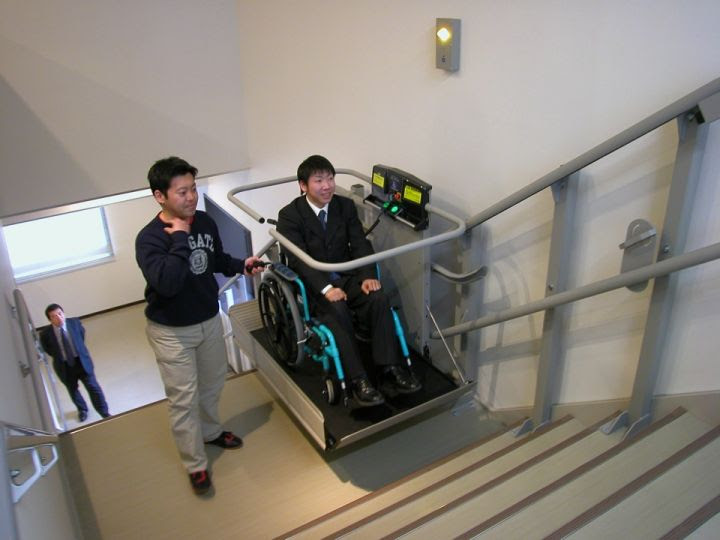
Inclined stairway chairlifts and inclined and vertical platform lifts are available for short-distance vertical transportation. Because an accessible route requires an 80 inch(2030 mm) vertical clearance, care should be taken in selecting lifts as they may not be equally suitable for use by people using wheelchairs and people standing. If a lift does not provide 80 inch (2030 mm) vertical clearance, it cannot be considered part of an accessible route in new construction.
The ADA and other Federal civil rights laws require that accessible features be maintained in working order so that they are accessible to and usable by those people they are intended to benefit. Building owners are reminded that the ASME A18 Safety Standard for Platform Lifts and Stairway Chairlifts requires routine maintenance and inspections. Isolated or temporary interruptions in service due to maintenance or repairs may be unavoidable; however, failure to take prompt action to effect repairs could constitute a violation of Federal laws and these requirements.
In summary, if the inclined chair lift meets the requirements of the ASME A18.1 then they can be used instead of a platform lift where they are allowed.
On May 27th we remember all the Veterans who have sacrificed with their lives to keep our country safe. According to the Journal of Rehabilitation, “It is estimated that for every military personnel that we lose in foreign wars and conflicts, there are at least sixteen wounded, and many will return to the United States with some type of disability”. The Department of Veteran Affairs has facilities to assist those veterans that will need assistance in rehabilitation and treatment. To provide building access, Federal government facilities are required to follow the Architectural Barriers Act (ABA). Because the percentage of disabled persons at VA hospitals is much higher than the percentage of disabled persons in the general population, The VA developed additional standards that we must follow. Those requirements are listed in The VA Barrier Free Design Standards This newsletter will give you some examples of the additional requirements found in the Standards.
.
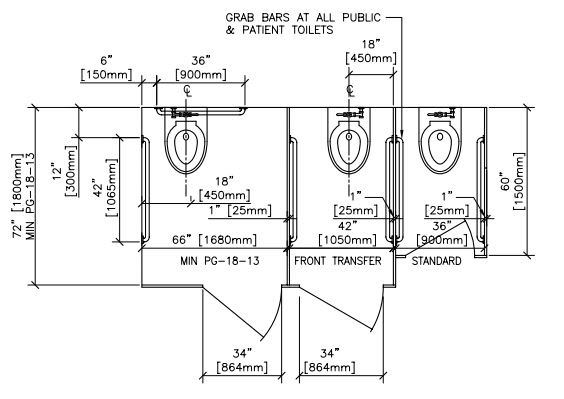
Grab bars at toilet compartments
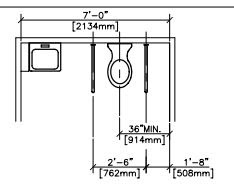
In the technical chapters of the ABA, just like in the ADA, one toilet compartment should be provided for persons in wheelchairs. In addition depending on how many compartments you have in the restroom if you have six or more toilets and urinals, you are also required to provide an “ambulatory” compartment. Both those compartments require that grab bars be installed. The VA also requires a wheelchair compartment and ambulatory when applicable. But in addition to the accessible compartments, every other toilet compartment is required to have grab bars.
This is a typical public restroom in a VA clinic or hospital where ALL toilet stalls must have grab bars installed.
In facilities that treat SCI patients, hospitals and long term care facilities the patient toilets must all have pull-down grab bars
Parking requirements
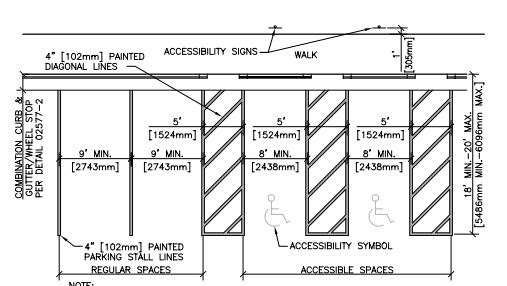
The VA requires that its facilities have 1% more parking spaces than the ABA mandates. in addition, in facilities dealing with Spinal cord Injury (SCI) the number of parking spaces will be determined by the number of beds in the facility. 0.2 accessible spaces per Inpatient bed; 0.5 per LongTerm Care bed; 5.6 per Outpatient Exam Room Dedicated for SCI/D patients
The parking spaces also have a slightly different configuration that an ABA parking space. Each parking space must have their own access aisle. They are not allowed to share between cars.
Accessible route differences:
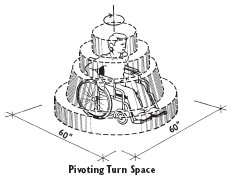
The turning space for VA rooms are bigger than the ABA requires. A turning space must be 6′-0″ rather than 5′-0″ in diameter. There are requirements for Bariatric patients as well which the ABA does not cover or mention.
Carpet padding and cushions are not permitted in a VA facility
Curb ramps are wider than an ABA curb ramp. They must be 4′-0″ min. rather than 3′-0″
The maximum slope that a VA ramp can be is 1:20 (5%). ABA allows a maximum of 1:12 (8.33%)
The door of an elevator has to be 4′-0″ wide rather than 36″ allowed by the ABA
The minimum number of guest rooms required to be accessible in transient lodging facilities is covered by section 224 of the 2010 ADA Standards. Scoping requirements for guest rooms with mobility features and guest rooms with communication features are addressed at section 224.2 and section 224.4, respectively.
Accessible guest rooms are used not only by individuals using mobility devices such as wheelchairs and scooters, but also by individuals with other mobility disabilities including persons who use walkers, crutches, or canes.
Guest rooms with communication features are used by persons that are visually and hearing impaired.
Even knowing where to look does not always make it simple to understand the requirements. This newsletter will give you some examples of the not so well known rules about Transient lodging.
Roll in Showers
#ADAFact: If there are less than 51 guest rooms in a hotel or dorm, you are required to have mobility rooms without roll in showers.
This rule is very easy to miss because most of hotels have more than 50 guest rooms. If you have less than 50, there are zero roll-in showers required. But there are still required accessible bathing fixtures. In a recent hotel review, I performed there were exactly fifty guest rooms. I looked at the chart to see how many rooms with mobility features were required and saw that it was two. But what I also noticed was that both of them could not have a roll in shower. As a matter of fact, there is always a minimum number that is required without roll in showers. So they could provide tubs or transfer showers instead. See the chart below.
If they are interested in providing a roll in shower as an option, they would have to add a third guest room with mobility features.
Shower seats
#ADAFact: All showers in a “transient lodging” facility are required to have a wall or floor mounted folding seat.
Generally, in the ADA Standards, the only showers that are required to have a seat are transfer showers. There is one exception: “Transient lodging”
608.4 Seats. A folding or non-folding seat shall be provided in transfer type shower compartments. A folding seat shall be provided in roll-in type showers required in transient lodging guest rooms with mobility features complying with 806.2. Seats shall comply with 610.
When a roll-in shower has a seat , the controls will have to be located no more than 27″ from the seat wall
controls in the roll in shower were located no farther than 27″ from the seat wall
Dispersion
#ADAFact: At least one guest room (but no more than 10%) required to provide mobility features as described in the 2010 ADA shall also provide communication features.
That means that you can’t have all your guest rooms with communication features in the mobility rooms. But you are required to provide at least one of the rooms with both communication and mobility features.
In addition, they have to be dispersed as described below:
224.5 Dispersion. Guest rooms required to provide mobility features complying with 806.2 and guest rooms required to provide communication features complying with 806.3 shall be dispersed among the various classes of guest rooms, and shall provide choices of types of guest rooms, number of beds, and other amenities comparable to the choices provided to other guests.
Where the minimum number of guest rooms required to comply with 806 is not sufficient to allow for complete dispersion, guest rooms shall be dispersed in the following priority: guest room type, number of beds, and amenities.
At least one guest room required to provide mobility features complying with 806.2 shall also provide communication features complying with 806.3.
Not more than 10 percent of guest rooms required to provide mobility features complying with 806.2 shall be used to satisfy the minimum number of guest rooms required to provide communication features complying with 806.3.
In the 1991 ADAAG this was not the case and some establishments made all the rooms with communication features the same as the rooms with mobility features. Communication features must be available as soon as the guest arrives. It is no longer allowed to have a device at the front desk for the guest’s to request.
Here are some examples of communication features
this is a hard-wired notification device for the hearing impaired.
There typically is more communication rooms required than mobility rooms, and therefore some would be exclusively rooms with communication features. Designers must be careful to make sure that they are providing 90% of the rooms with communication features without mobility features.
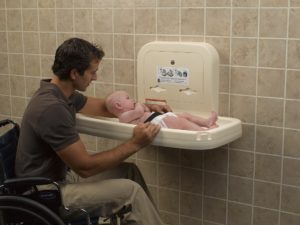
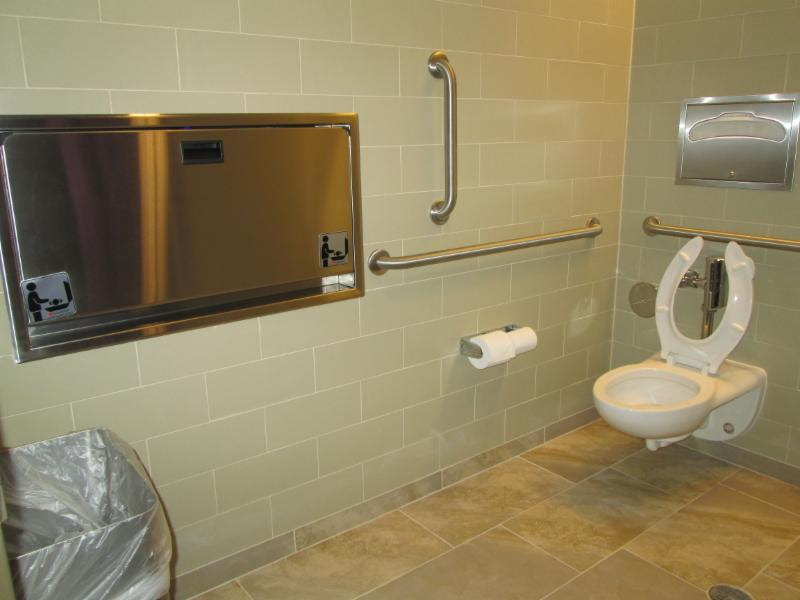
#ADAFact: Diaper changing stations must be compliant with the 2010 ADA section 902, and be able to be used by persons with disabilities.
In this blog, we will explore the proper locations of a diaper changing station within the restroom, which will allow the technical requirements to be met without creating any other accessibility issues.
The Location could affect Clear Floor Space
One of the requirements is for the diaper changing station to have a forward approach knee space. The location of the table or counter must not have anything in front of it which will impede the forward approach
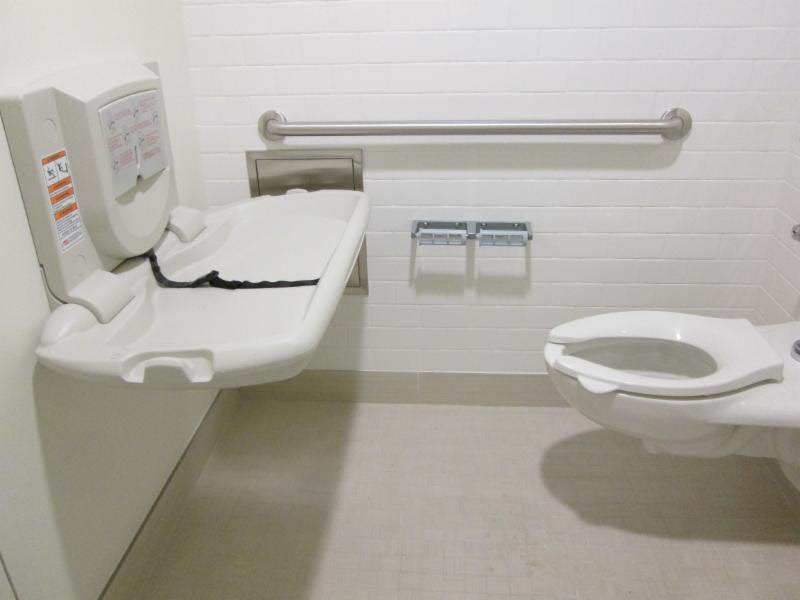
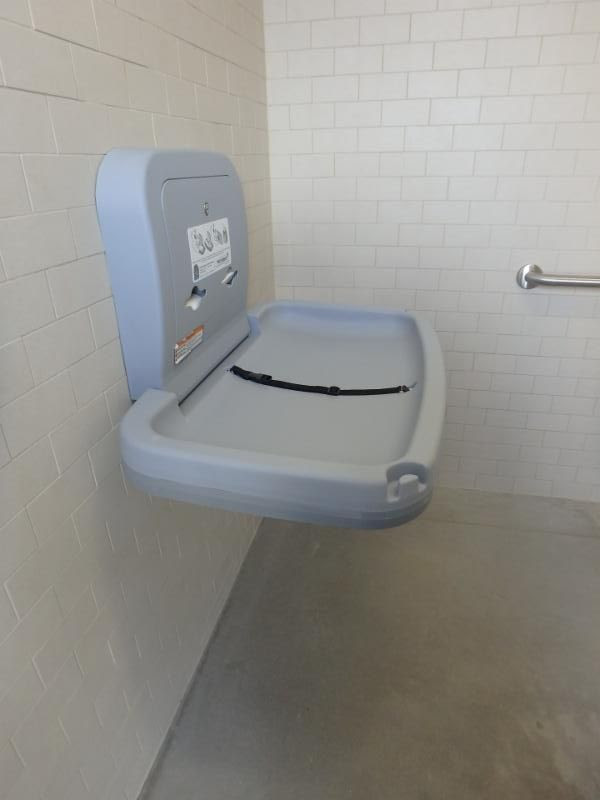
This baby changing station does not have a clear forward approach because the toilet is in the way
Can the diaper changing station be inside a toilet compartment? Yes, as long as there is enough room for a forward approach. Even though it is not a violation to have the only diaper changing station in the accessible stall, it would be recommended that it be located so that most of the public can use it without having to wait for the stall to be freed up.
The diaper changing station in the photo above is located in the toilet compartment_ but it has plenty of room after entering to have a forward approach
The Location could affect Door Clearance
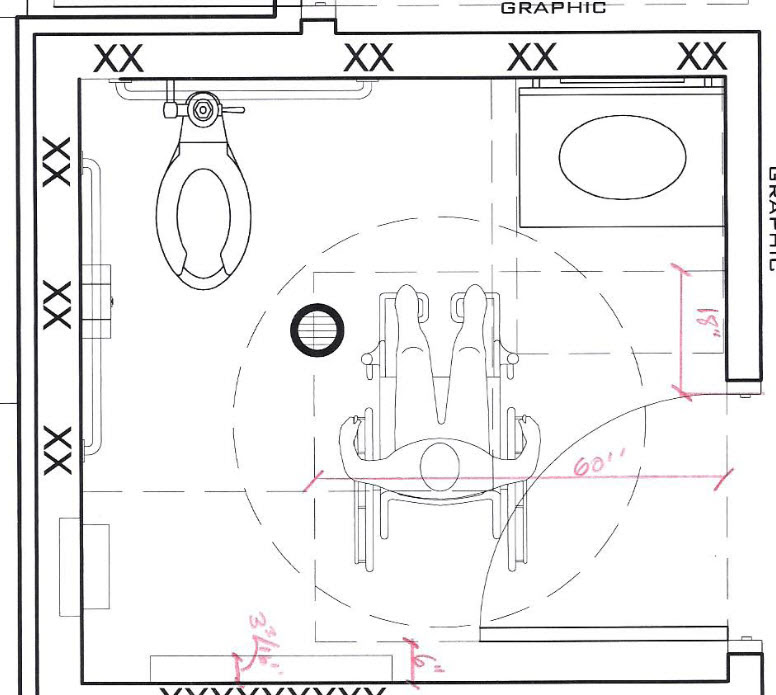
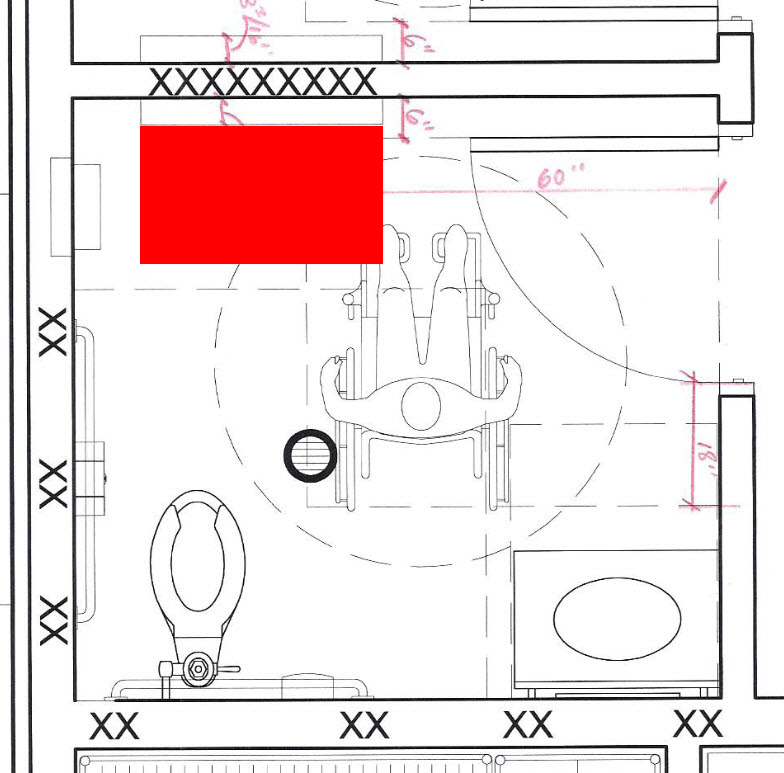
When locating the diaper changing station on a wall within a single user restroom, it is important to locate it so that it is not in the way of the door maneuvering clearance. The door should be able to swing clear of the diaper changing station like it is shown on the drawing below
Not only do we have to be concerned about the diaper changing station when it is closed, but also when it is open. If the diaper changing station is left open and a person in a wheelchair wants to come into the restroom, they would have a hard time maneuvering through the door since there is not a clear 60 of floor space.
the open diaper changing station is in the way of the
60 inches of required clearance to enter the restroom
this diaper changing counter is in the way of the 18 inches minimum required at the pull side of the door
Possible Protruding Objects
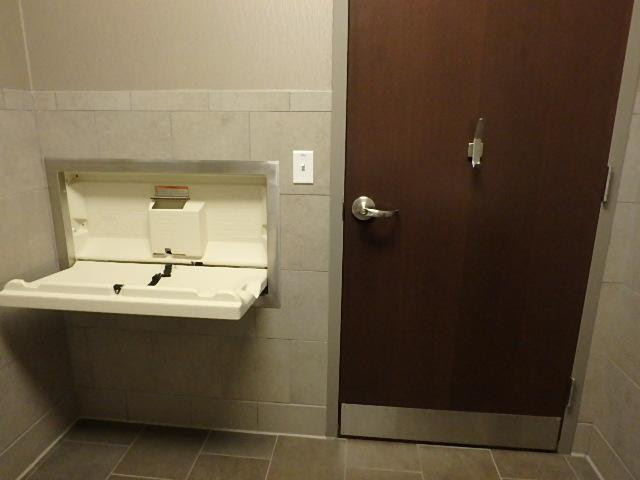
Depending on where the diaper changing counter is located it might be considered a protruding object when open (or closed). If the person who might have been using it forgets to close it and a person who is visually impaired enters the restroom, if the counter is mounted so that the bottom edge is higher than 27″ a.f.f. then the counter will be an undetectable hazard and a protruding object. This was explained by TDLR in a Technical MemoTM 2013-15 published in June 2013.
This open counter is higher than 27″ a.f.f. and is located in the way to the toilet. Therefore, it is considered a protruding object
The solution would be to either mount the counter so that the bottom edge is EXACTLY 27″ a.f.f. which provides the required knee clearance, but also allows it to be cane-detectable. Or it can be relocated away from the circulation path.
Detectable warnings are only required at curb ramps located in the public right of way and platform boarding edges.
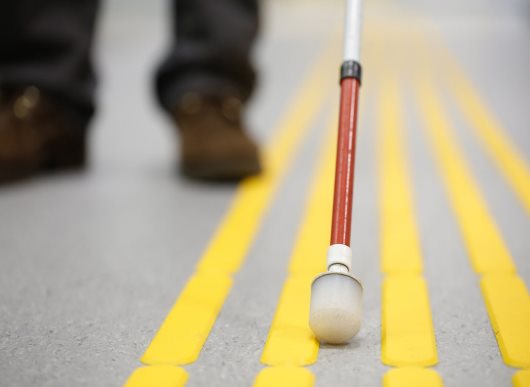
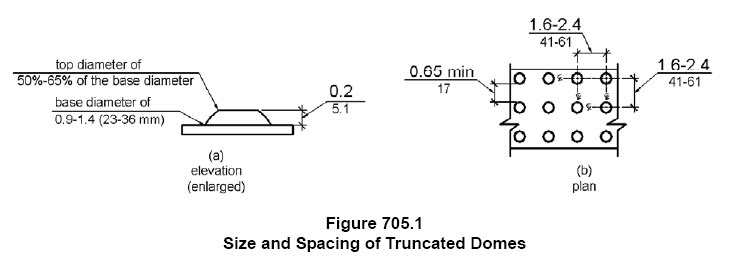
Detectable warnings are used to assist persons that are visually impaired in detecting hazards along their wayfinding. A person who is visually impaired uses a sense of touch to find their way. Detectable warnings is one of those methods. In the 1991 ADAAG, detectable warnings were described as having contrasting color and texture. Contrasting color meant that it should have a different color than its surroundings (either light to dark or dark to light) and texture was achieved by using truncated domes. They were required at curb ramps and the edges between pedestrian and vehicular ways.
But in the 2010 ADA Standards they were limited to only platform boarding edges. The Public Right of Way Accessible Guidelines (PROWAG) and the 2012 Texas Accessibility Standards (TAS) also requires detectable warnings at curb ramps located within the public right of way.
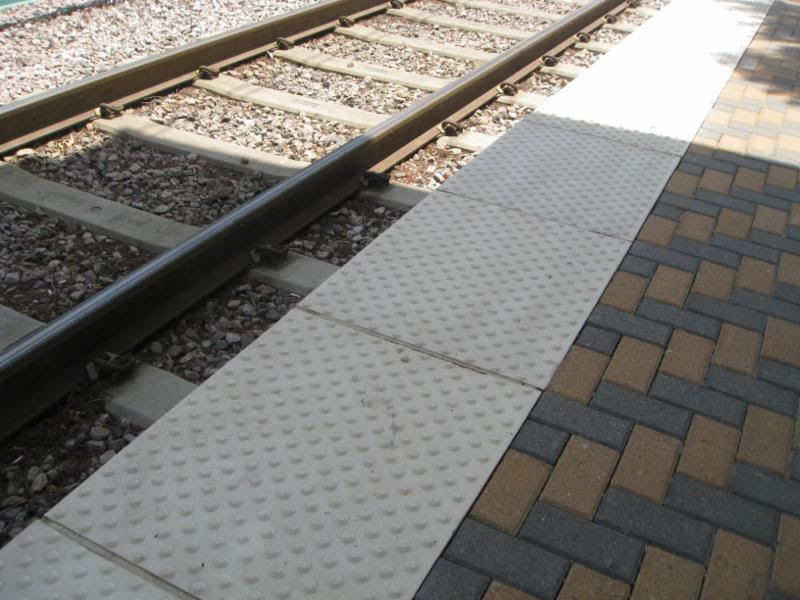
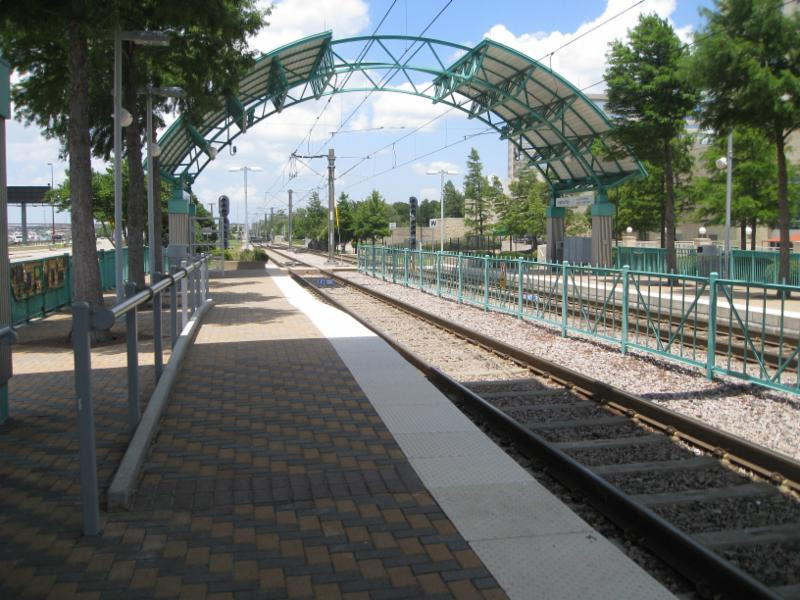
detectable warnings at the platform edge of a train stop
This blog will give you the required regulations governing detectable warnings
Platform Boarding Edges
The ADA standards requires that detectable warnings be located along the boarding edges of trains or bus platforms.
ADA 705.2 (train) Platform Edges. Detectable warning surfaces at platform boarding edges shall be 24 inches (610 mm) wide and shall extend the full length of the public use areas of the platform.
ADA 810.5.2 (Bus) Detectable Warnings. Platform boarding edges not protected by platform screens or guards shall have detectable warnings complying with 705 along the full length of the public use area of the platform.
light rail boarding platform edge has a lightly colored detectable warning
Public Rights of Way
There are also requirements for public rights of way (located outside the property line). The federal standards are called the “Public Right of Way Accessibility Guidelines” (PROWAG). These are still a draft and have not been adopted, although they are recommended. In Texas, TDLR wrote in their administrative rules a set of guidelines for public rights of way. Below is a brief summary of each.
PROWAG state:
R208 Detectable Warning Surfaces
R208.1 Where Required. Detectable warning surfaces complying with R305 shall be provided at the
following locations on pedestrian access routes and at transit stops:
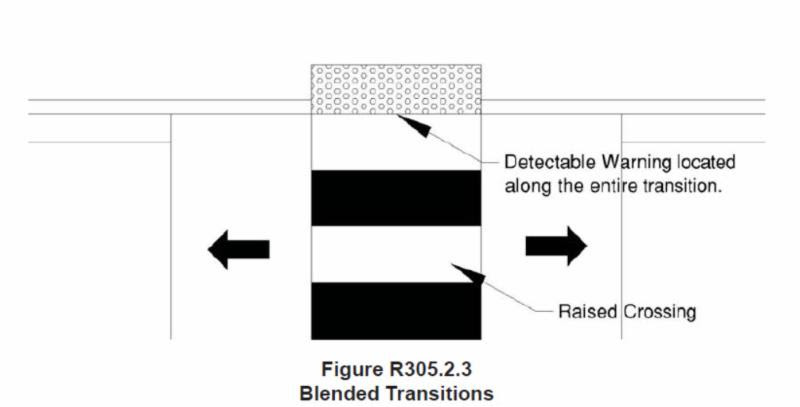
1. Curb ramps and blended transitions at pedestrian street crossings;
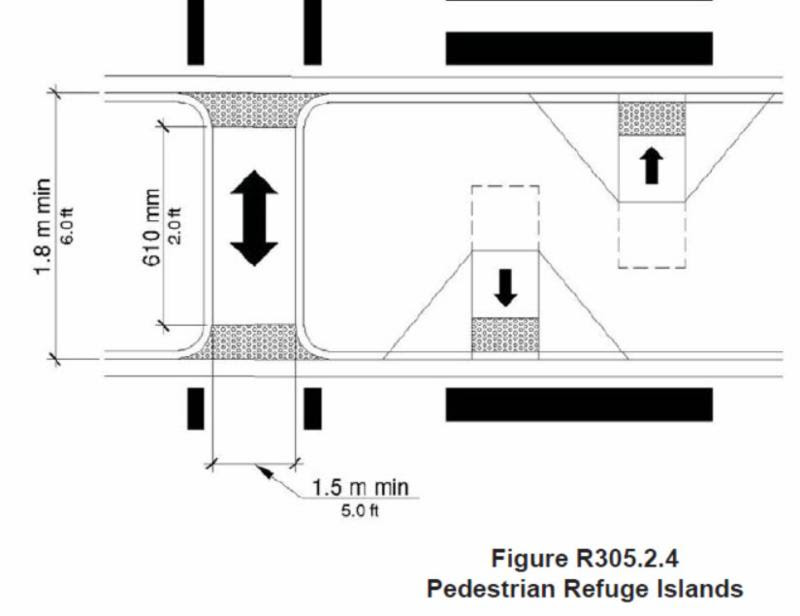
2. Pedestrian refuge islands;
3. Pedestrian at-grade rail crossings not located within a street or highway;
4. Boarding platforms at transit stops for buses and rail vehicles where the edges of the boarding platform are not protected by screens or guards; and
5. Boarding and alighting areas at sidewalk or street level transit stops for rail vehicles where the side of the boarding and alighting areas facing the rail vehicles is not protected by screens or guards.
R305.1.4 Size.
– Detectable warning surfaces shall extend 610 mm (2.0 ft) minimum in the direction of pedestrian travel.
– At curb ramps and blended transitions, detectable warning surfaces shall extend
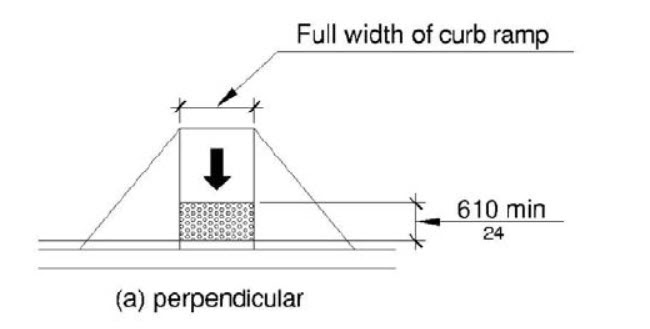
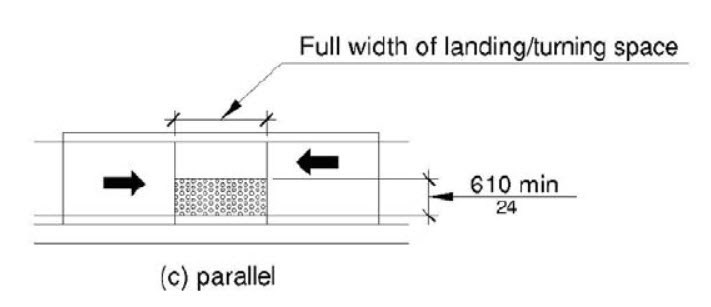
the full width of the ramp run (excluding any flared sides), blended transition or turning space.
– At pedestrian at-grade rail crossings not located within a street or highway, detectable warnings shall extend the full width of the crossing.
– At boarding platforms for buses and rail vehicles, detectable warning surfaces shall extend the full length of the public use areas of the platform.
– At boarding and alighting areas at sidewalk or street level transit stops for rail vehicles, detectable warning surfaces shall extend the full length of the transit stop.
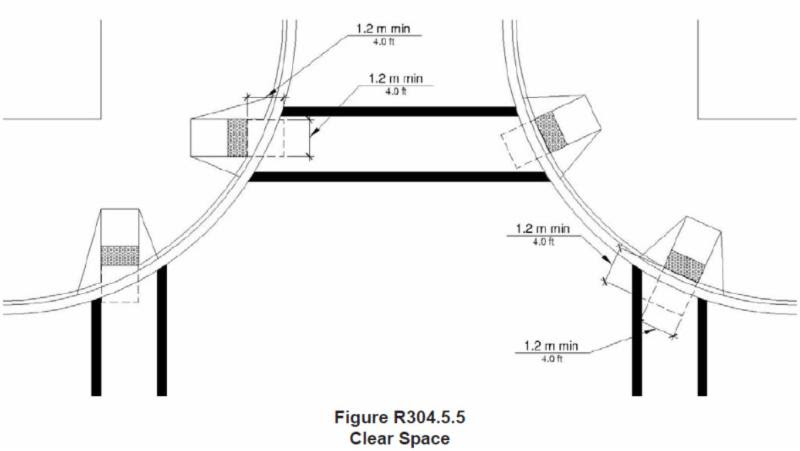
R305.2 Placement. The placement of detectable warning surfaces shall comply with R305.2.
R305.2.3 Blended Transitions. On blended transitions, detectable warning surfaces shall be placed at the back of curb. Where raised pedestrian street crossings, depressed corners, or other level pedestrian street crossings are provided, detectable warning surfaces shall be placed at the flush transition between the street and the sidewalk.
R305.2.4 Pedestrian Refuge Islands. At cut-through pedestrian refuge islands, detectable warning surfaces shall be placed at the edges of the pedestrian island and shall be separated by a 610 mm (2.0 ft) minimum length of the surface without detectable warnings
TDLR AB Rules requires:
These requirements are not located in the Texas Accessibility Standards, but rather in the TDLR Administrative Rules Chapter 68
68.102. Public Right-of-Ways Projects
(2) Curb Ramps-
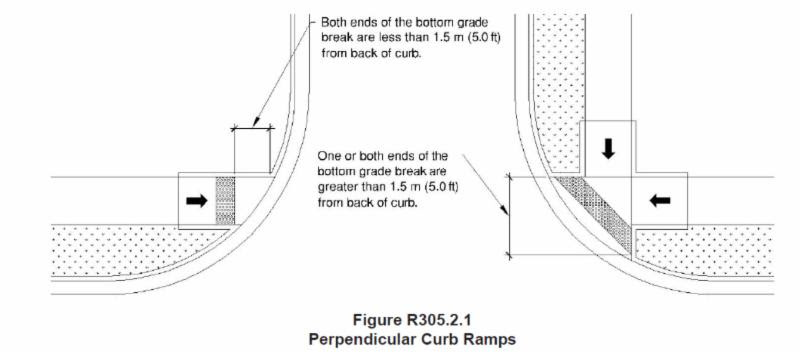
(A) At perpendicular curb ramps constructed within the public right of way, detectable warnings complying with TAS 705 at a minimum of 24″ in depth (in the direction of pedestrian travel) and extending the full width of the curb ramp shall be provided where the pedestrian access route enters a crosswalk or other hazardous vehicular area.
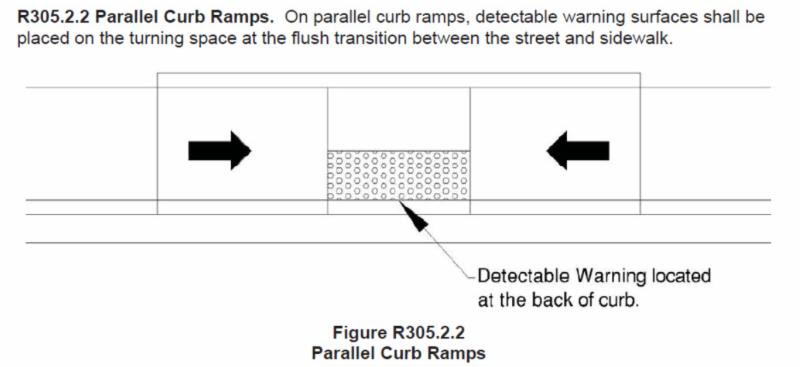
(B) At parallel curb ramps constructed within the public right-of-way, detectable warnings complying with TAS 705 at a minimum of 24″ in depth (in the direction of pedestrian travel) and extending the full width of the landing shall be provided where the pedestrian access route enters a crosswalk or other hazardous vehicular area.
(C) At diagonal curb ramps constructed within the public right-of-way, detectable warnings complying with TAS 705 at a minimum of 24″ in depth (in the direction of pedestrian travel) and extending the full width of the curb ramp or landing, shall be provided where the pedestrian access route enters a crosswalk or other hazardous vehicular area. Additionally, the department will allow the detectable warning to be curved with the radius of the corner.
The detectable warning shall be located so that the edge nearest the curb line is 6″ minimum and 10″ maximum from the curb line.
For more information about PROWAG and its requirements click on this link
TABS (Texas Architectural Barriers online System)
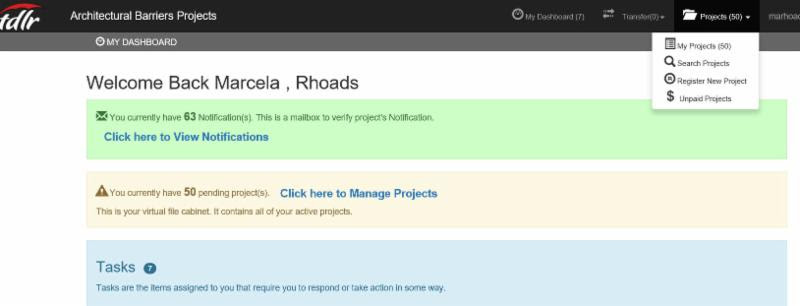
If you do work in Texas you should be aware that there is a new system for online registration and keeping track of the projects. The Texas Department of Licensing and Regulation has now created a system that eliminates most paper forms and makes many things cloud-based.
The main differences are as follows:
1) In order to register a project, you will have to create an account with TDLR here
2) The TDLR registration occurs in the pull-down menu shown below. You can also fill out the registration form and send it to your RAS for her to do it for you.
4) when you register the project (or fill out the registration form), you will also be required to submit the square footage of the building. If it is not a building, make your best faith effort to estimate it.
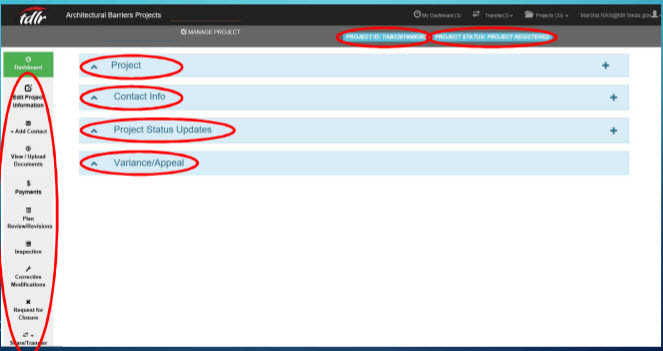
5) Once you register the project you will be able to view results and other saved items in the online “file cabinet”
In this new system you will be able to update information to the project, upload revised drawings, and check the status of the project.
If you have any questions about this new system you can reach our office or TDLR directly.
 Abadi
Abadi