Author Archive
Tuesday, January 3rd, 2023
There is a lot of confusion in the ADA on what clearances and elements are allowed to overlap each other. The main idea for restrictions to having elements overlap is the inability for a person in a wheelchair to use the element or the space efficiently. The amount of clearance that we design by translates to the amount of space that should be provided for one wheelchair. Floor clearances are not fixed elements and if they overlap each other it does not impede the usage of the clearance. But if a fixed element overlaps the clearance, that might reduce the clearance and prevents a person from using the element.
In addition, there is a confusion about protruding objects and elements that are overlapping the clearances of plumbing fixtures.
This newsletter will explain which elements can overlap since they don’t impede the usage of the space or element, and which ones may not overlap. All the rulings are taken from the 2010 ADA Standards.
Fixture clearances and turning space
In a toilet room, the floor space and other clearances including the turning space can overlap each other.
603.2.2 Overlap . Required clear floor spaces, clearance at fixtures, and turning space shall be permitted to overlap.
As was explained in the introduction, the clear floor space of the plumbing fixtures are not fixed elements. When we show them in plan it is a depiction of where a wheelchair can be in order to utilitize the fixtures. Therefore those clearances can overlap without preventing a wheelchair to utilize or manuever around the fixtures.
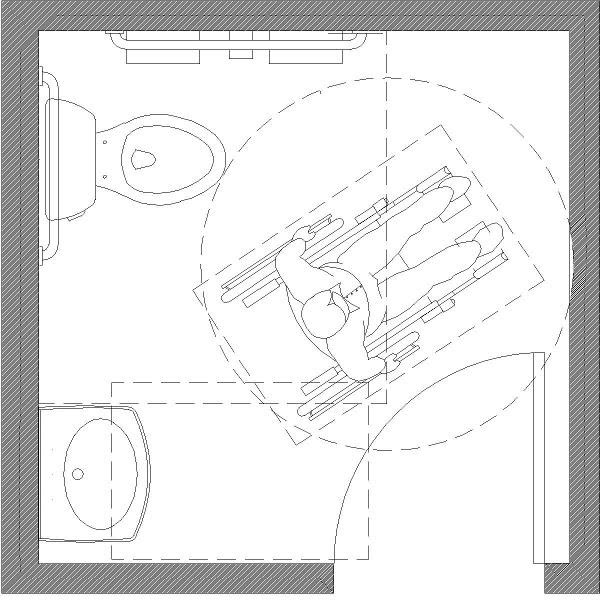
The drawing above shows the turning space overlaping the clerances of fixtures and the door clearance can also overlap the turning space. This turning space is essentially a representation of where a person in a wheelchair could use to turn, but it is not a permanent element. The drawing is also showing the lavatory and water closet clearances that can also overlap.
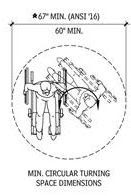
Clearance around a water closet
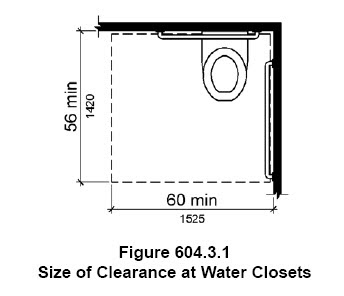
Toilets require a minimum of 60″ wide x 56″ depth clearance in order for a person in a wheelchair to transfer onto the water closet. The clearance must not be obstructed. There are only certain elements that are allowed to overalp the clearance:
- the water closet
- associated grab bars
- dispensers*
- sanitary napkin disposal units,
- coat hooks
- shelves
- accessible routes
- clear floor space and clearances required at other fixtures
- the turning space
Per the 2010 ADA Standards for Accessible Design:
604.3.2 Overlap. The required clearance around the water closet shall be permitted to overlap the water closet, associated grab bars, dispensers, sanitary napkin disposal units, coat hooks, shelves, accessible routes, clear floor space and clearances required at other fixtures, and the turning space. No other fixtures or obstructions shall be located within the required water closet clearance.
*Clearance around a water closet
*The part of the section that is not clear is the “dispensers”. We think of dispensers in a restroom as soap dispesers, paper towel dispensers, femenine napkin dispensers for example. So if the list includes “dispensers” we may be inclined to provide those within the clearance of the toilet. You might want to check with the AHJ at your State, but in Texas the AHJ (TDLR) came on record as stating in their
Technical Memo 2013-17 that the word “dispenser” is describing those associated with the toilet and therefore any other dispenser is not allowed to be inside the clearance of the toilet.
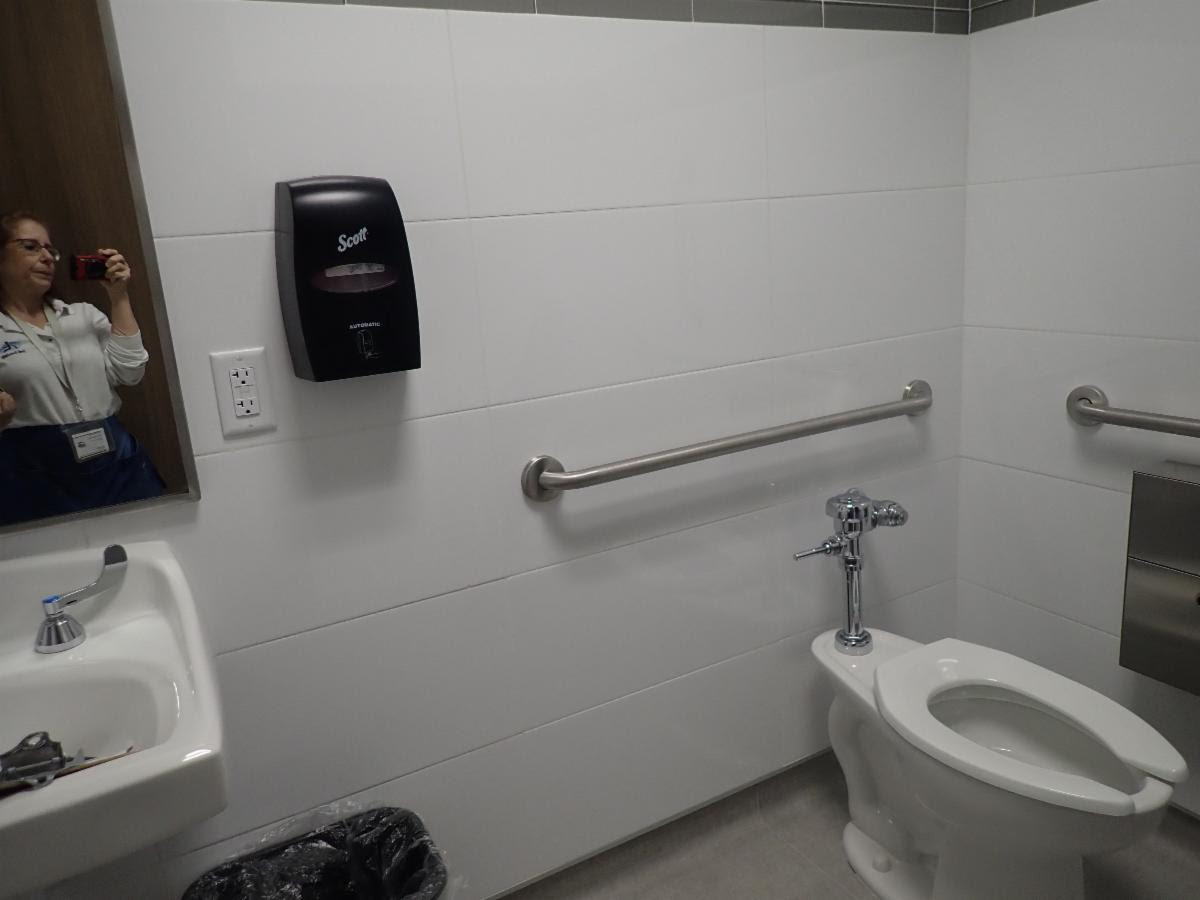
This toilet in the picture above had a soap dispenser that overlaps the clearance which it is not allowed
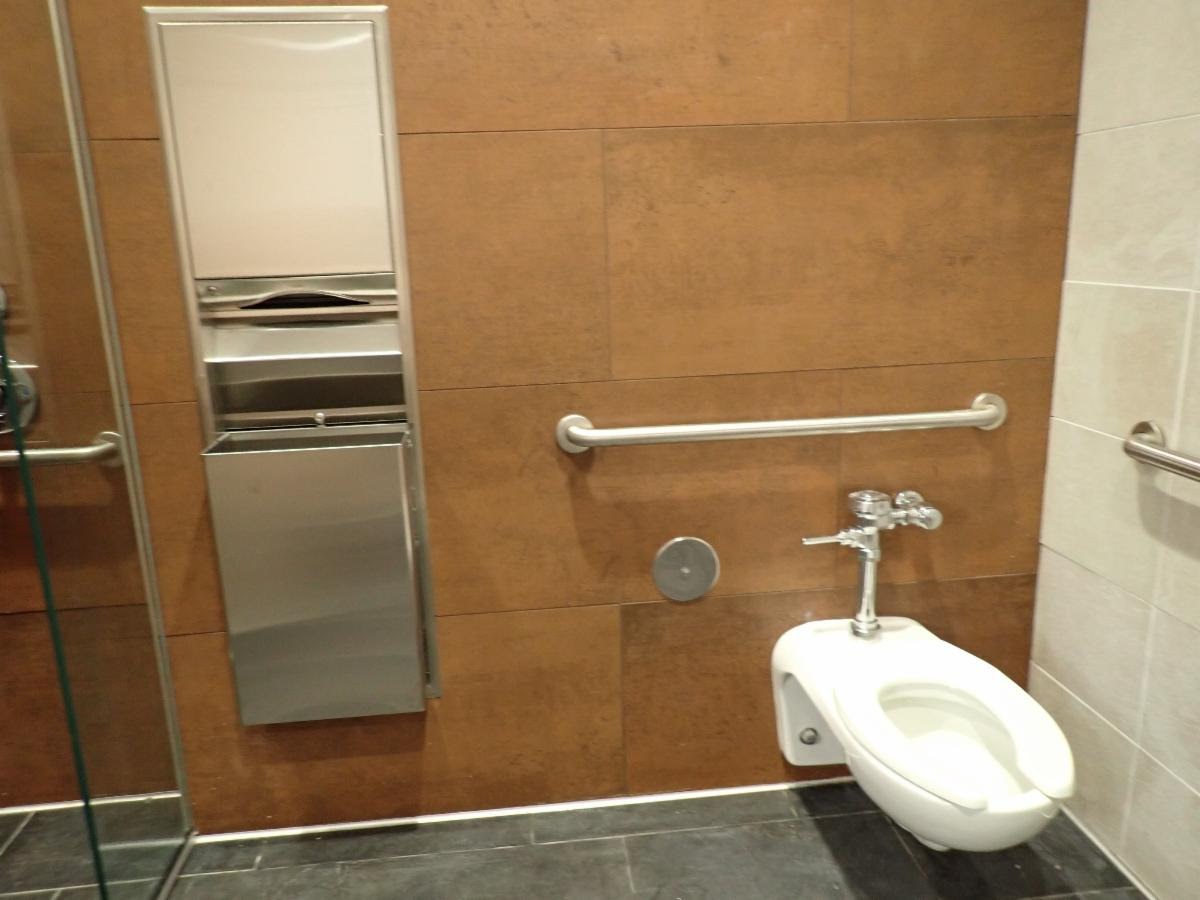
This toilet in the picture above had a paper towel dispenser and waste receptable that overlaps the clearance which it is not allowed. Note that the paper towel dispenser was recessed in the wall and did not overlap the clearance. if the element is completely recessed it is not considered overlapping.
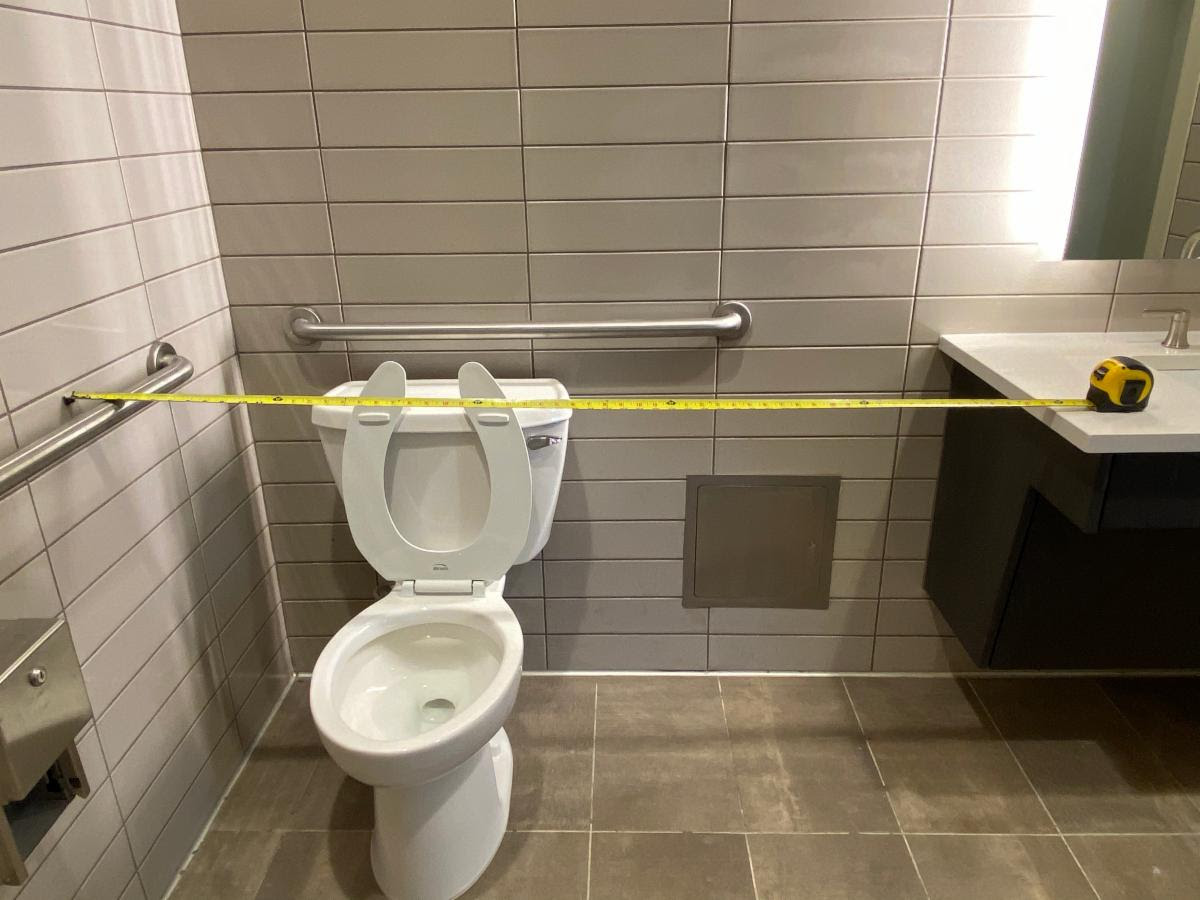
The picture above had a lavatory overlapping the clearance of the toilet. Remember that the clearance includes the overhang of the counter.
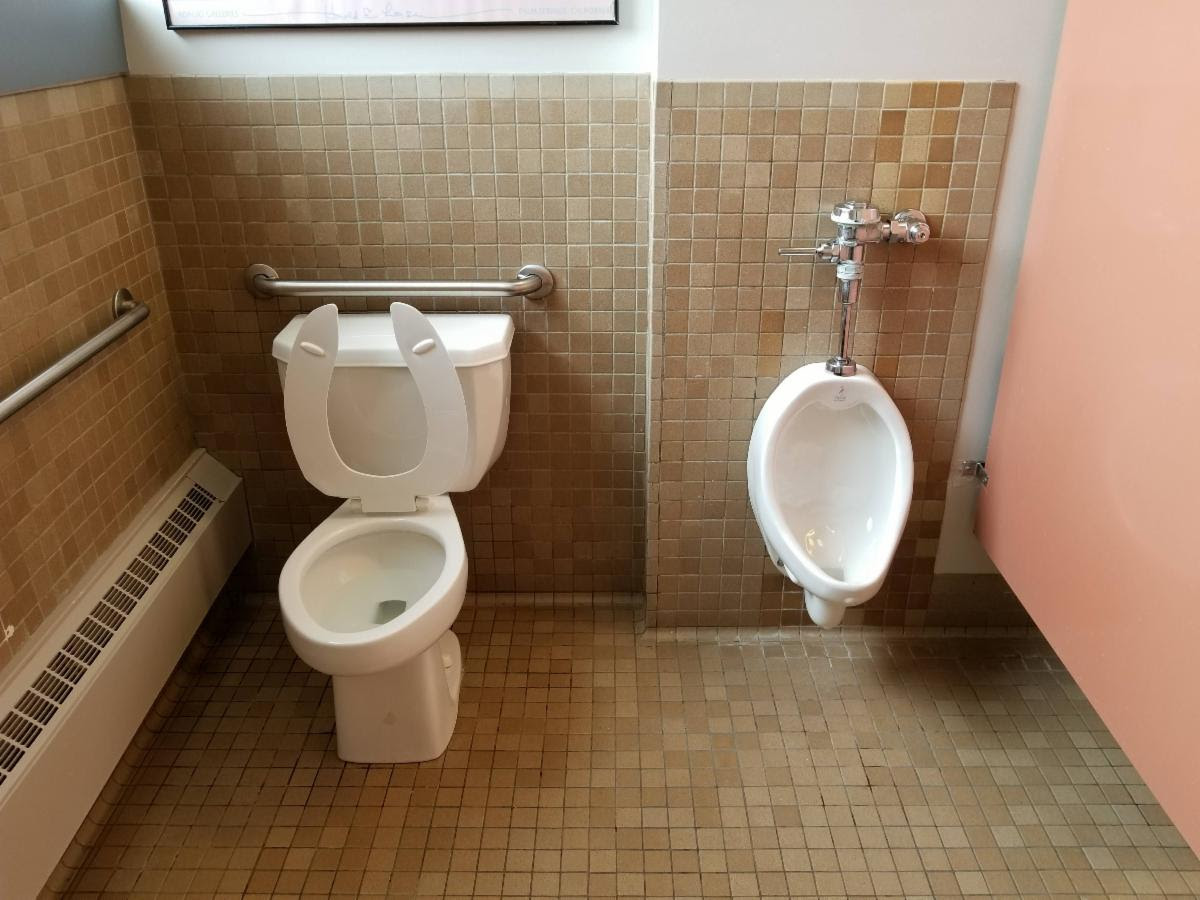
The picture above had a urinal overlapping the clearance of the toilet.
“But it is less than 4 inches”
Some of my clients conflate the “overlap” rule and the “protruding object” rule. They think that as long as the element projects less than 4″ from the wall then it is allowed to overlap the clearance. Those are two different requirements:
The protruding object rule is for people who are visually impaired that cannot detect objects mounted in their circulation path and could get hurt. So the standards suggests that if there are any objects located on a pedestrian circulation path that it should not project more than 4″ onto that path.
The clearance around the toilet rule is for people in wheelchairs to provide a clear space for them to transfer on. the US Access Board did their research and determined that any object (no matter how big or small) inside the toilet clearance makes it difficult to transfer onto the toilet.
Thursday, December 1st, 2022
Have you noticed that there are many instances in the ADA that uses 60″ as a requirement?
- Turning spaces
- Passing spaces
- Manuevering clearances at some doors
- Landings at ramps
- Clearance around the toilet
- access aisle as parking spaces
I am not sure exactly why they like that dimension….but one thing is clear is that it confuses many of my architects. This newsletter will clarify (hopefully) that even though these are the same numbers, they are meant to be for two SEPARATE instances.
Turning spaces
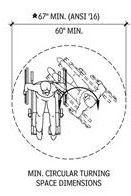
Toile rooms are required to be large enough in order to provide a turning space. It can either be a circle or a “T” turn. This turning space can overlap door clearances. It can overlap fixture CLEARANCES but it cannot overlap the fixture itself.
304.3.1 Circular Space. The turning space shall be a space of 60 inches (1525 mm) diameter minimum. The space shall be permitted to include knee and toe clearance complying with 306.
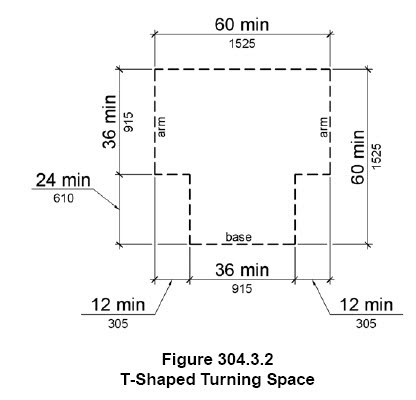
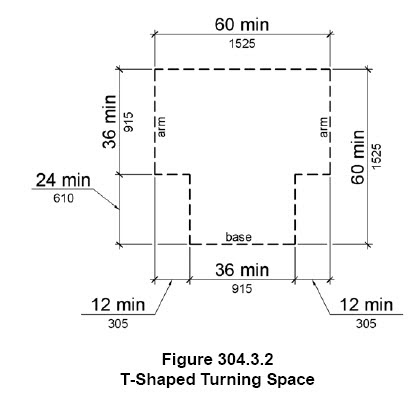
304.3.2 T-Shaped Space. The turning space shall be a T-shaped space within a 60 inch (1525 mm) square minimum with arms and base 36 inches (915 mm) wide minimum. Each arm of the T shall be clear of obstructions 12 inches (305 mm) minimum in each direction and the base shall be clear of obstructions 24 inches (610 mm) minimum. The space shall be permitted to include knee and toe clearance complying with 306 only at the end of either the base or one arm.

The drawing above shows the turning space overlaping the clerances of fixtures and the door clearance can also overlap the turning space. This turning space is essentially a representation of where a person in a wheelchair could use to turn, but it is not a permanent element.
Clearance around a water closet
Toilet rooms require a minimum of 60″ x 56″ in order for a person in a wheelchair to transfer onto the toilet room. This is different and separate than the 60″ turning space. It is only related to the toilet even though they have the same dimension.
604.3 Clearance. Clearances around water closets and in toilet compartments shall comply with 604.3.
604.3.1 Size. Clearance around a water closet shall be 60 inches (1525 mm) minimum measured perpendicular from the side wall and 56 inches (1420 mm) minimum measured perpendicular from the rear wall.
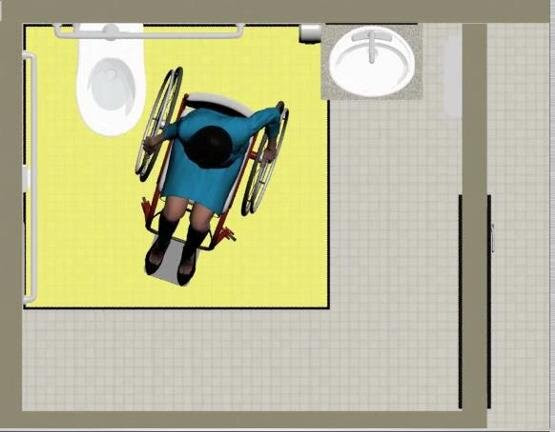
This image shows the clearance required for a wheelchair to transfer onto the toilet
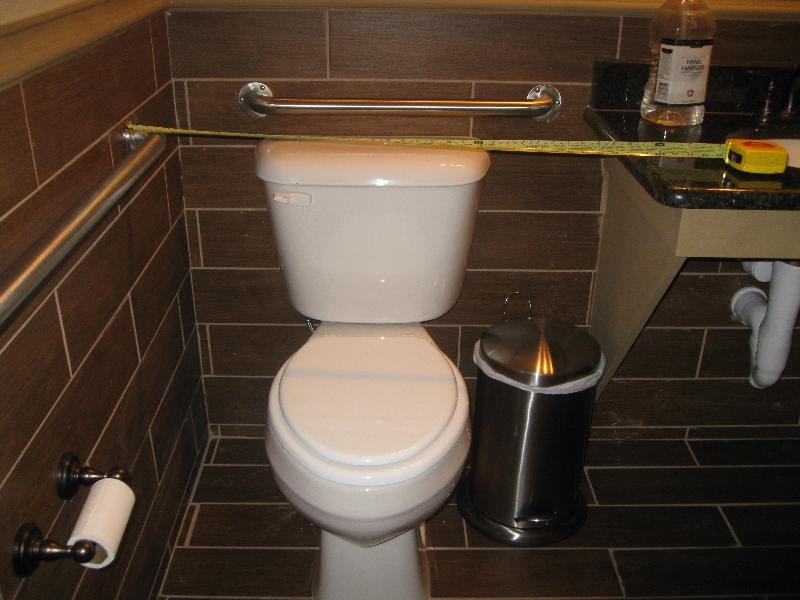
This toilet in the picture above did not have the 60″ min. clearance around the toilet- it does have the 60″ turning space, but that is a different requirement.
Upcoming Classes
December 13th- Understanding the ADA: Case Studies
I will be giving a zoom to the Mother’s In Architecture Facebook Group, but I am opening it up to others.
Here is the Zoom Link. Email me for the password.
Tuesday, November 1st, 2022
There seems to be a lot of confusion regarding the parallel (side) approach at sinks. The ADA, TAS and ANSI standards require all sinks and lavatories have a forward approach with a knee and toe clearance provided.
ADA and TAS (ANSI A117.1 similar) 606.2 Clear Floor Space. A clear floor space complying with 305, positioned for a forward approach, and knee and toe clearance complying with 306 shall be provided.
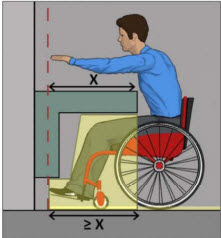
There are some exceptions that we will cover in this newsletter. Exceptions don’t have to be used, but if you need them, they are available.
Kitchen sinks WITHOUT a cook top or range
Exception 1. A parallel approach complying with 305 shall be permitted to a kitchen sink in a space where a cook top or conventional range is not provided and to wet bars.
The confusion in this exception is what is a “kitchen” sink. When there is not a clear definition in the definition section of the standards, they recommend that a dictionary definition may be used. TDLR did go on record as explaining what is their definition of kitchen with their Technical Memo TM2012-09.
In essense, a space with a fixed or built in cooking appliance will be considered a kitchen. And if the kitchen DOES NOT have a cooktop or range, then a parallel approach at the sink can be used.
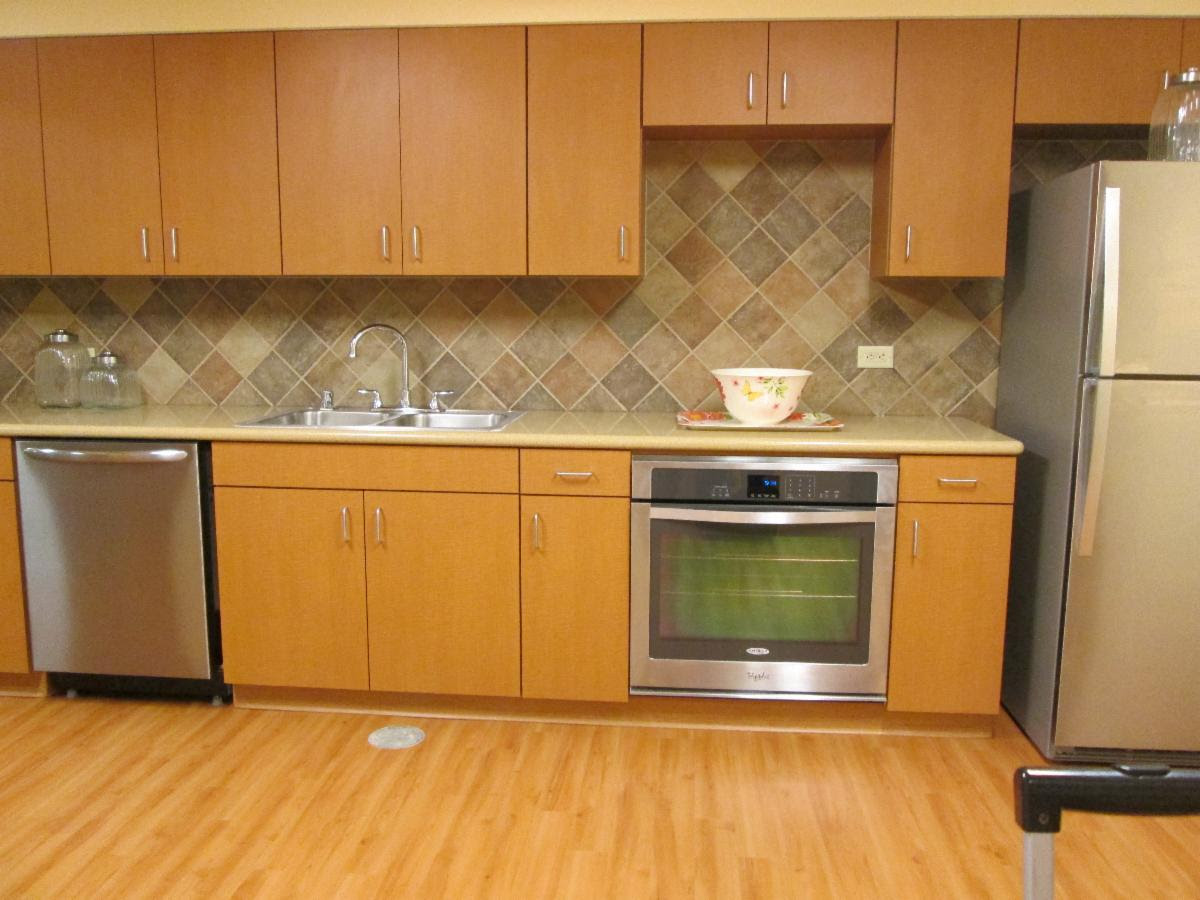
The photo above is of a space with a built in oven. It is a built in cooking appliance, therefore it is considered a kitchen. Because this “kitchen” does not have a cook top or a range, the sink may have a parallel approach.
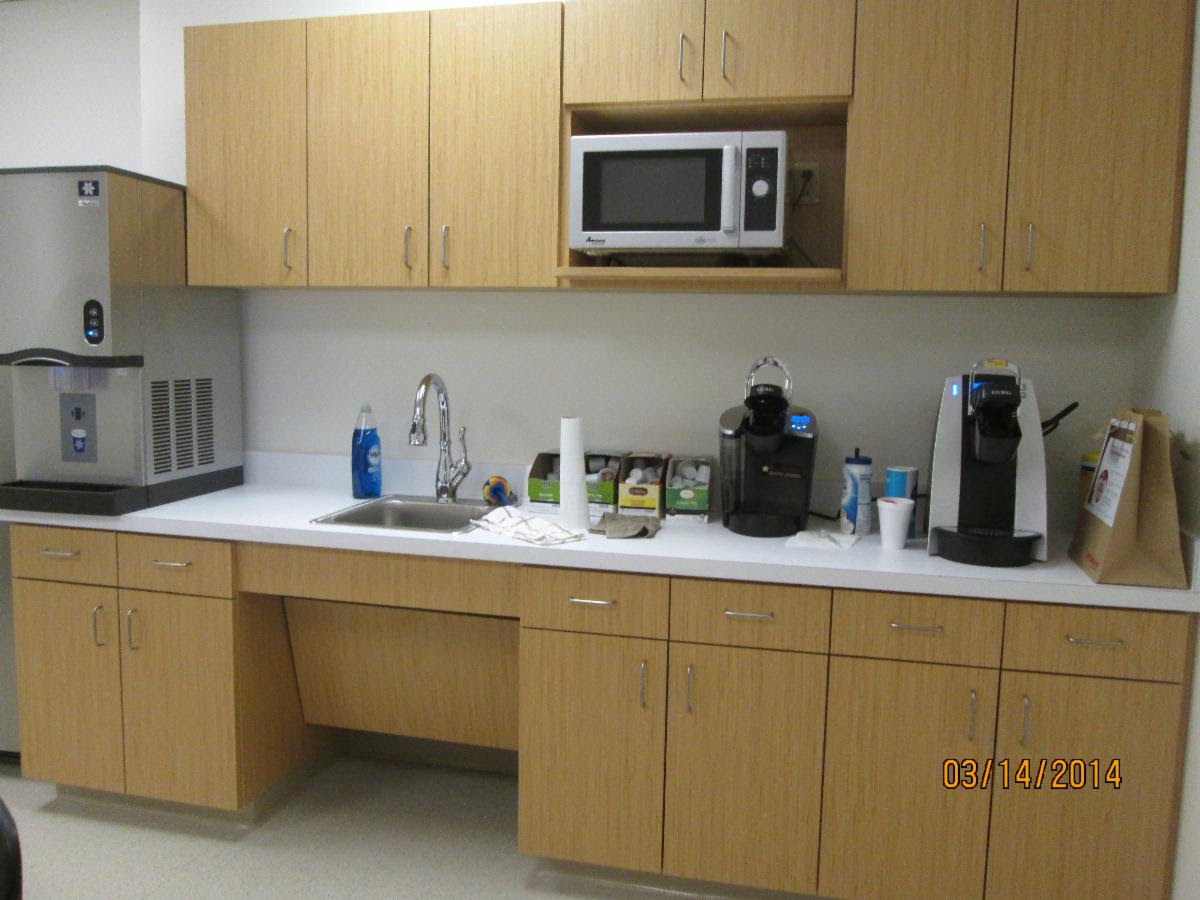
The photo above is of a space with a movable microwave oven on a shelf. Since the microwave is not built in, this is not considered a “kitchen” and a parallel approach cannot be used at the sink. The sink must have a forward appraoch with a knee and toe clearance as shown.
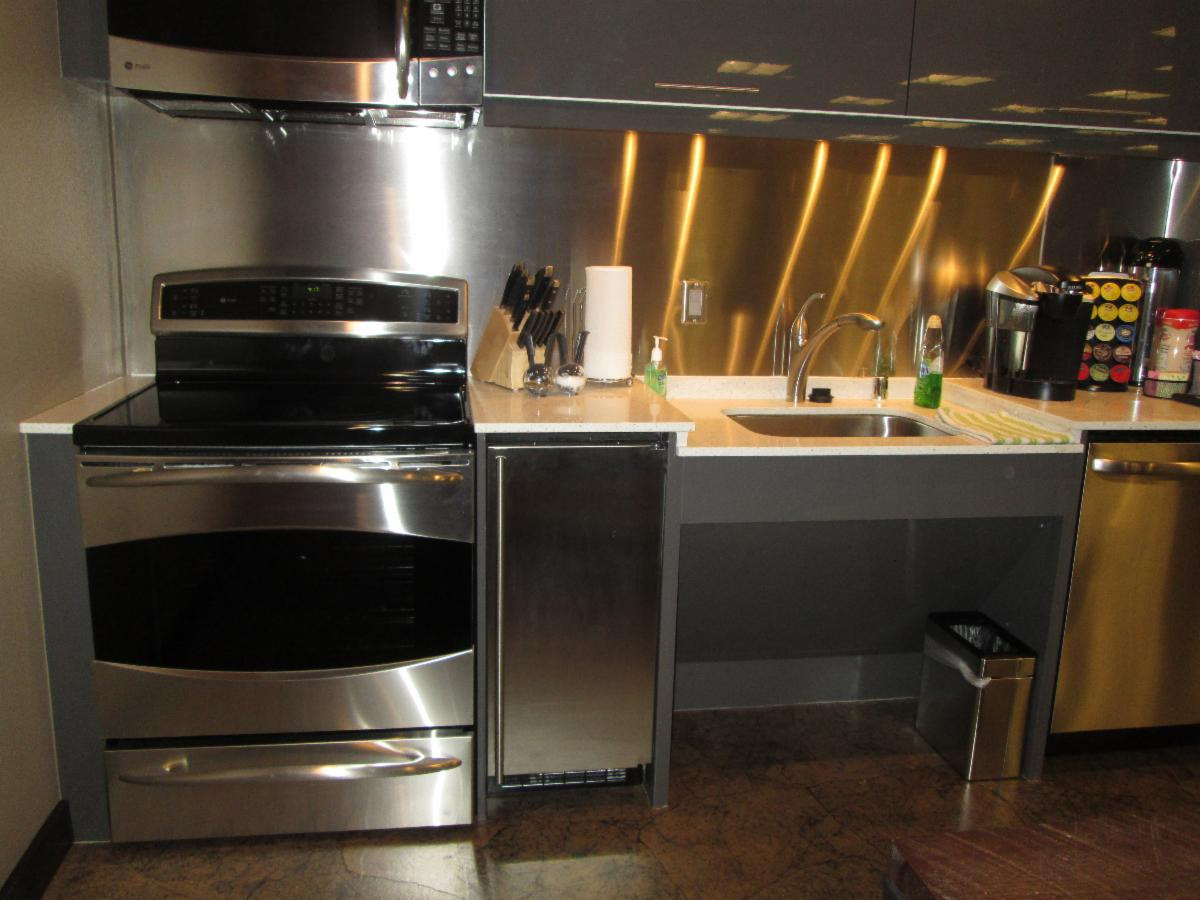
The photo above is of a space with a built in microwave oven and a built in range. This is considered a kitchen. And since it has a range, it cannot take the parallel approach exception and a knee clearance must be provided (as shown) at the sink.
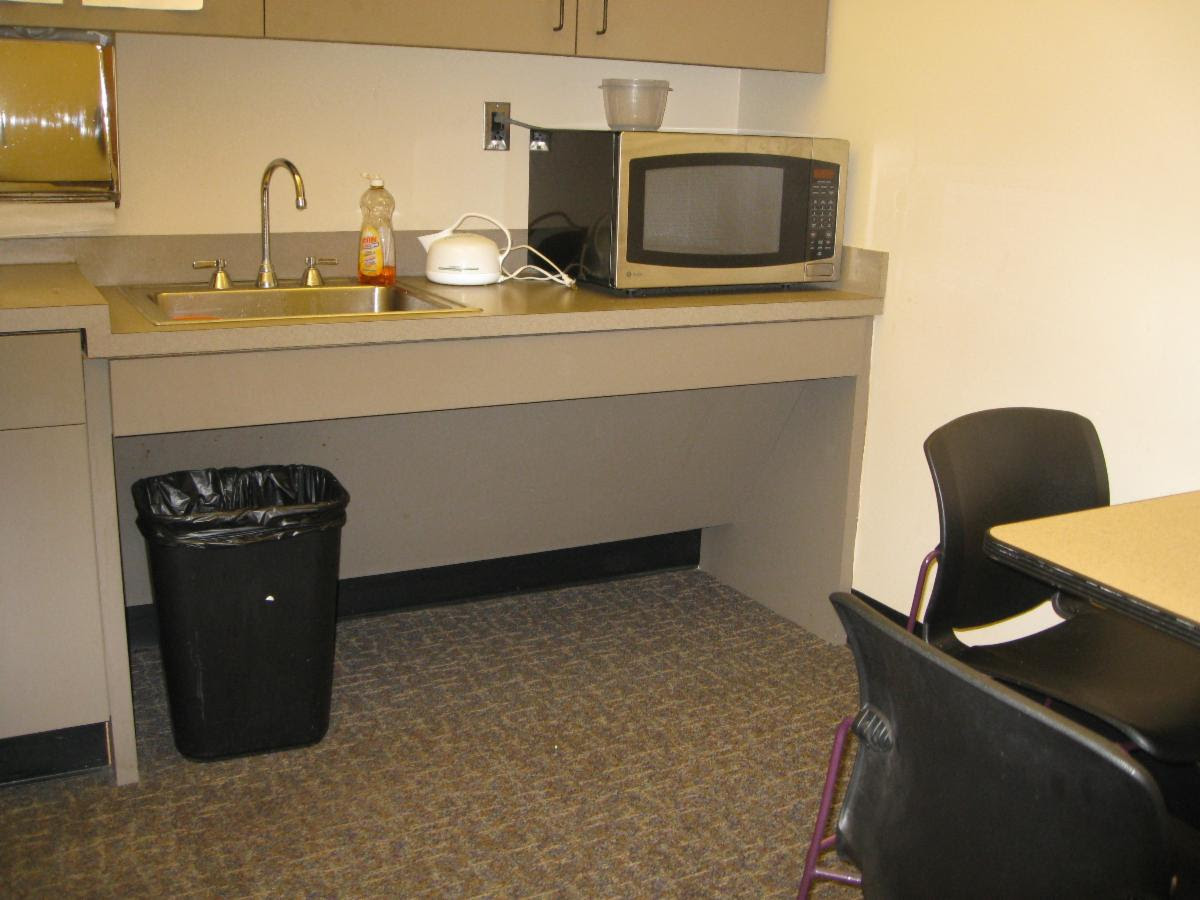
The photo above is of a space with a microwave on the counter. Because the microwave is not built in, it is not considered a kitchen. Therefore, it cannot take the parallel approach exception and a knee clearance must be provided (as shown) at the sink.
Outdoor Kitchen Sinks
The photo below is of an outdoor kitchen for an office space. It is in essense an outdoor break area. The outdoor kitchen is scoped per TAS 212, 606, and 804. The sink is not eligible for 606.2 exception 1 because a fixed cooking facility is provided (grill). The parallel approach is not compliant because the kitchen does not meet the definition of a wet bar – it provides a fixed cooking facility and it is used as a range/cook top.
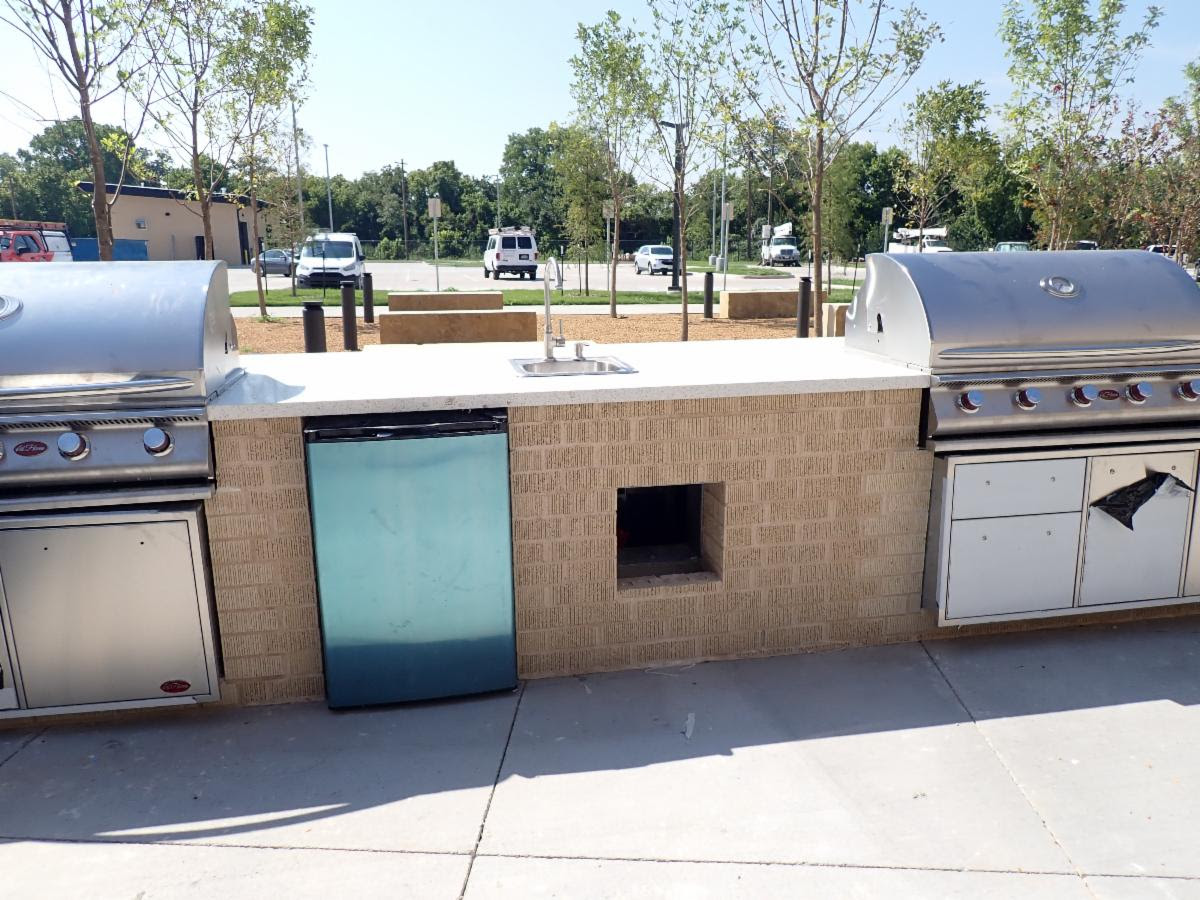
The photo above is of an outdoor break area with a sink and a range
Wet Bars
Exception 1. A parallel approach complying with 305 shall be permitted to a kitchen sink in a space where a cook top or conventional range is not provided and to wet bars.
Part of this exception allows a parallel approach if the sink is part of a “wet bar”. A wet bar is essentially a place where only drinks will be served or prepared. These most commonly occur at waiting rooms or at hotel rooms without kitchennettes.
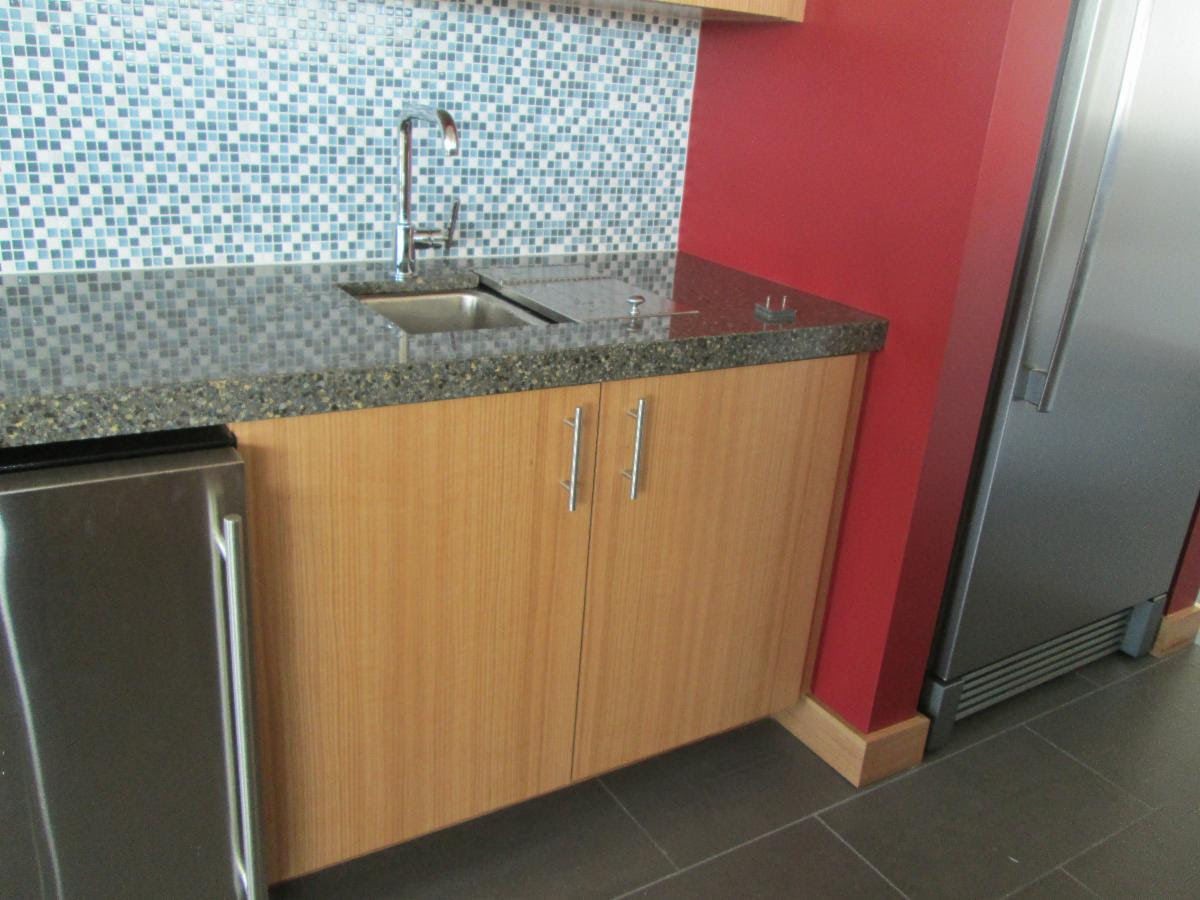
The photo above is of “wet bar” at a waiting room in a clinic
Lavatory at a private bathroom (accessed from a private office)
Exception 2. A lavatory in a toilet room or bathing facility for a single occupant accessed only through a private office and not for common use or public use shall not be required to provide knee and toe clearance complying with 306.
A office is deemed “private” if it is only for one person and not located in a common area. A “private” bathroom is deemed private if it is only accessed from the private office and only used by one person.
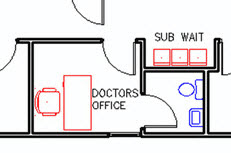
The image above is of a “private bathroom” that is accessed by a doctor’s office. The lavatory may take excepton 2
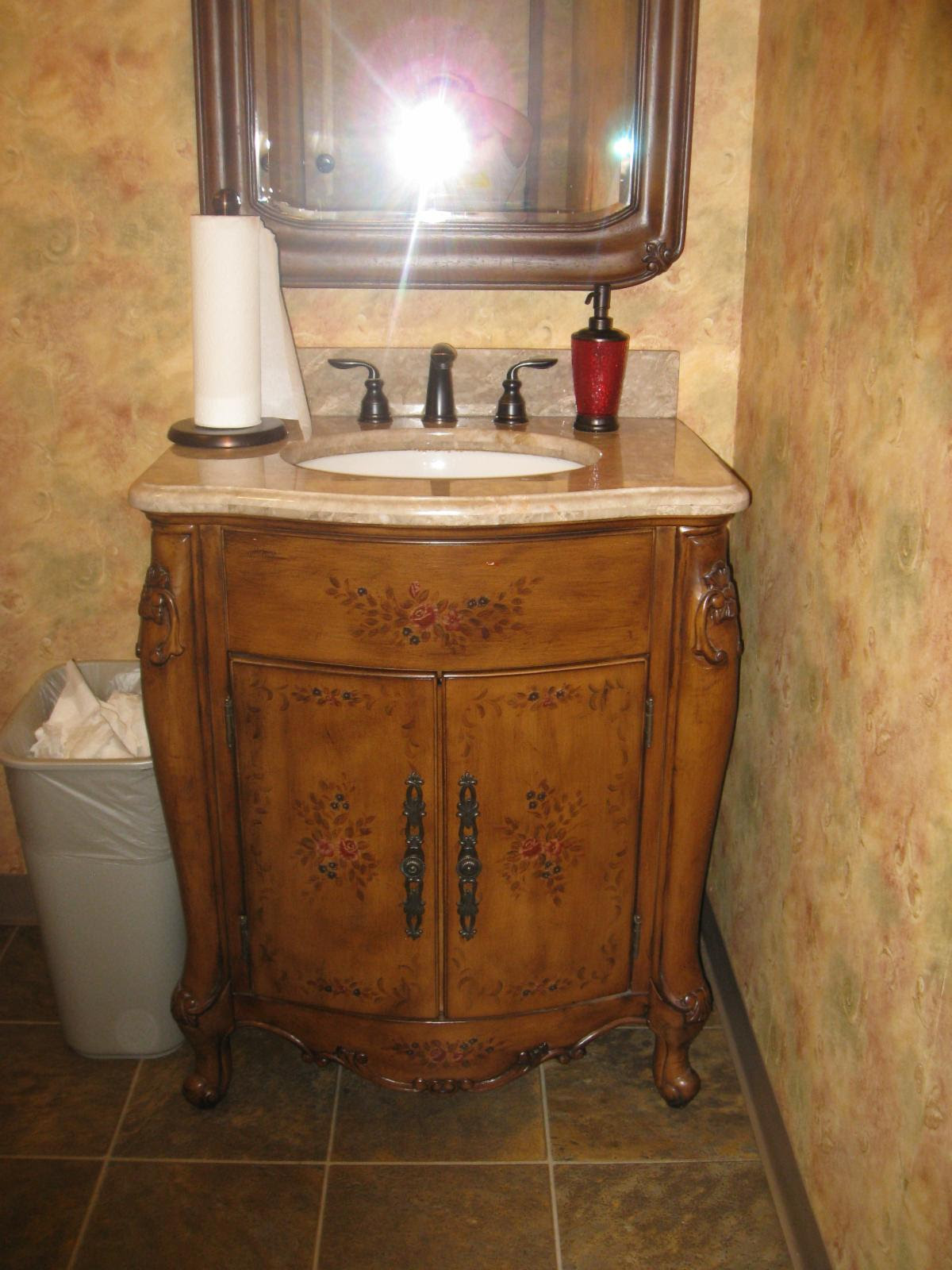
The photo above is of the lavatory at the private restroom that is accessed by a doctor’s office. The lavatory may take excepton 2 and can have a parallel approach.
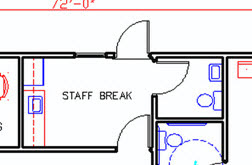
The image above is of a restroom accessed from the staff break room. This is NOT a private bathroom and the lavatory must have a forward approach w
ANSI A117.1, ADA and TAS Residential Lavatory and Kitchen Sinks
Exception 3. In residential dwelling units, cabinetry shall be permitted under lavatories and kitchen sinks provided that all of the following conditions are met:
(a) the cabinetry can be removed without removal or replacement of the fixture;
(b) the finish floor extends under the cabinetry; and
(c) the walls behind and surrounding the cabinetry are finished
This exception can be taken only at residential dwelling units. If it is taken a door can be used to cover the knee clearance, but the floor finish must extend to the back wall and the pipes must be protected. In addition the cabinetry must be able to be removed without having to re-build the knee clearance.
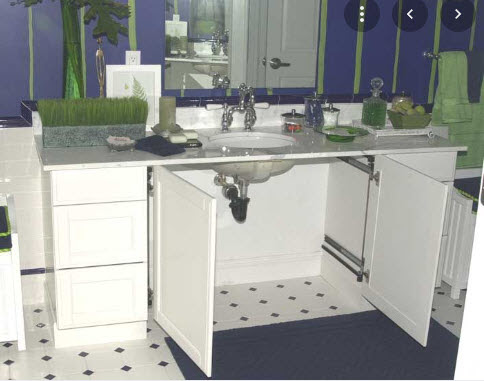
The image above shows a sink at a residential dwelling unit that has doors in front of the knee space. Once the doors are open, the floor finish and all the side walls around the sink are finished as well.
Sinks and lavatories for children 5 years old and younger
Exception 5. A parallel approach complying with 305 shall be permitted to lavatories and sinks used primarily by children 5 years and younger.
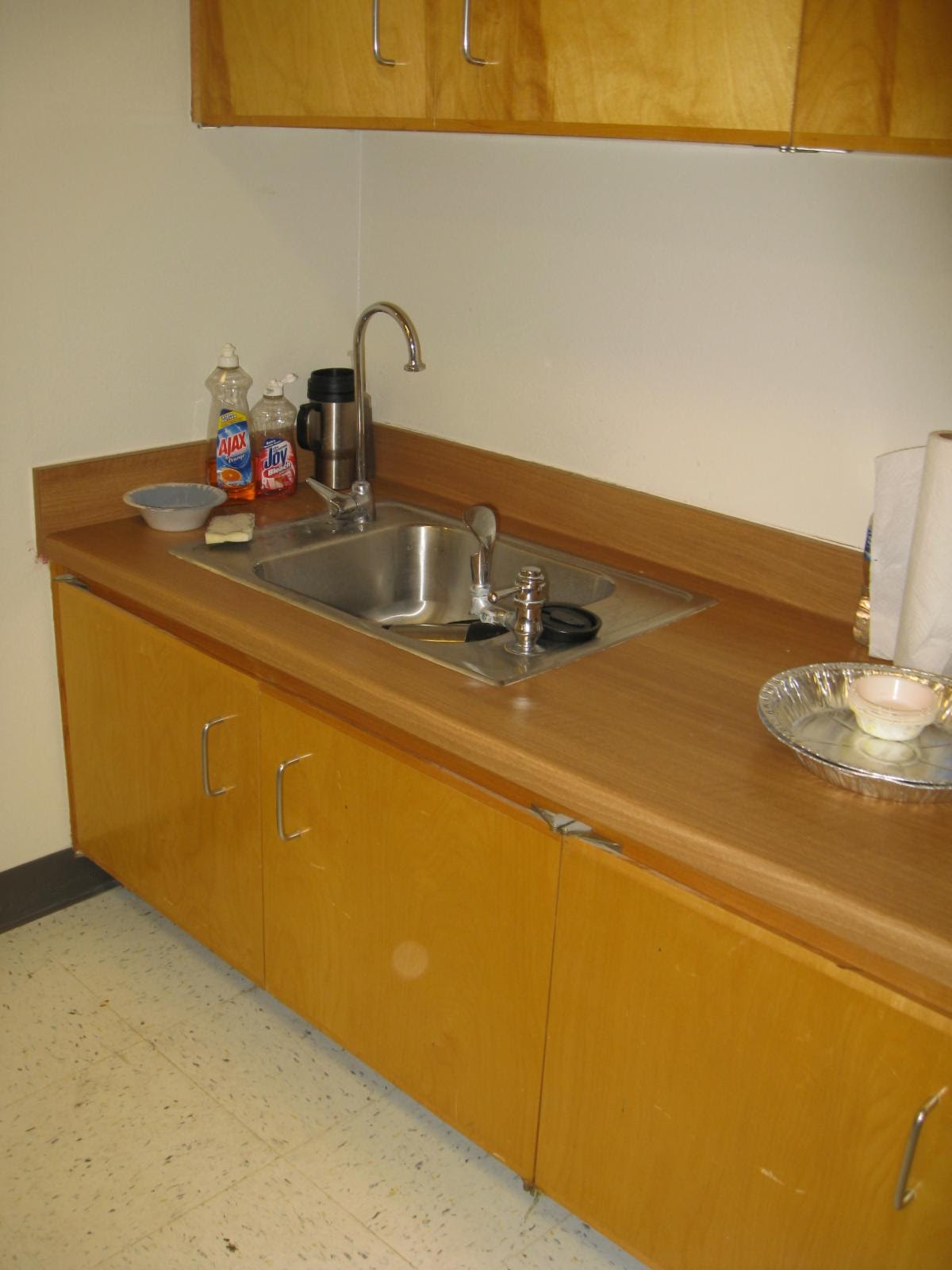
The image above shows a sink at a classroom for children five years old and younger
Upcoming Classes
November 17, 2022
8:30-9:30 a.m.
“Understanding and Complying with Barrier-Free Requirements in Outdoor Spaces” 1 HR HSW Barrier Free CEU
Webinar for HalfMoon Education
Monday, October 3rd, 2022
The ADA is not the only Standard that requires clear floor space to be centered. The Fair Housing Design Guidelines and ANSI A117.1 also does. This newsletter will provide guidance on when the clear floor space in a residential dwelling unit must be centered.
Fair Housing Kichen Appliances
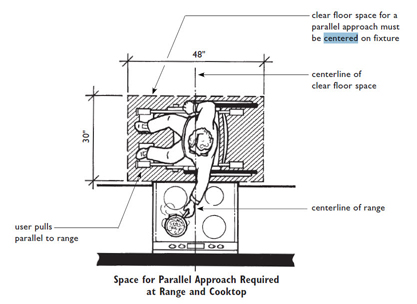
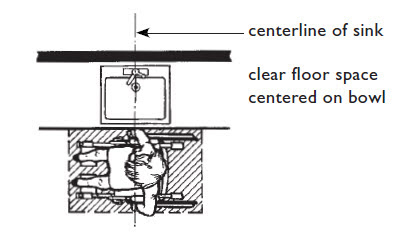
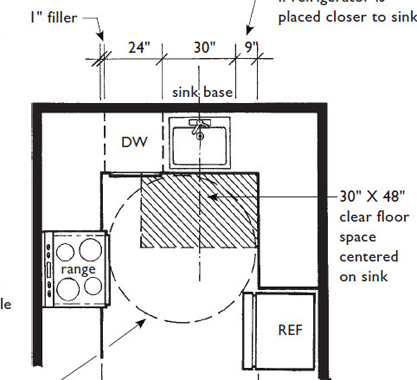
The parallel clear floor space at sinks, as at sink when bowls are ranges and cooktops, must be centered on the bowl of unequal size or appliance.
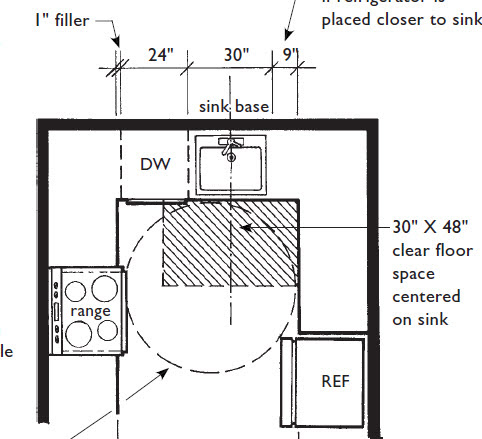
In addition to the turning space, the kitchen must be arranged so there is a 30-inch x 48-inch clear floor space for a parallel approach centered on the sink, range, or cooktop. The centerline of the fixture or appliance must be aligned with the centerline of the clear floor space.
Fair Housing Clear Floor Space Bathroom Lavatories
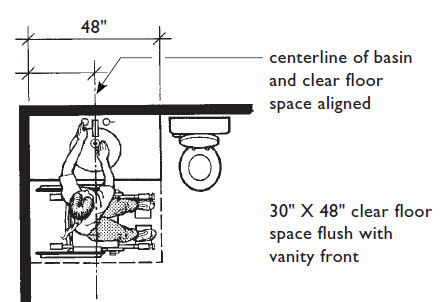
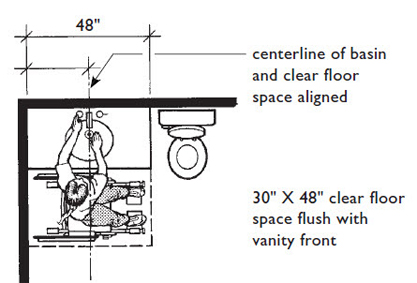
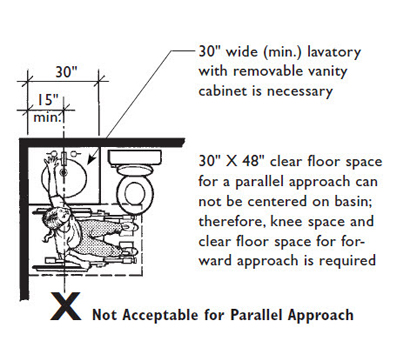
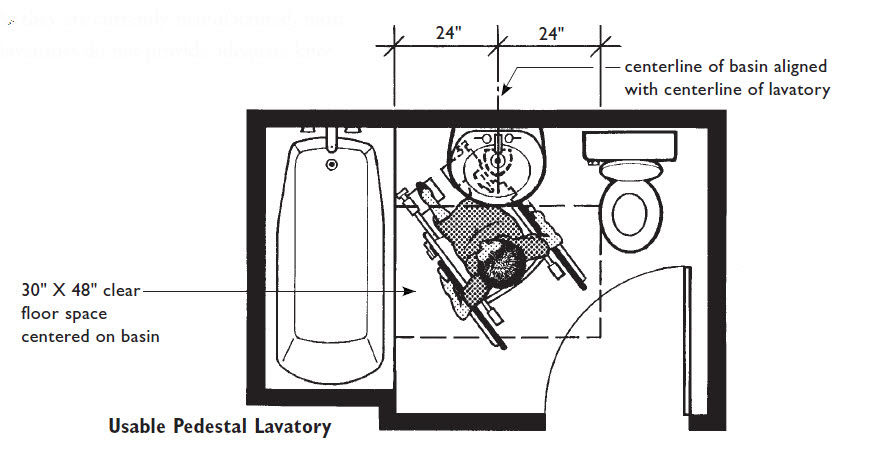
A 30-inch x 48-inch clear floor space is required at the lavatory so a person who uses a wheelchair or scooter can get close enough to the basin and controls to use the fixture. When knee space is not provided for a forward approach, this 30-inch x 48-inch clear floor space must be parallel to the cabinet or counter front and centered on the basin.
ANSI A117.1 Washer and Dryer
611.2 Clear Floor Space. A clear floor space complying with Section 305, positioned for parallel approach, shall be provided. For top loading machines, the clear I floor space shall be centered on the appliance. For front loading machines, the centerline of the clear floor space shall be offset 24 inches (610 mm) maximum from the centerline of the door opening.
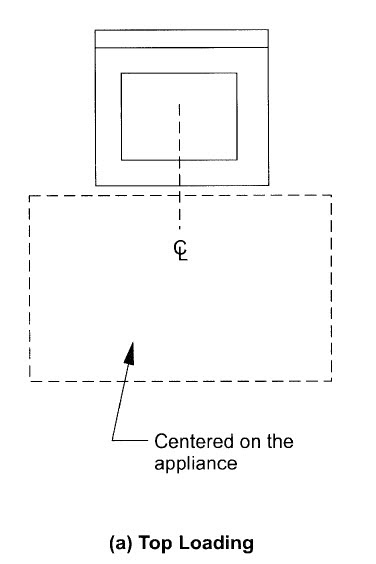
ANSI A117.1 Residential Kichen Work Surface
In kitchens of residential dwelling units there is a requirement to provide a “work surface” with a knee clearance with a floor space centered and allowing a forward approach.
804.3 Kitchen Work Surface (Residential only)
804.3.1 Clear Floor or Ground Space. A clear floor space complying with 305 positioned for a forward approach shall be provided. The clear floor or ground space shall be centered on the kitchen work surface and shall provide knee and toe clearance complying with 306.
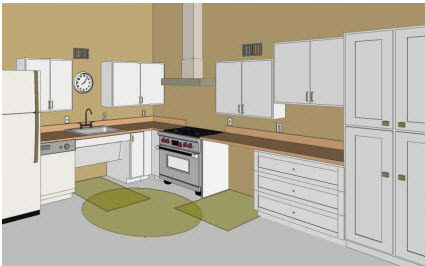
The image above shows a residential kitchen with a sink as well as a “work surface” which provides a forward approach. The work surface is required that the clear floor space below it be centered at the surface. The sink is not required to provide a clear floor space that is centered.
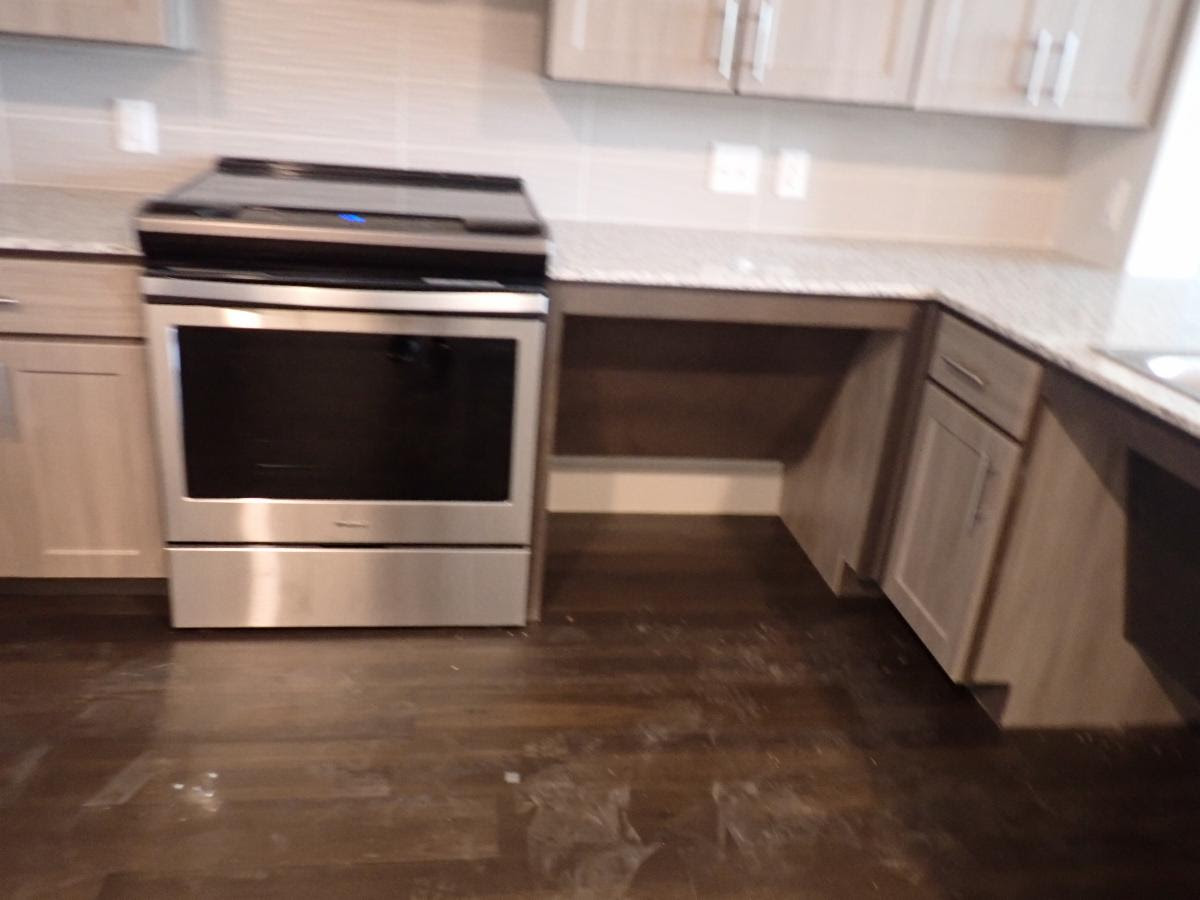
The image above shows a residential kitchen work surface and it is centered at the surface.
Thursday, September 1st, 2022
Part 2
We have been discussing when we should make our clear floor space centered on the elements. This is a continuation of the commercial guidelines outlined in the ADA. For Part 1 refer to the
August Newsletter.Below are some other instances that the ADA will require that there be a clear floor space that is centered.
Residential Kichen Work Surface
In kitchens of residential dwelling units (not located in multi-family housing, but required by section 233 to be accessible, there is a requirement to provide a “work surface” with a knee clearance with a floor space centered and allowing a forward approach.
804.3 Kitchen Work Surface (Residential only)
804.3.1 Clear Floor or Ground Space. A clear floor space complying with 305 positioned for a forward approach shall be provided. The clear floor or ground space shall be centered on the kitchen work surface and shall provide knee and toe clearance complying with 306.
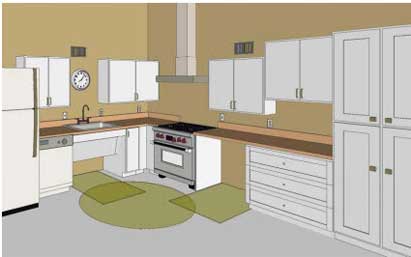
The image above shows a residential kitchen with a sink as well as a “work surface” which provides a forward approach. The work surface is required that the clear floor space below it be centered at the surface. The sink is not required to provide a clear floor space that is centered.
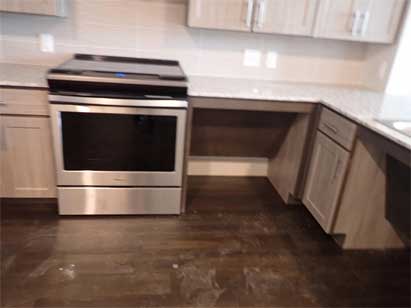
The image above shows a residential kitchen work surface and it is centered at the surface.
Altered Sales and Service counter
When an existing sales and service counter is altered, they must provide an accessible portion. Typically a sales or service counter must be 36″ long minimum, but if they cannot accommodate that length they would be allowed to only provide a 24″ counter as long as there is a clear lfoor space centered and parallel to the counter.
904 Sales and Service counters
904.4 Sales and Service Counters.
EXCEPTION: In alterations, when the provision of a counter complying with 904.4 would result in a reduction of the number of existing counters at work stations or a reduction of the number of existing mail boxes, the counter shall be permitted to have a portion which is 24 inches (610 mm) long minimum complying with 904.4.1 provided that the required clear floor or ground space is centered on the accessible length of the counter.
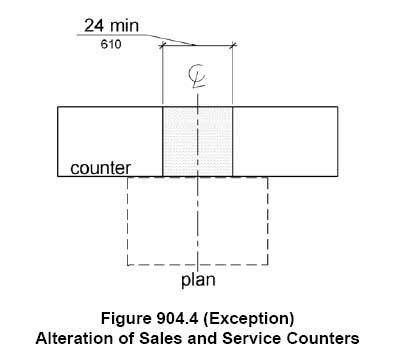
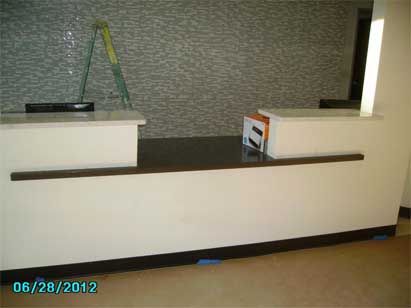
The image above shows an example of a counter which has a parallel approach at the lower counter and the clear floor space is also centered at the accessible portion. The length is unknown, but this would be an example of how the exception could be taken.
Playground transfer system
When playgrounds have elevated components that require an accessible route, one way that they can reach the elevated portion is via a transfer system. That transfer system will also require to have a parallel clear floor space centered at the platform.
1008.3Playground Transfer Systems
1008.3.1.3 Transfer Space. A transfer space complying with 305.2 and 305.3 shall be provided adjacent to the transfer platform. The 48 inch (1220 mm) long minimum dimension of the transfer space shall be centered on and parallel to the 24 inch (610 mm) long minimum side of the transfer platform. The side of the transfer platform serving the transfer space shall be unobstructed.
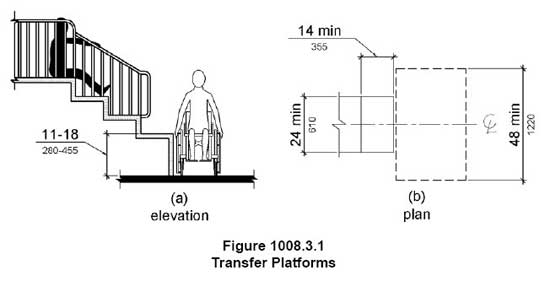
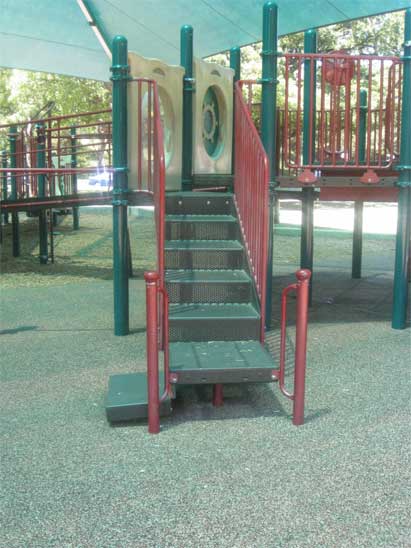
The image above shows a transfer system at an elevated play structure. There is room for the clear floor space to be centered at the platform.
Pool transfer walls and platforms
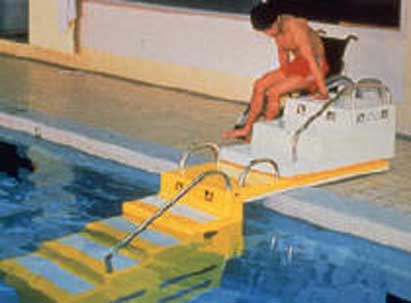
Pools and spas (jacuzzis/hot tubs) are required to have an accessible entry (or two depending on the size of the pool). There are several options for the accessible entry. One is a transfer wall and another a transfer platform. The transfer wall or the transfer platform must have a clear floor space centered at the deck to assist with entry to the pool.
1009.4 Pool Transfer Walls
1009.4.1 Clear Deck Space. A clear deck space of 60 inches (1525 mm) minimum by 60 inches (1525 mm) minimum with a slope not steeper than 1:48 shall be provided at the base of the transfer wall. Where one grab bar is provided, the clear deck space shall be centered on the grab bar. Where two grab bars are provided, the clear deck space shall be centered on the clearance between the grab bars.
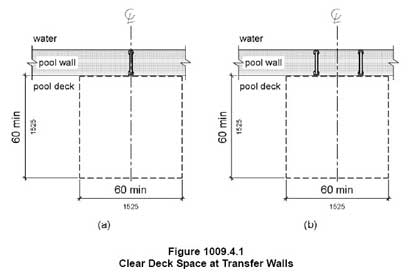
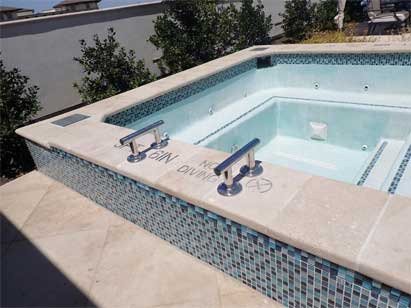
The image above shows a transfer wall with two grab bars at a jacuzzi. There is room for the clear floor space to be centered between the two grab bars.
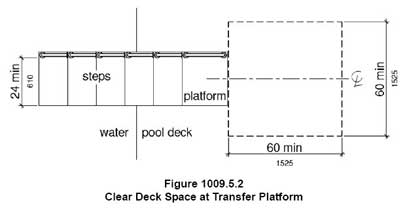
1009.5 Pool Transfer Platform
1009.5.2 Transfer Space. A transfer space of 60 inches (1525 mm) minimum by 60 inches (1525 mm) minimum with a slope not steeper than 1:48 shall be provided at the base of the transfer platform surface and shall be centered along a 24 inch (610 mm) minimum side of the transfer platform. The side of the transfer platform serving the transfer space shall be unobstructed.
1) Texas Association of Interior Design
Ludowici Dallas Design Center | 133 Manufacturing St, Dallas, TX 75207
Monday, August 1st, 2022
Part 1
In the 2010 ADA and the 2012 Texas Accessibility Standards there are certain elements that require front approach and centered clear floor space on the element, but not all of them do. This newsletter will enumerate the one’s that do. Other elements such as lavatories and sinks only require forward approach but the clear floor space is not required to be centered.
Below are the elements that require a clear floor space to be centered:
Drinking fountains
Drinking fountains are one of the elements listed in the ADA and TAS that require that the wheelchair drinking fountain have a clear floor space centered on the unit. The clear floor space must also be a forward approach.
602 Drinking Fountains
602.2 Clear Floor Space. Units shall have a clear floor or ground space complying with 305 positioned for a forward approach and centered on the unit. Knee and toe clearance complying with 306 shall be provided
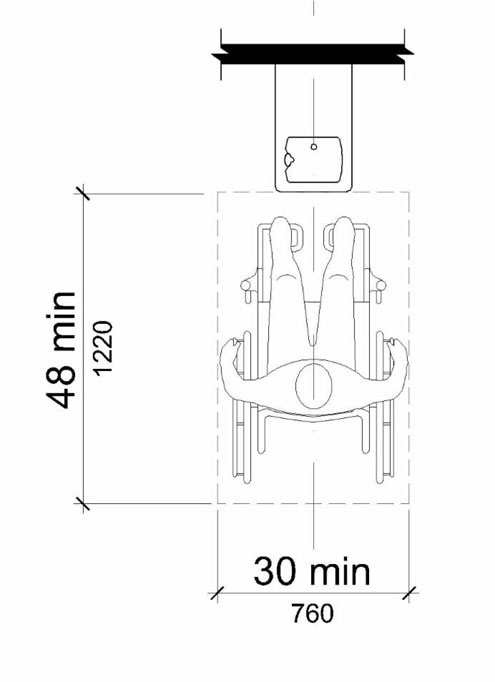
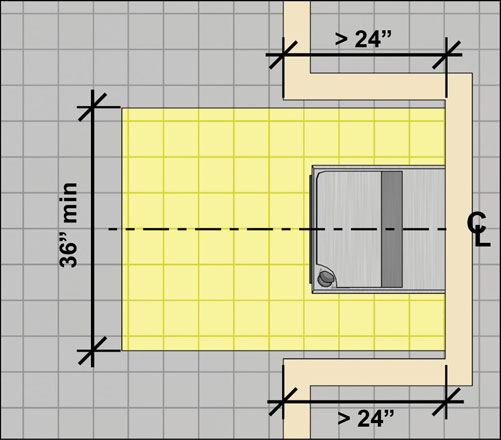
The image above shows the required clear floor space at the drinking fountain. It must be a forward approach and it must be centered on the wheelchair accessible drinking fountain. If it is located at an alcove deeper than 24″ the clear floor space must be widened to 36″ wide.
There are two violations that occurr with this requirement. One is that sometimes the drinking fountains are located along a corridor and not in an alcove. This creates a protruding object issues (see this newsletter that explains that). In order to resolve the protruding object, a cane dectable apron is sometimes installed at the bottom of the “high” drinking fountain and the apron reduceds the ability to have a forward approach because it might be lower than 27″ a.f.f.
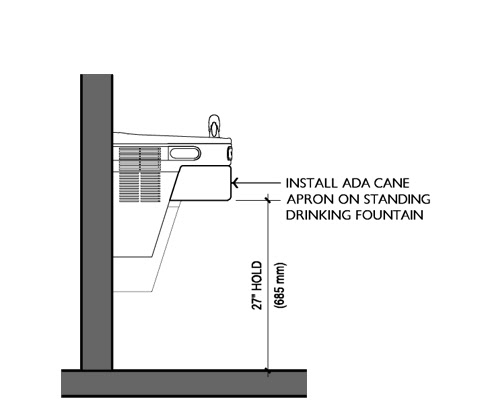
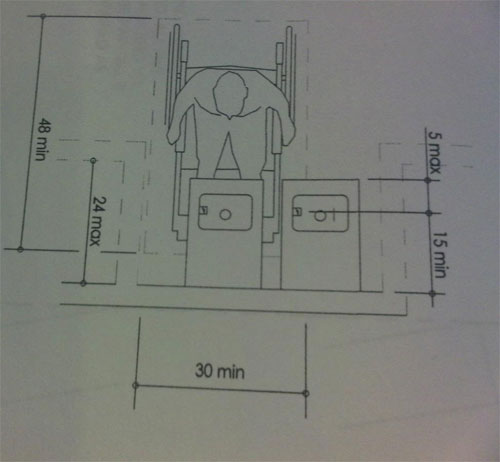
The image above shows how the clear floor space centered under the “low” drinking fountain spans below the “high” one and if there is an apron below the 27″ a.f.f. it will prevent the use of the drinking fountain by a wheelchair.
Number two is that sometimes the drinking fountains are located in an alcove and the walls creating the alcove reduce the 30″ clearance which must be centered. The wall adjacent to the wheelchair accessible drinking fountain should be a minimum distance of 15″ from the centerline of the drinking fountain to the inside of the wall.
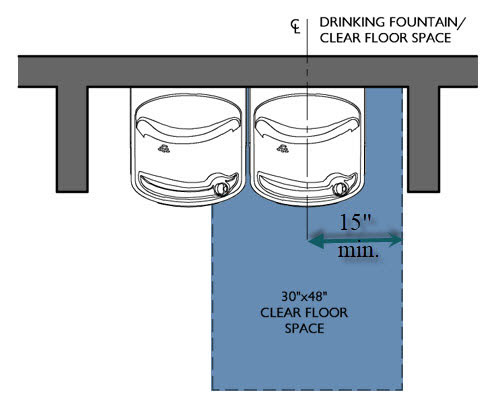
The image above shows how the clear floor space centered under the “low” drinking fountain must be a minimum of 15″ from the center of the drinking fountain to the inner edge of the alcove.
Washer and Dryer
The washer and dryer must also have the clear floor space centered on the appliance and must have parallel approach.
611 Washer and Dryer
611.2 Clear Floor Space. A clear floor or ground space complying with 305 positioned for parallel approach shall be provided. The clear floor or ground space shall be centered on the appliance.
This sometimes causes issues if the washer and dryer are located inside a closet. The doors may reduce the clearance.
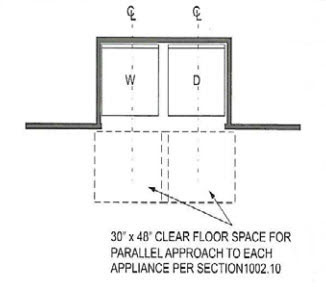
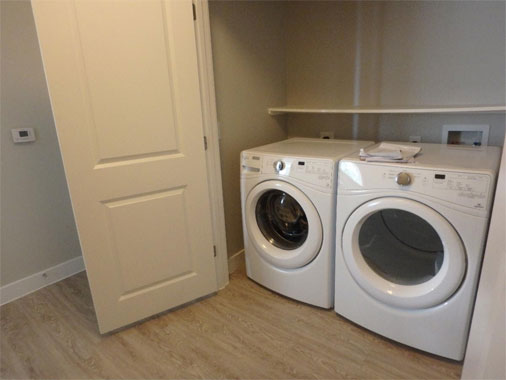
The image above shows a set of washer and dryer located inside a utility closet. The doors do not open 180 degrees and reduce the clear floor space to less than 24″ from the centerline of the dryer to the edge of the floor space.
Signage
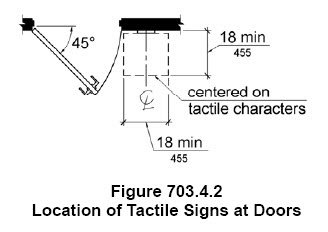
The signage that designate permanent rooms must have an 18″x18″ clear floor space centered on the sign.
703 Signage
703.4.2 Location. ….Signs containing tactile characters shall be located so that a clear floor space of 18 inches (455 mm) minimum by 18 inches (455 mm) minimum, centered on the tactile characters, is provided beyond the arc of any door swing between the closed position and 45 degree open position.
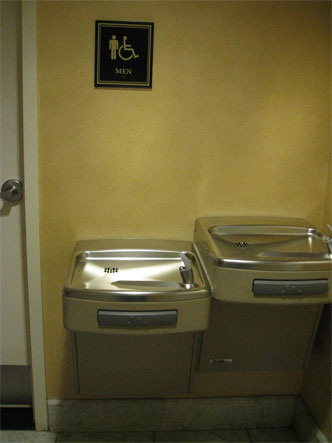
The image above shows a sign which has a drinking fountain in front of it, therefore the requirement for a clear floor space centered on the sign has not been met.
Lavatories and Sinks
One of the misconceptions is that a clear floor space at the sink or lavatory is required to be centered. The approach must be forward, but the clear floor space is not noted as needing to be centered, like the other sections do. Therefore by omission we understand that the clear floor space can be offset.
606 Lavatories and Sinks
606.2 Clear Floor Space. A clear floor space complying with 305, positioned for a forward approach, and knee and toe clearance complying with 306 shall be provided.
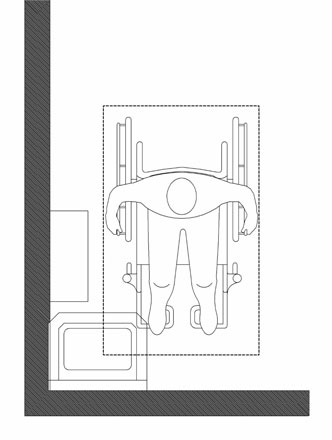
The image above shows a wheelchair clear floor space that is not centered at the lavatory. The clear floor space under the lavatory can be offset if there is an obstruction such as a paper towel dispenser next to the lavatory.
Friday, July 1st, 2022
July 2022: Inspector’s Corner
I do ADA inspections every Wednesday and I always find some interesting things that I wanted to share. Here are some interesting solutions and products that are good for accessibility, and I will show them in this newsletter.
Diaper Changing Counters and Cane Detection
A diaper changing counter will sometimes be located in a circulation path around the restroom and when it is left open it can be a protruding object. TDLR issued a technical memo on the topic. Here is the link. At some of my inspections I have seen some interesting ways of handling this:
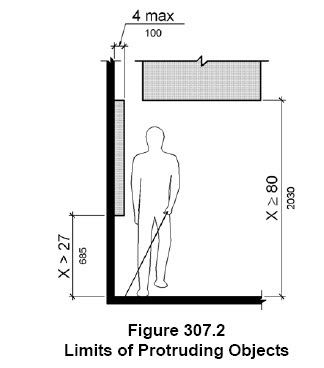
The figure above shows the requirements for objects mounted in a circulation path so they will not be hazards for people with visual impairments.
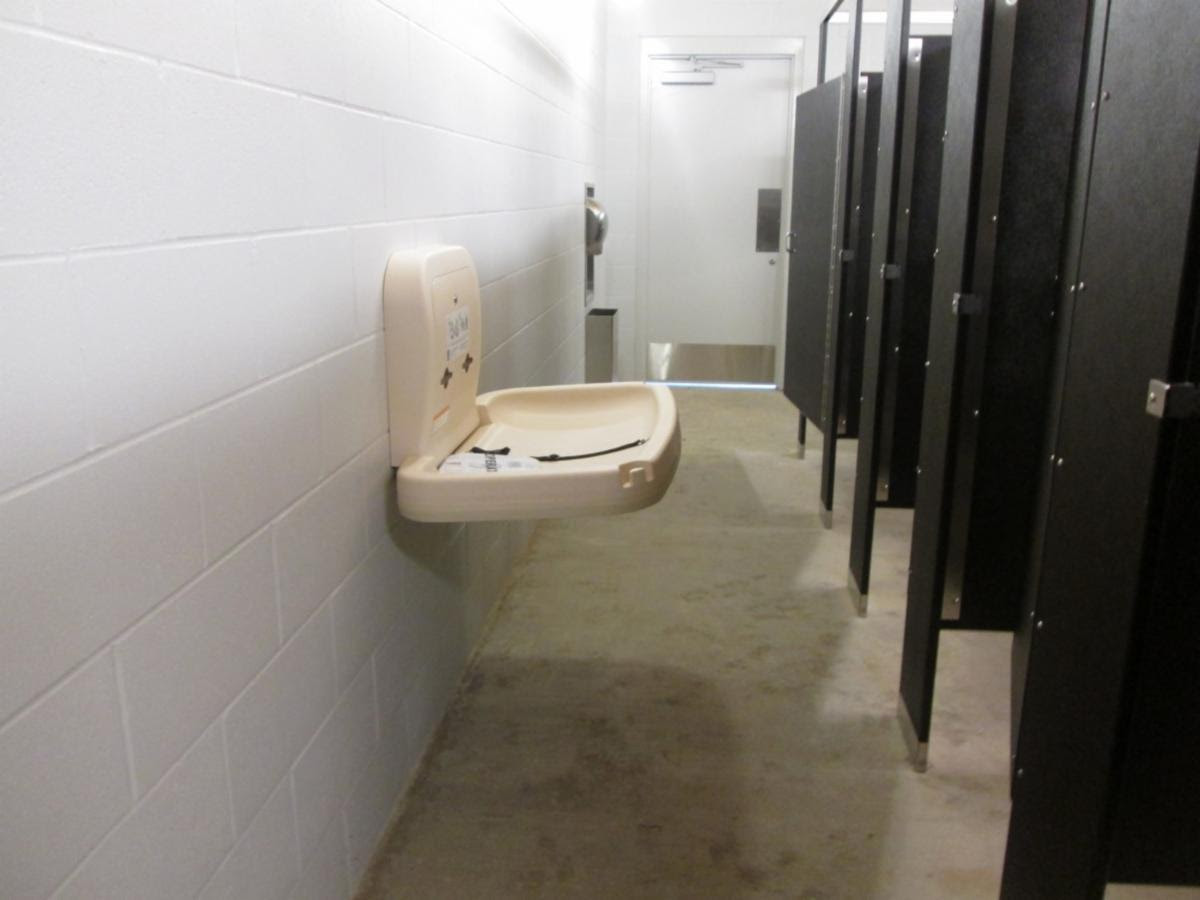
The photo above shows a diaper changing counter in the open position and located on the circulation path to the toilet compartments and exit door and is a protruding object.
Recently I have seen this Koala diaper counter installed. What is unique and interesting about it is that they are taking into consideration the “protruding object” concern and they have designed it so that the handle you use to open it, once it is in the down position, acts as cane detection.
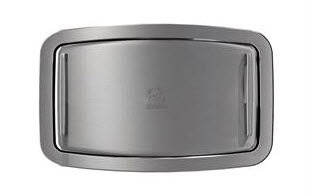
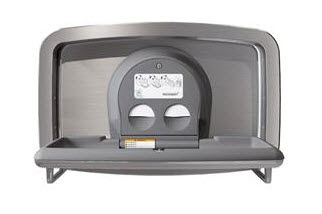
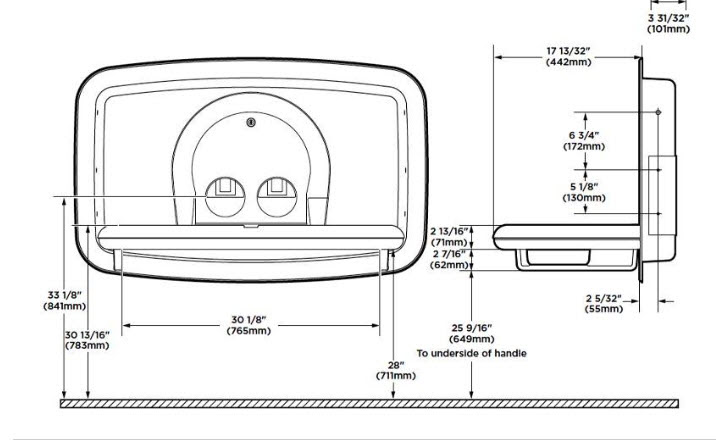
This diaper counter’s handles will reach below 27″ a.f.f. if installed correctly and it acts as cane detection.
Reflective Surface at Mirrors
Most of us understand the rule about mirrors over lavatories or sinks. They must be located so that the reflective surface is not higher than 40″ a.f.f. I was recently at an inspection where the mirror had a frame as part of the mirror where the outer edge was the reflective surface, then frosted glass and back to the reflective surface. Obviously, the intent was for a person in a wheelchair to be able to see themselves in the mirror, so although technically there is a reflective surface at 40″ a.f.f., the real “mirror” was above that.
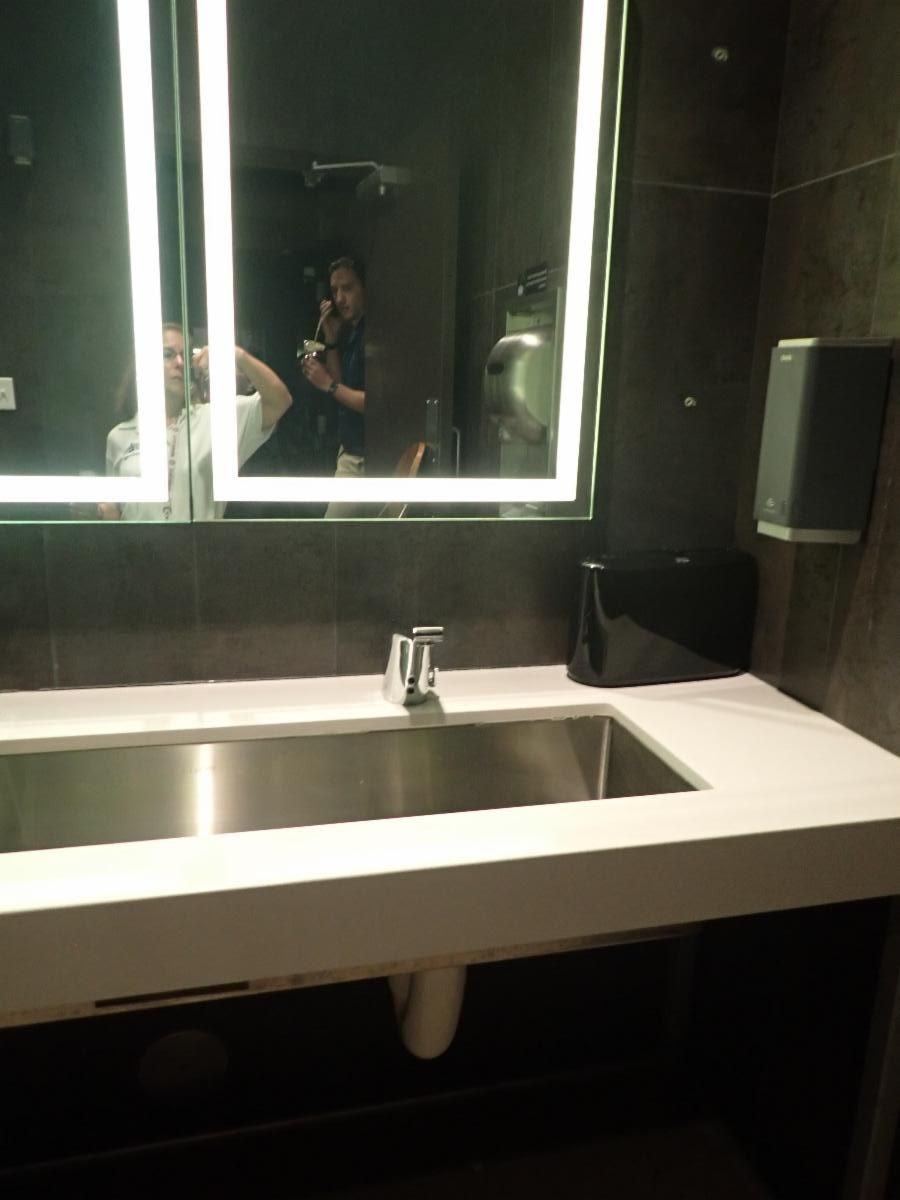
The mirror in the picture above has a frosted glass frame that has an outer edge made of the reflective surface of the mirror.
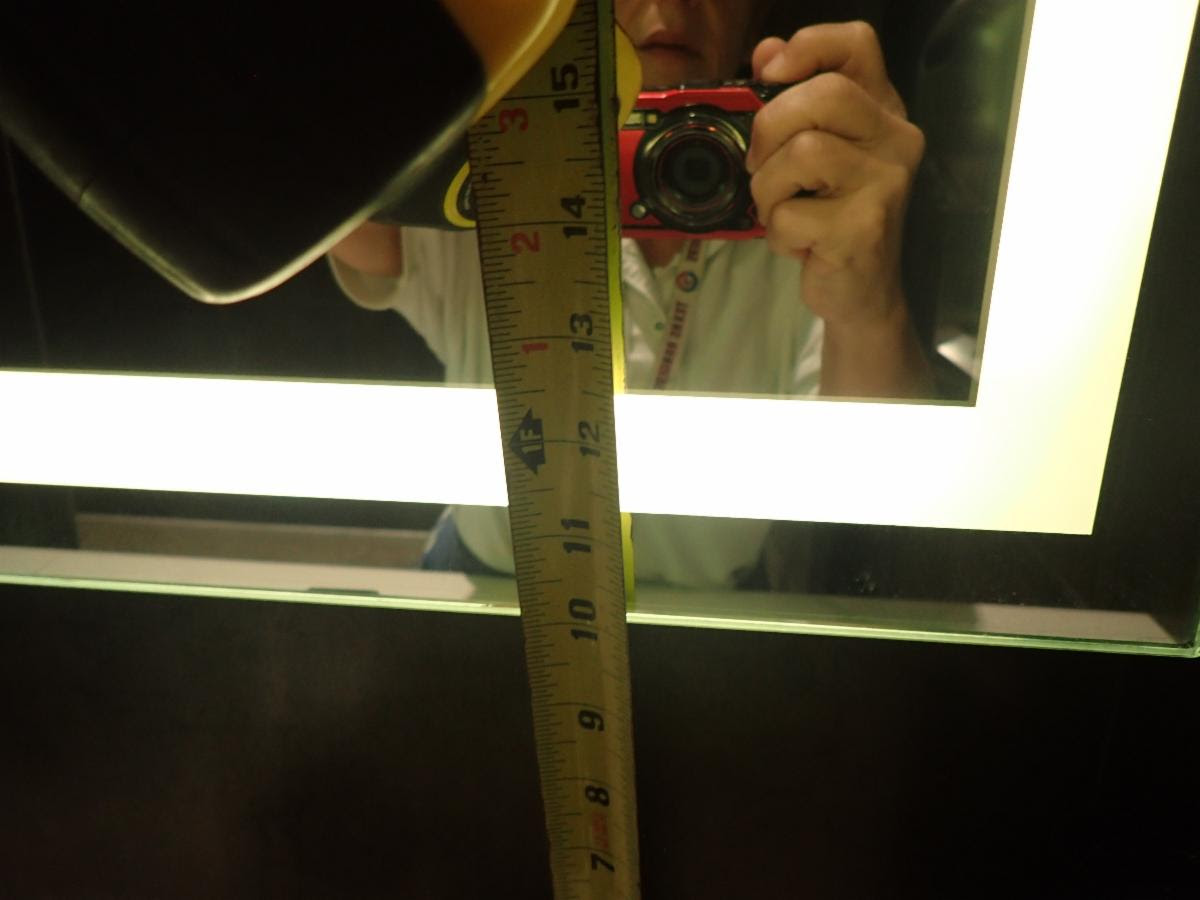
The “reflective” surface of the mirror (as the Standards intended) will be the one above the frosted glass, even though there is a reflective surface below the frosted glass.
Call for Entries: Click here for more information
Need Barrier-Free CEUs? On Demand Online courses:
We offer live online courses as well. If you are interested, please contact our office.
Visit our Resource Page that we are building to give you guidance on products and services
If you would like a private class for your office, contact us and we can schedule one in person or virtual.
If you want to learn more about these standards, be sure to check out my books:”The ADA Companion Guide” “Applying the ADA” published by Wiley.
Subscribe to our YouTube Channel
Follow us on LinkedIn
Join our group on LinkedIn
Like our Page on Facebook
Wednesday, June 1st, 2022
Introduction:
Accessible signage can be a very confusing topic. Even after all these years of practicing my accessibility consulting, I am still learning a thing or two. Sadly they can even be confusing to signage manufacturers and installers.
Accessible signs require the following things:
- Raised and Brailled Characters
- Contrasting background
- San Serif Fonts
- If using Pictogram, there are requirements
- If depicting accessible spaces the use of the ISA (International Symbol of Access)
This newsletter will focus on a few common errors I encounter during my inspections.
Raised Characters
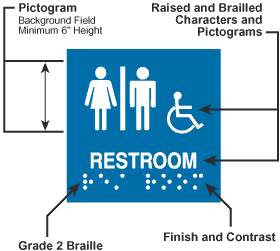
The accessible signage will require that the characters describing the space whether it be a number or letters, must be raised. They should be at least 1/32″ above the surface of the sign.
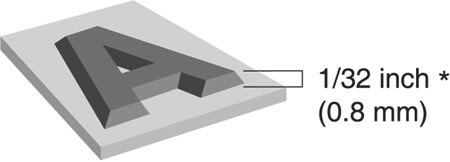
This graphic shows the minimum requirement for the raised characters of a sign.
There should also be Braille below the words that states the same words that are provided. So all words and numbers should be duplicated by Braille
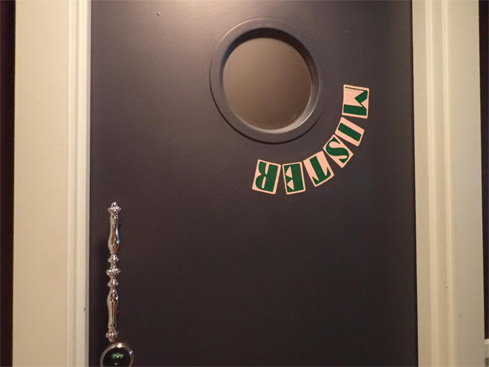
The restroom had a painted sign on the door but the characters were not raised and it did not have brailled as a duplicate. This is not compliant
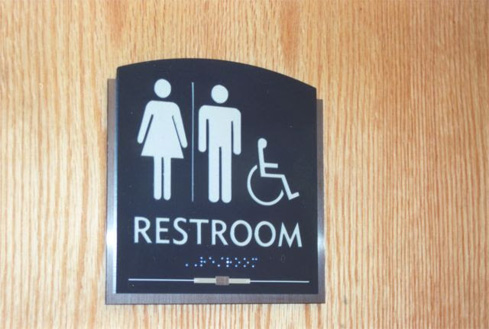
The restroom sign has both raised letters and characters and braille duplicated below the words. This is a compliant sign..
Pictograms
What are pictograms? It is a figure that represents the words of the sign. Pictograms are not required, but if you use them the field they are in should be 6″ minimum. The pictogram can be smaller than that, but the field must be at least 6″ tall.
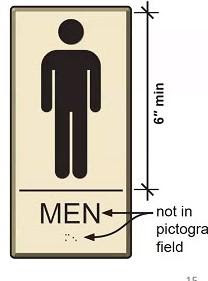
Pictograms must be located ABOVE the words they are describing. Per section 703
703.6.3 Text Descriptors. Pictograms shall have text descriptors located directly below the pictogram field. Text descriptors shall comply with 703.2, 703.3 and 703.4.
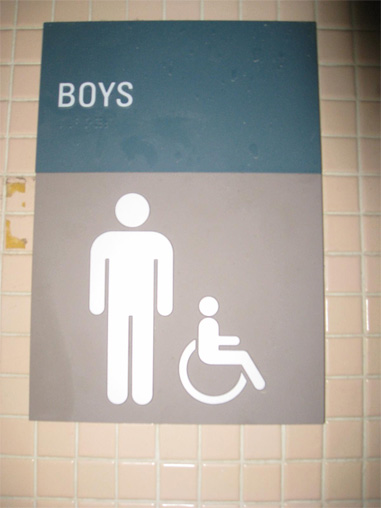
The pictogram at this sign is located below the words describing it. That is not compliant
Monday, May 2nd, 2022
Introduction:
Changes to the Texas Accessiblity Standards have been proposed and are open for public comments. The new standard, once adopted would be called The 2022 Texas Accessibility Standards.
This newsletter will give you a few proposed changes. These have not been adopted yet, and if you have any comments for TDLR before they implement them, the comments will be accepted until May 9th, 2022 using this link
2022 Texas Accessibility Standards Changes
Here are a few of the changes that are being proposed:
1. Outdoor Developed Areas. There will be a brand new chapter for Outdoor developed areas, Section 245 and Chapter 11. These will include trails, beaches, camping and picnic areas (just to name a few).
2. Advisory. Many of the advisories have become part of the Standards
3. Definition of Alteration. The definition of “alteration” has change slightly to include clarification on “circulation paths”. It now includes flooring as part of the definition:
106.5.5 Alteration. A change to a building or facility that affects or could may affect the usability of the building or facility or portion thereof. Alterations include, but are not limited to, remodeling, renovation, rehabilitation, reconstruction, historic restoration, resurfacing of circulation paths or vehicular ways including carpets, floors, or fields, changes or rearrangement of the structural parts or elements, and changes or rearrangement in the plan configuration of walls and full-height partitions.
Normal maintenance, reroofing, painting or wallpapering, or changes to mechanical and electrical systems are not alterations unless they affect the usability of the building or facility
The exemption for employee work areas clarified what “approach, enter and exit” means
203.9 Employee Work Areas. …..
“Approach, enter, and exit” means that people using wheelchairs must be able to enter and back out of the space. Employee work area doors, doorways, and gates, therefore, must comply with TAS 404 except the maneuvering clearance is limited to the “enter” side unless required for egress by TAS 207.1.
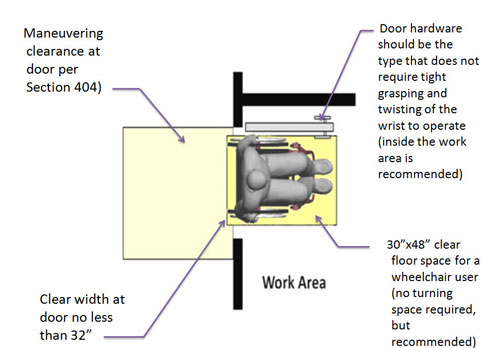
The picture above shows the diagram which explains the requirements for a work area entrance.
4. Licensed Physical and Occupational Therapy spacesused to have to go through a variance process in order to allow them not to be accessible. The proposed changes makes them not required and will no longer need a variance.
203.15 Licensed Physical and Occupational Therapy Training Areas Including Bathrooms and Kitchens. Licensed provider areas that are purposefully inaccessible for the intent of training persons with disabilities to function in a simulated home environment for when they leave therapy and return home shall not be required to comply with accessible features. The user must be able to get to the area but may not necessarily be required to provide an accessible route within the space for training purposes.
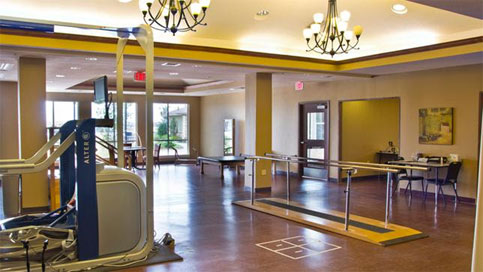
Physical Therapy areas will no longer require a variance not to comply
5. Electrical Vehicle Charging Stations. TDLR has issued many Technical Memos throughout the years. The 2022 TAS will incorporate some as part of the standards. One of them is about Electrical Vehicle parking and charging spaces. The requirements will now be part of the 2022 TAS in section 244, 208 and 502.
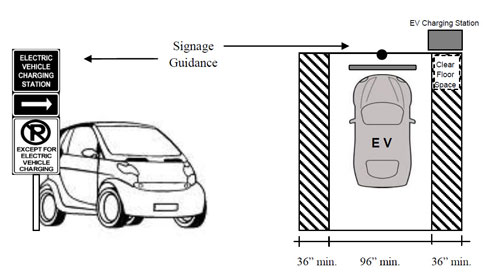
This is the requirements from the Technical Memo for Electrical Vehicle Charging Stations. They will now be part of the new standards
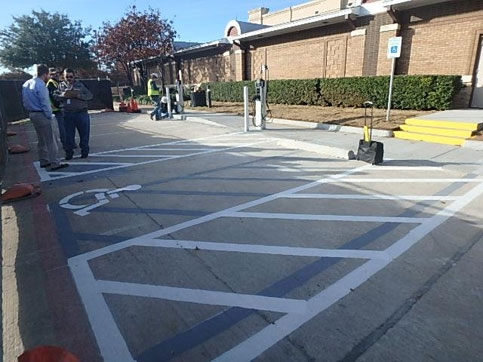 .
.
A built example
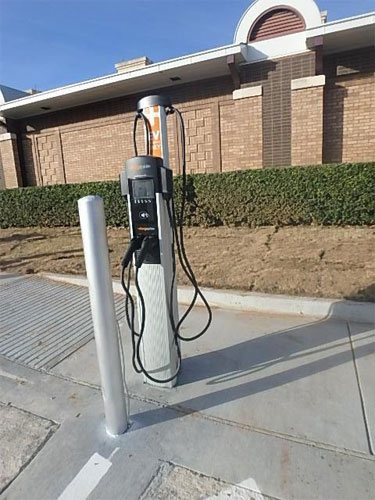
A charging station. The 2022 TAS will require a clear floor space to reach the accessible one.
6. 208.1 Parking Facilties. TDLR has clarified that parking facilities that are served by valet parking are not exempted from compliance with 208 and must have accessible parking.
7. Curb ramps at public right of way. THEY’RE BACK!!! Detectable warnings (truncated domes with contrasting color) are being proposed to come back on the Standards. Don’t kill me!
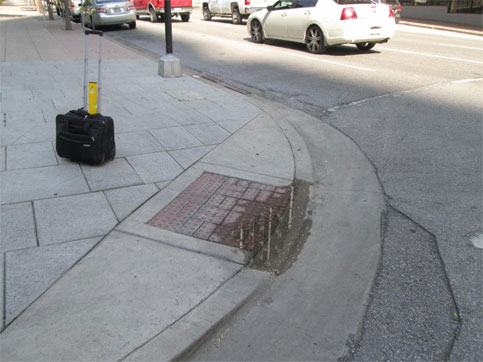
curb ramps located within the public right of way are proposed to have detectable warnings.
Be sure you get involved in the public comments. We need your voices and opinions to be heard to ensure that the Standards are clear and are providing proper guidance for design professionals so we can design and build environments for persons with disabilities that are inclusive and safe.
Friday, April 1st, 2022
Introduction:
If you have been around for a minute in the building industry you have seen our esteemed “truncated domes” come and go, and come and go…well it happened again….When the ADAAG was published in 1991, there was a section called “Detectable Warnings”. These were elements used for people that were visually impaired to assist them in navigating their exterior environment. A detectable warning had texture and contrasting color so a person who used a cane could feel the texture as he walked and maybe if they had low vision they could detect a change in color. Both of these methods allowed them to be aware that there might be a hazard on its way.
The detectable warning texture was required to be “truncated domes” located at a curb ramp and later it was added to pedges at a train track platforms.
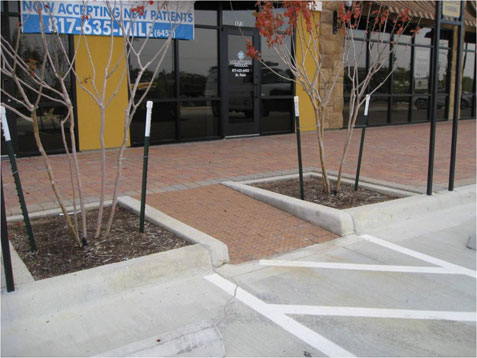
This is a curb ramp inside the property line with detectable warnings.
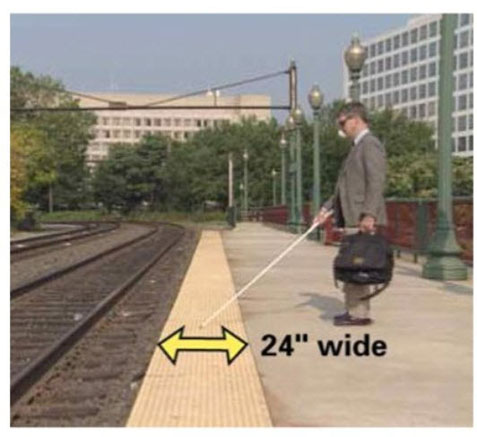
This is a train platform edge with detectable warnings.
The ADA Standards for Accessible Design and the Texas Accessibility Standards
After the 2010 ADA Standards for Accessible Design was passed into law, the rules about detectable warnings changed. Before, detectable warnings were required at curb ramps. The new version now only requires it at train platform edges. Curb ramps inside of the property line (which is all that ADA regulates) will no longer require texture or color on it.
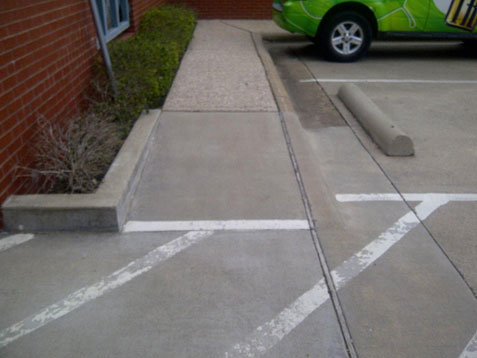
The picture above built in microwaves mounted above the 48″ allowable reach range. They added a counter top microwave that was not built in. This does not alleviate the lack of reach range.
Public Right of Way
The Public Right of Way guidelines (which are only proposed and have not been adopted), as well as municipalities and Department of Transportation may require that detectable warnings be provided at the bottom 24″ of the curb ramp. This will allow people that are visually impaired be aware that there might be a hazard beyond the texture.
The ADA does not have requirements beyond the property line. Therefore the public right of way does not fall under the ADA.
The Texas Department of Licensing and Regulation used to have a section in Chapter 68 which required detectable warnings at curb ramps within the public right of way, but they eliminated that in the most current version of the Rules. Click Here to see what they require.
TDLR no longer requires detectable warning at curb ramps at the public right of way.
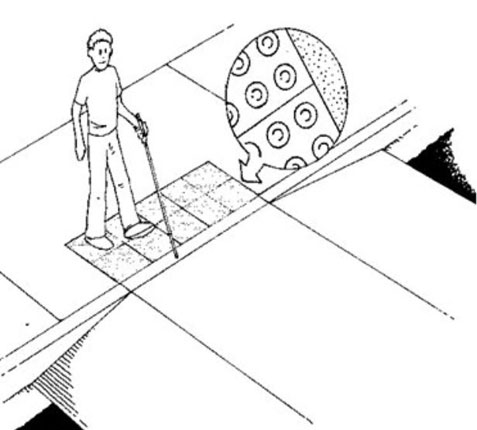
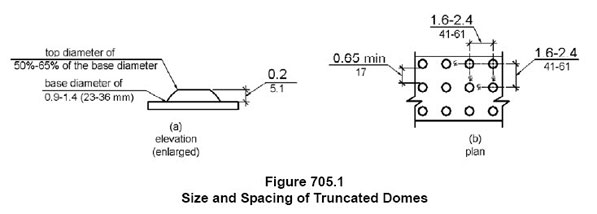
The figure above shows the requirement for detectable warnings listed in the Public Right of Way Guidelines
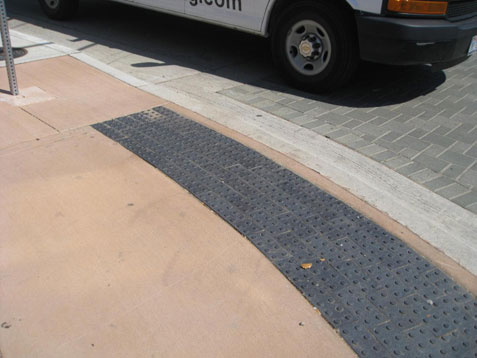
The curb ramp has detectable warnings per the Department of Transportation and the Public Right of Way Guidelines. Check your municipality to make sure what it requires
 Abadi
Abadi