Author Archive
Wednesday, November 1st, 2023
Signage clearance
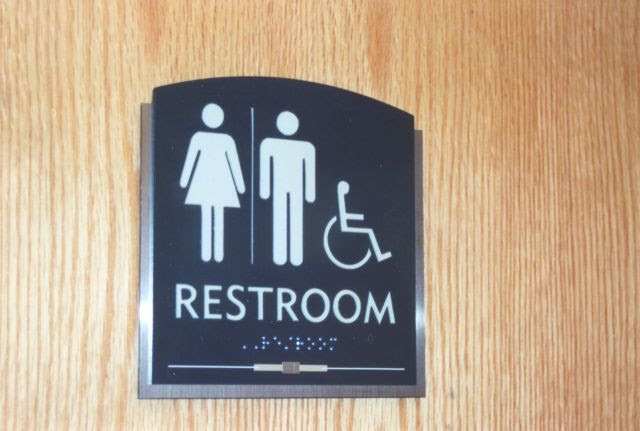
The ADA and TAS requires that an 18″x18″ centered clear floor space be provided at the permanent room signage
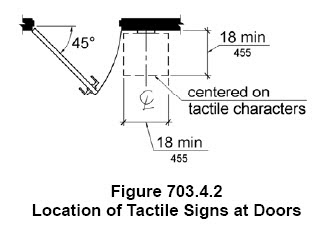
Sometimes elements get inadvertaly placed in front of the signage which violates this requirment.
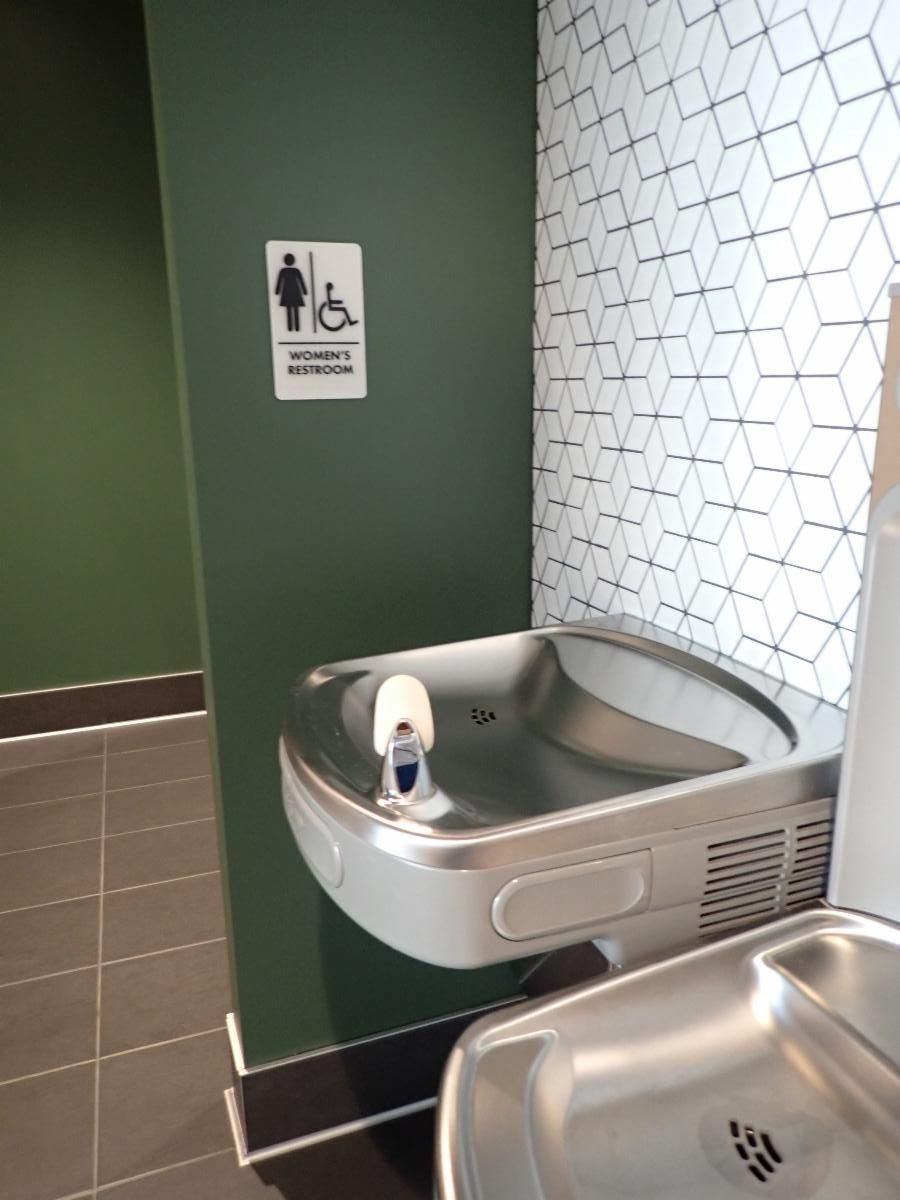
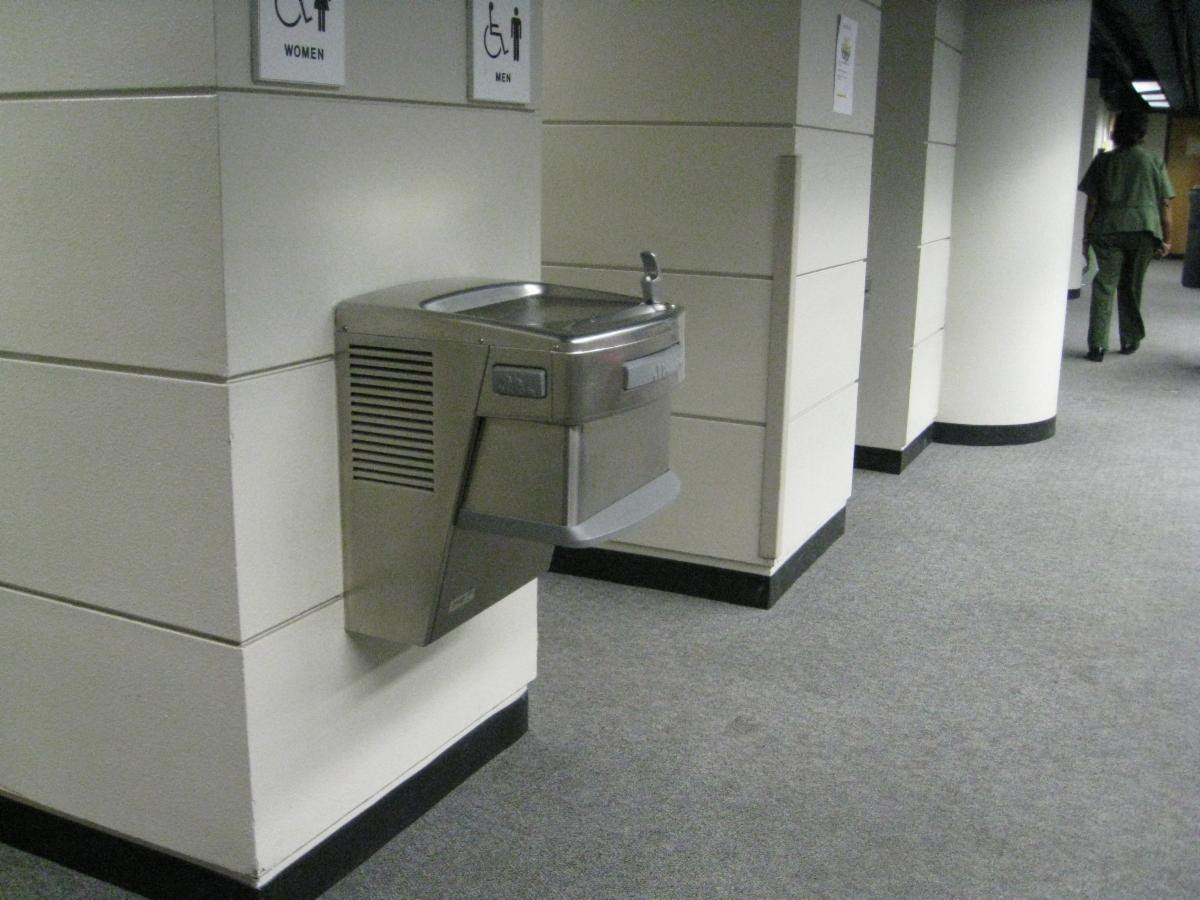
The above image is of a drinking fountain located in front of the restroom signage which does not allow for the 18″x18″ space at the floor centered below the sign.
Not all shower seats are created equal
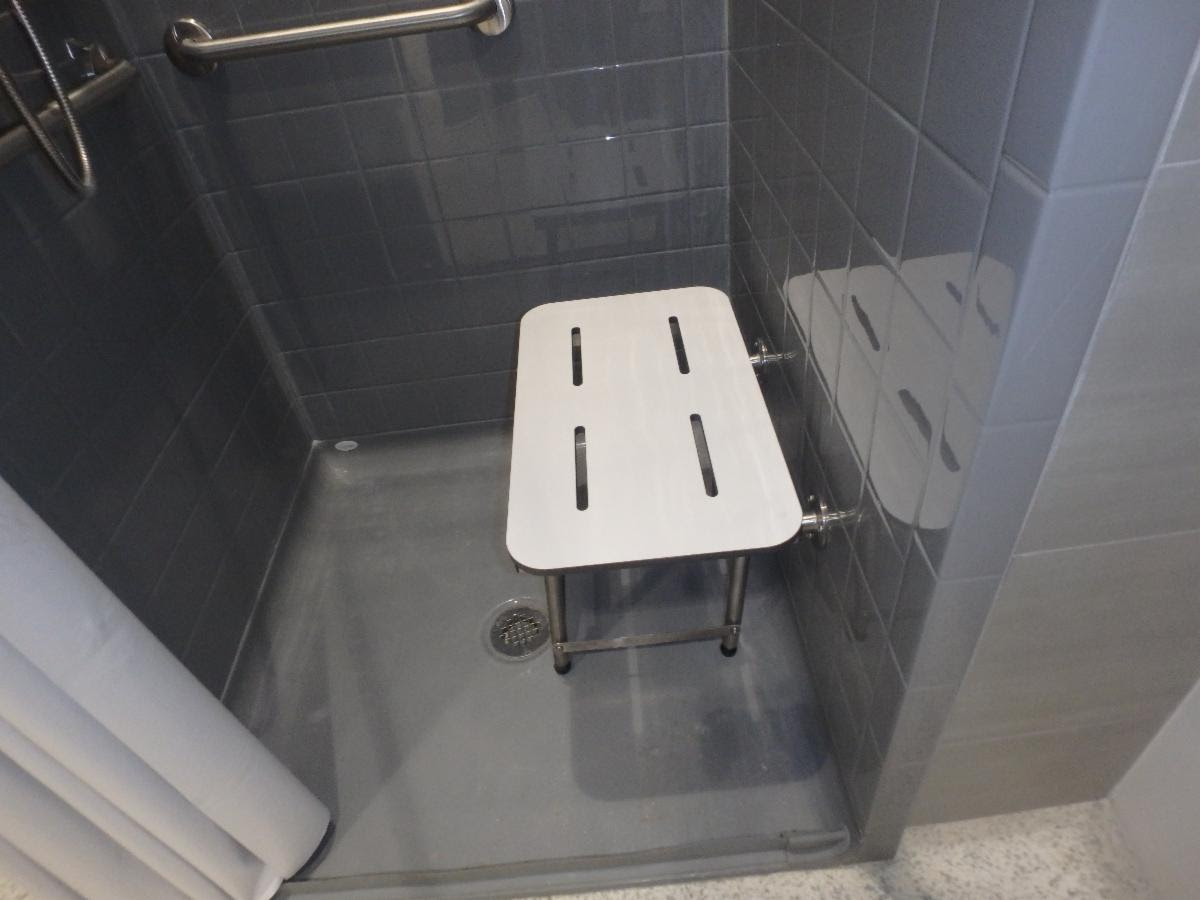
When showers require seats to be provided, it can’t just be any shower seat. There are requirements that we must follow:
- No more than 3″ from the entrance of the shower
- No more than 1 1/2″ from the side wall and
- 2 1/2″ from the rear wall
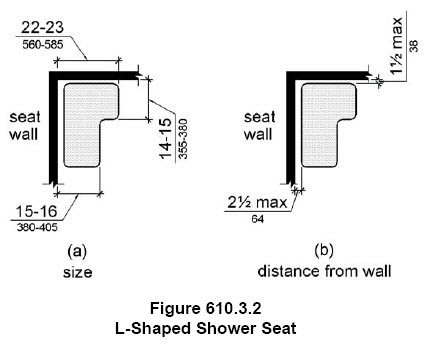
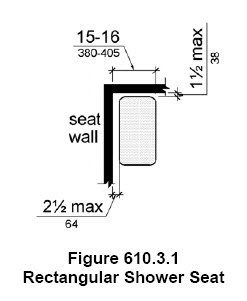
Many times, I have seen shower seats that are too short to meet the requirements. Most of the time they don’t take into consideration the depth of the shower and the seat is typically farther than 3″ fron the entry
“
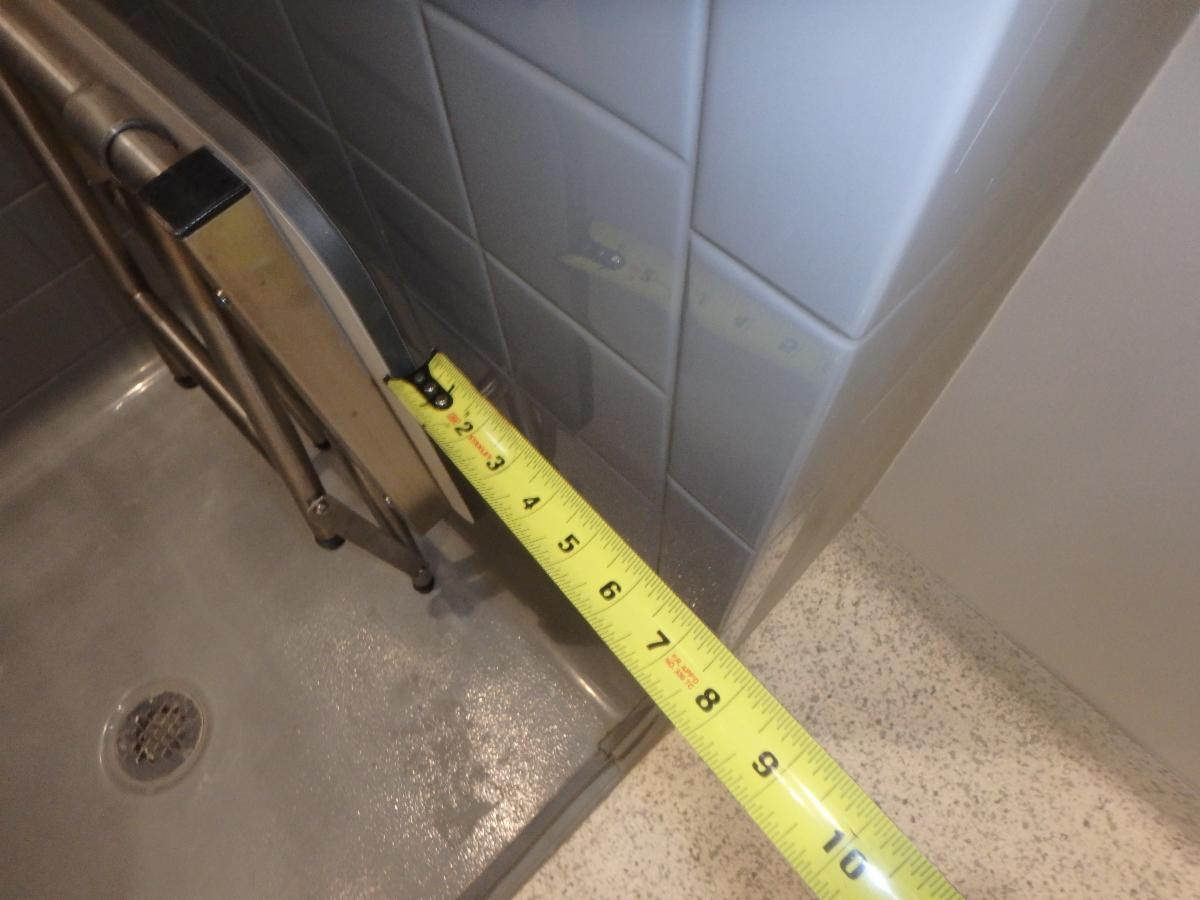
The shower seat in the photo above was located 7″ from the entrance
What are the cane detectable apron at drinking fountains for?
There is an accessory that is available to specify for drinking fountains called “cane detectable apron”. And they are not cheap….
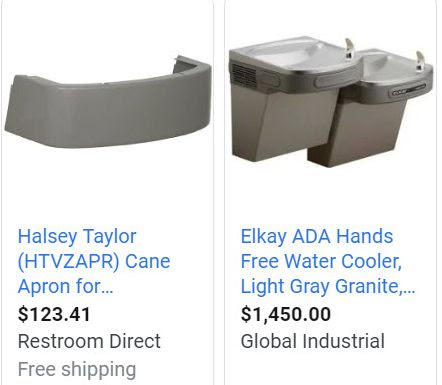
This accessory is for Halsey Taylor but other drinking fountains also carry it.
The apron is used when the high drinking fountain (for standing persons) is located along a circulation path and possibly a protruding object. The apron is installed under the high drinking fountain bringing the leading edge to 27″ a.f.f. making it detectable to canes used by people with visual impairments..
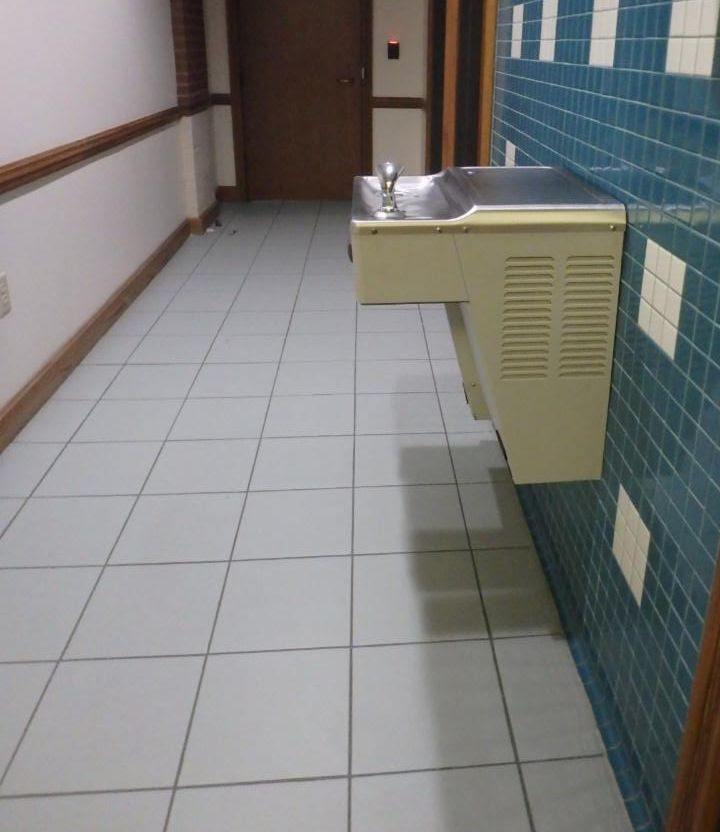
This drinking fountain is located where pedetrians would circulate and mounted where a person that is visually impaired would not be able to detect it.
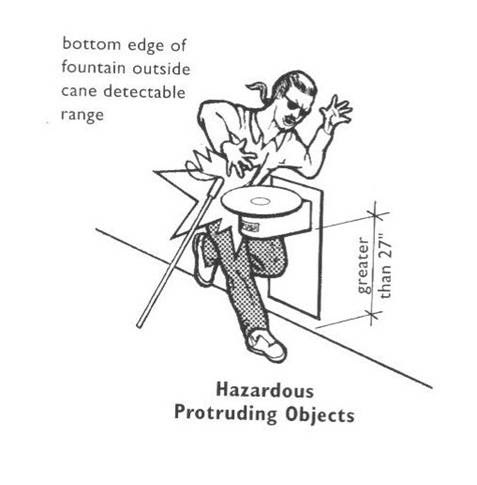
This depicts a drinking fountain that is not cane detectable.
This photo shows the cane detectable apron installed at the high drinking fountain making it cane detectable.
TheBut not everyone understands how to install it and how it works. At some of my inspections I have found the apron mounted to the low drinking fountain which is not needed and removes the knee clearance. I have also seen them installed where built cane detection was provided.
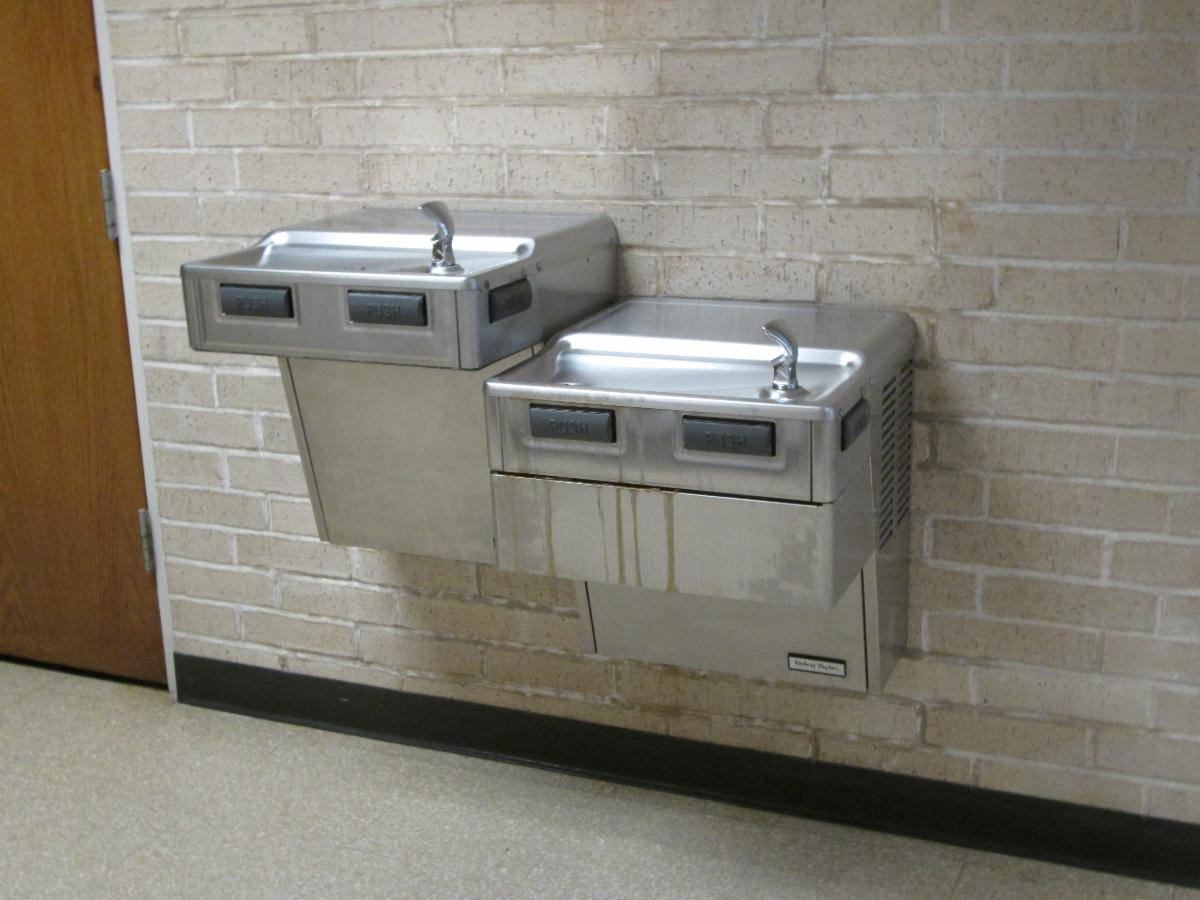
This photo shows the cane detectable apron installed at the low drinking fountain instead of the high one
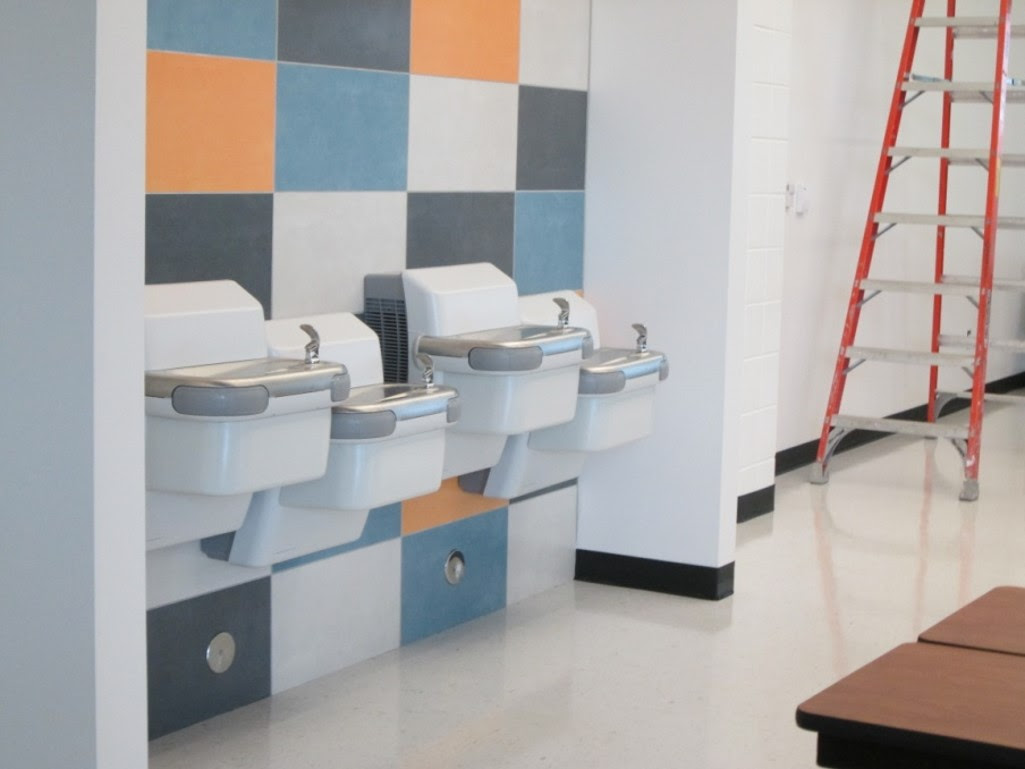
This photo shows the cane detectable apron installed at all drinking fountains (high and low), but because the drinking fountains were recessed in an alcove, they weren’t even required. The walls that make the alcove acts as cane detection. None of these drinking fountains were protruding objects.
Monday, October 2nd, 2023
Rear wall grab bar
In the ADA Standards, Texas Accessibility Standards A117.1 the rear wall grab bar is required to be a minimum 36″. It should be mounted in relation to the CENTERLINE OF THE TOILET as shown in the figure below:
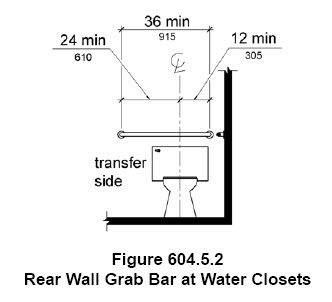
604.5.2 Rear Wall. The rear wall grab bar shall be 36 inches (915 mm) long minimum and extend from the centerline of the water closet 12 inches (305 mm) minimum on one side and 24 inches (610 mm) minimum on the other side.
There are some exceptions. One of them is for when the flush valve interferes with the location. This could be if there is a bed pan cleaner at hospital paitent rooms, or at children’s toilet when the flush valve is required to be higher.
EXCEPTIONS:
2. Where an administrative authority requires flush controls for flush valves to be located in a position that conflicts with the location of the rear grab bar, then the rear grab bar shall be permitted to be split or shifted to the open side of the toilet area.
The exception, though, can ONLY be taken IF there is an administrative authority that requires the flush control to be in a specific location. Therefore it is not IF we specifiy a toilet with a flush valve which interferes, or if the contractor locates them in the wrong place. There must be a reason that would make it technically infeasible to achieve the required mounting location.
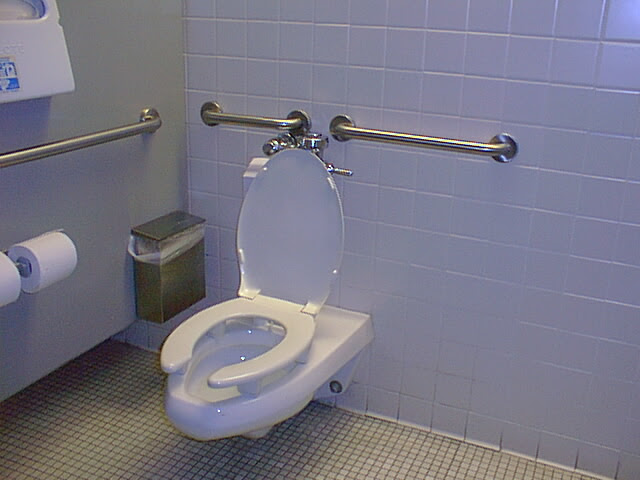
This is rear wall grab bar was allowed to be split
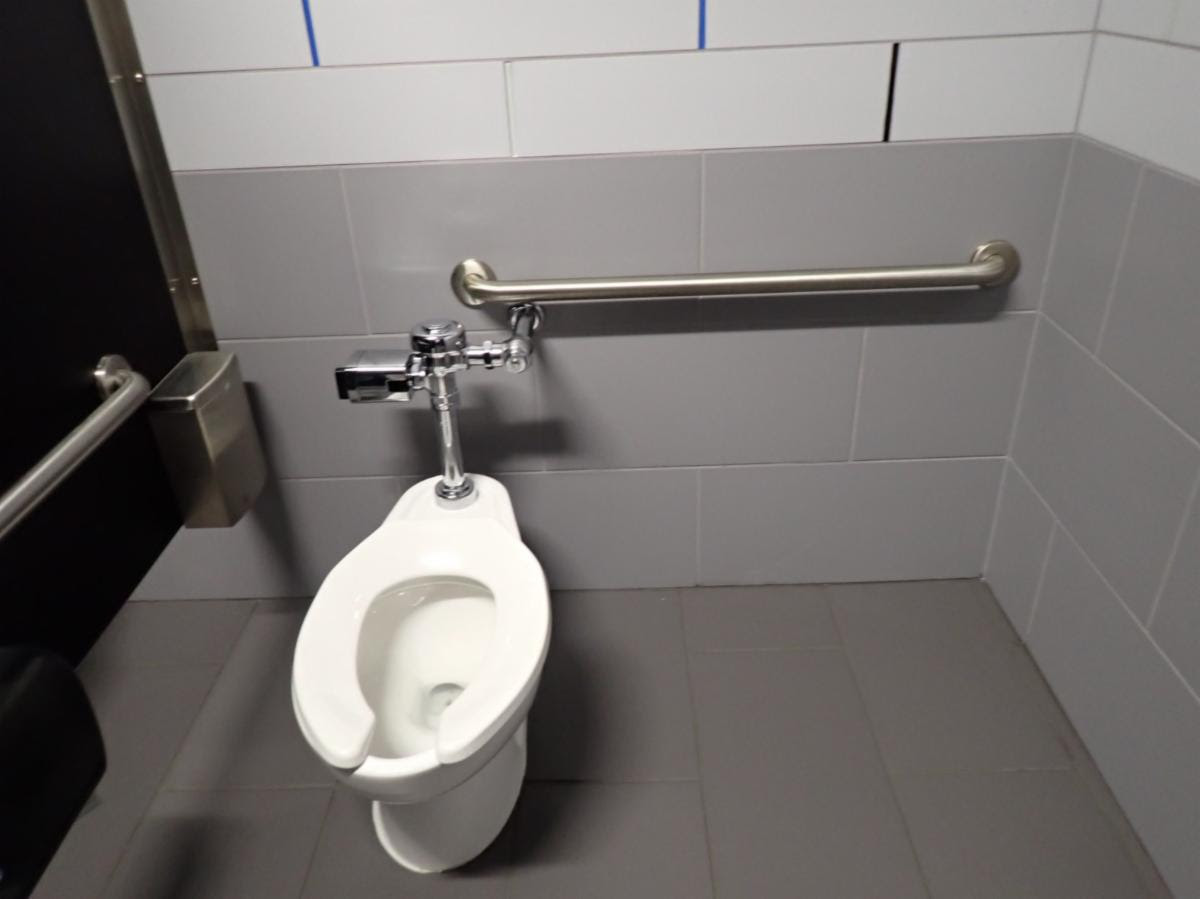
This is rear wall grab bar was allowed to be shifted
ADA classes
October 19th Gannet Flemming is hosting a course called: Designing for All: A Conversation Around the Principles of Inclusive Architecture and Accessibility.
Here is the link to register
Friday, September 1st, 2023
Recessed Fixtures adjacent to water closets
In the ADA Standards, Texas Accessibility Standards and ICC ANSI A117.1 the rear wall grab bar is required to be a minimum 36″. There is an exception to be able to use a shorter when the water closet is located on the same wall as a recessed plumbing fixture.
604.5.2 Rear Wall. The rear wall grab bar shall be 36 inches (915 mm) long minimum and extend from the centerline of the water closet 12 inches (305 mm) minimum on one side and 24 inches (610 mm) minimum on the other side.
EXCEPTIONS:
1. The rear grab bar shall be permitted to be 24 inches (610 mm) long minimum, centered on the water closet, where wall space does not permit a length of 36 inches (915 mm) minimum due to the location of a recessed fixture adjacent to the water closet.
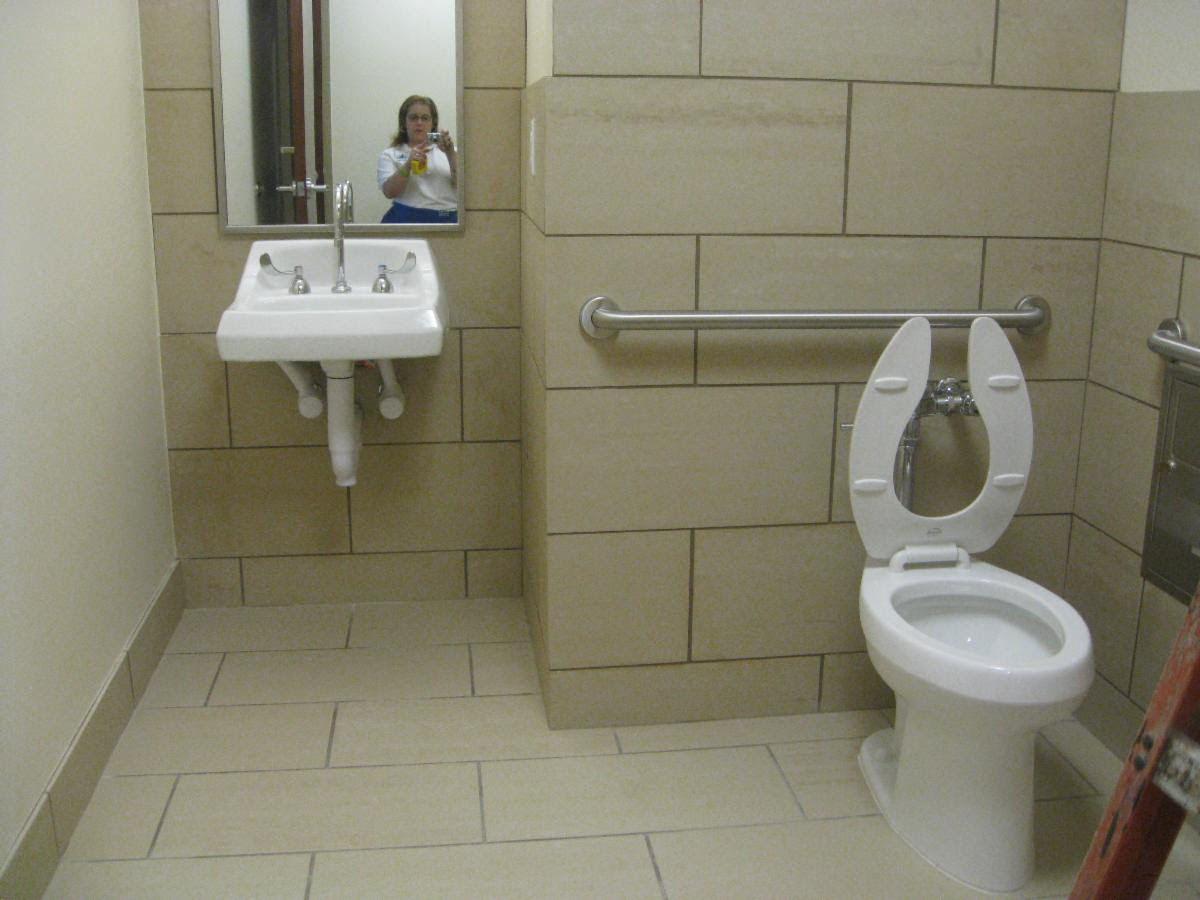
This is recessed lavatory adjacent to the the water closet
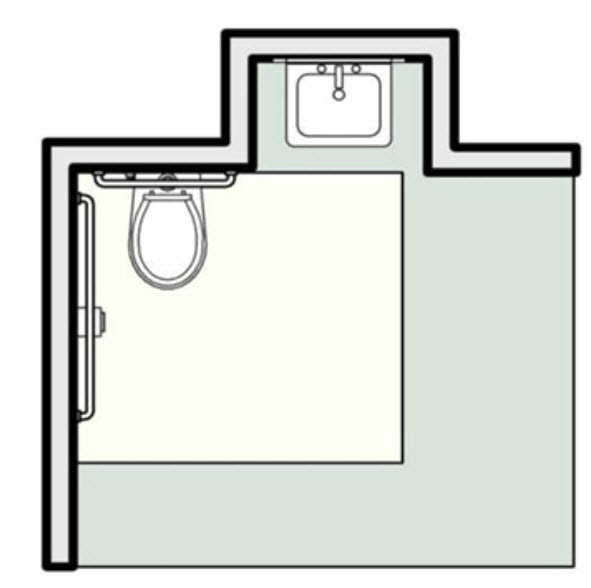
This is a plan view of the recessed lavatory adjacent to the water closet which creates the wall condition too short to install a 36″ grab bar. This condition is allowed to have a 24″ rear wall grab bar installed centered on the toilet.
But is a lavatory the only fixture allowed to be recessed adjacent to the toilet? No. Actually any fixture that is recessed will allow the rear wall grab bar to be shorter. A shower that is recessed and adjacent to the toilet will also allow the exception to be taken
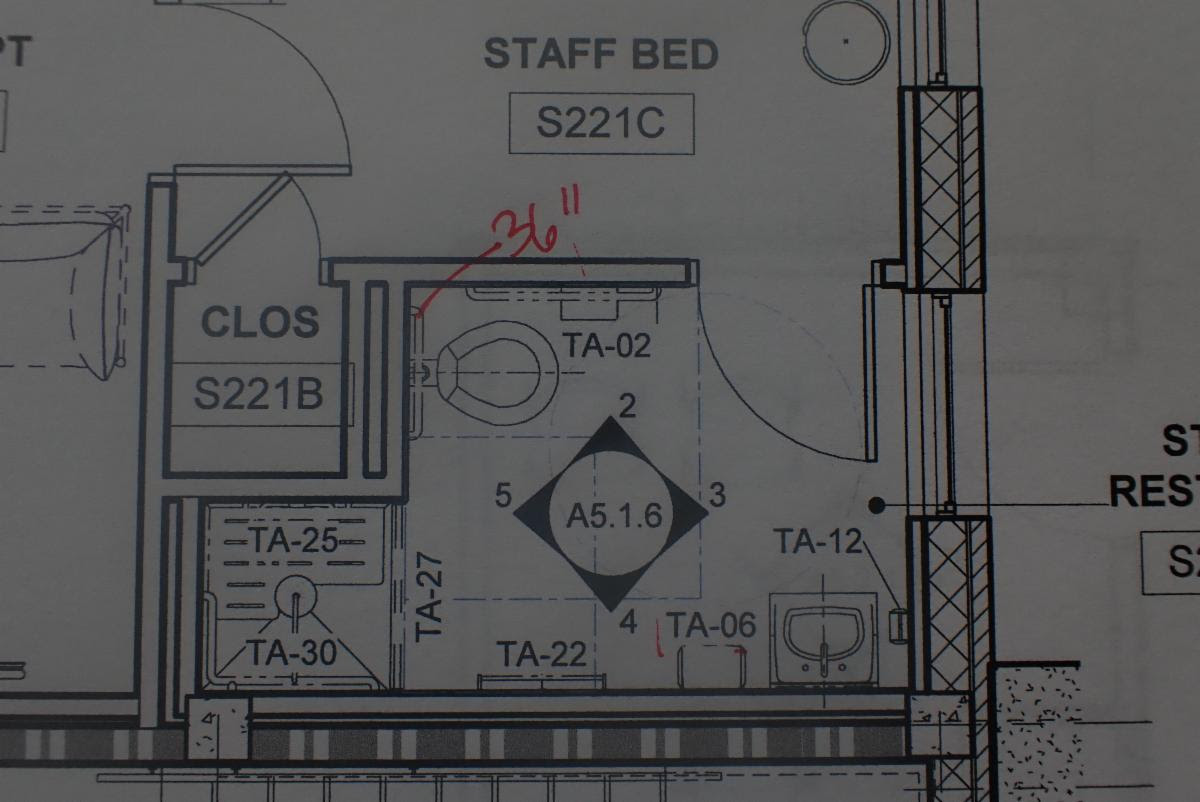
This is a plan view of the recessed shower adjacent to the water closet which creates the wall condition too short to install a 36″ grab bar. This condition is also allowed to have a 24″ rear wall grab bar installed centered on the toilet.
Recessed Doors
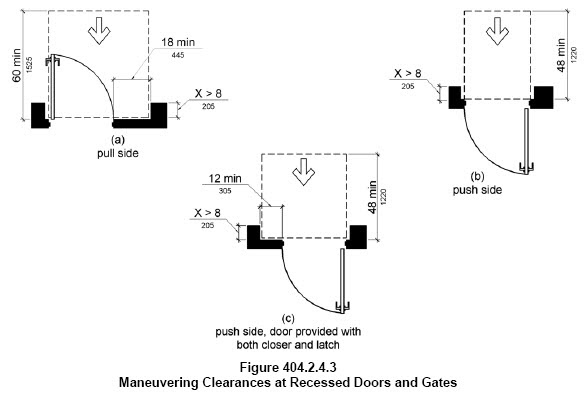
A door that is located within a wall that is no thicker than 8″ measured from its face to the front of the wall will be considered a “recessed” door. Also if there is an object located next to the door latch and it is not 8″ perpendicular from the face of the door to the front of the object, it will also be considered a “recessed” door.
404.2.4.3 Recessed Doors and Gates. Maneuvering clearances for forward approach shall be provided when any obstruction within 18 inches (455 mm) of the latch side of a doorway projects more than 8 inches (205 mm) beyond the face of the door, measured perpendicular to the face of the door or gate.
“
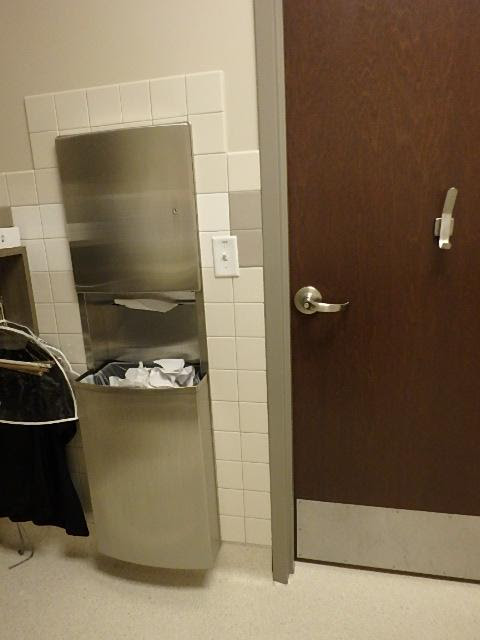
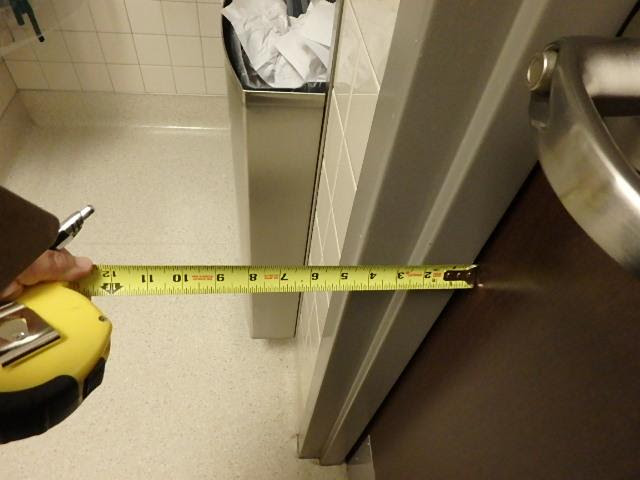
The door shown above has a trash receptacle within the maneuvering clearance. Since the trash receptable is less than 8″ it is allowed to be included in the manuevering clearance to reach the door handle
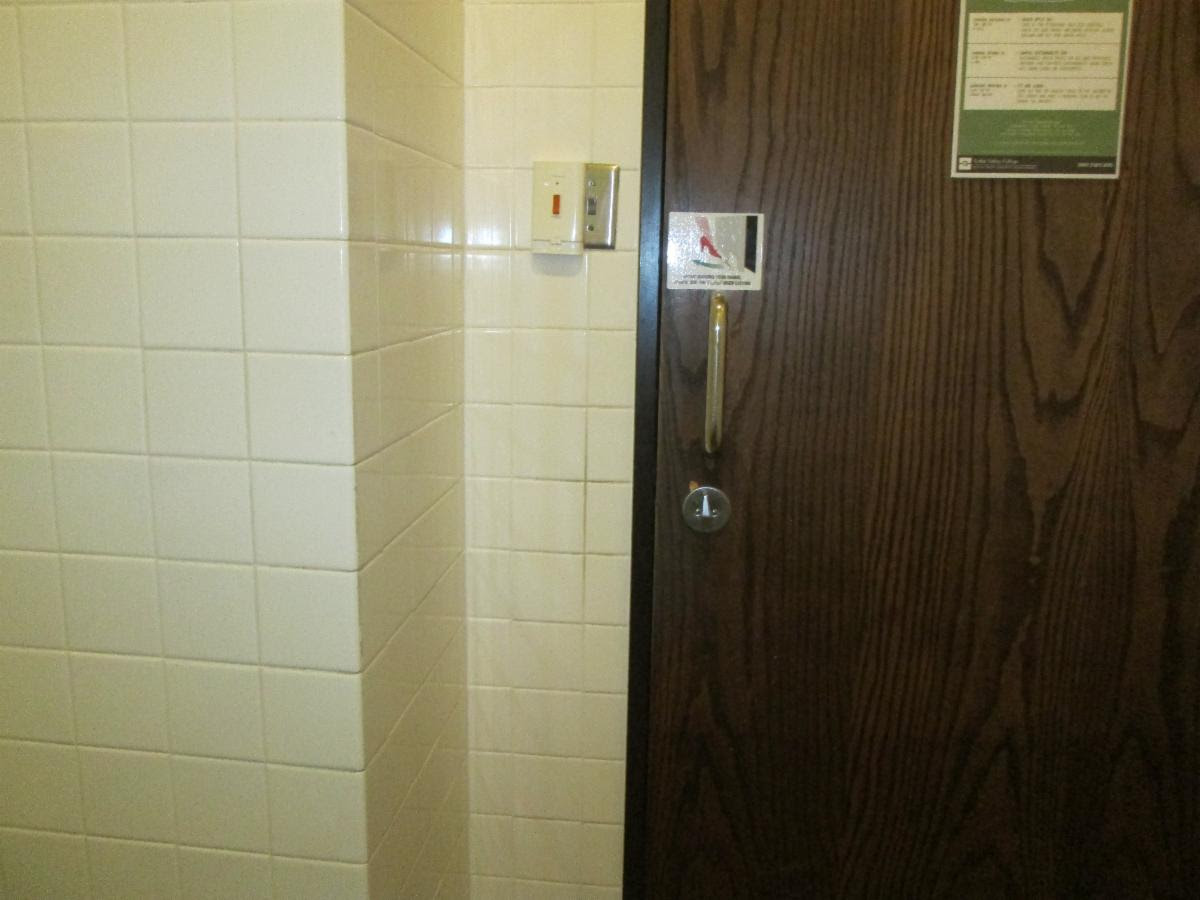
The door shown above is located in a small alcove that is 8″ deep. The maneuvering clearance will be acceptable for a “recessed” door.
Recessed elements in Alcoves
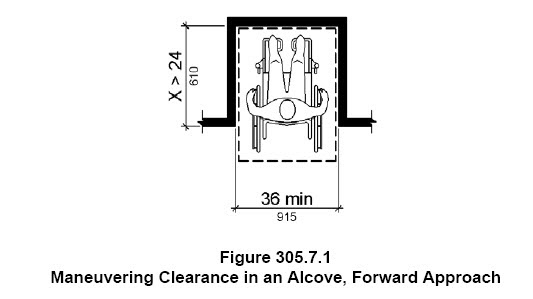
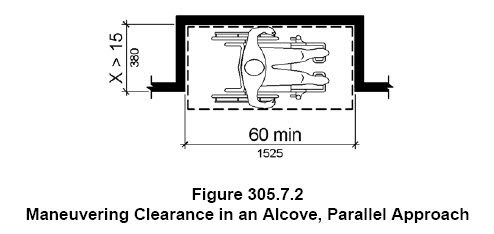
A clear floor space for wheelchairs is required to be a minimum of 30″ x 48″. But if an element is located in an alcove that is more than 24″ deep, then the clear floor space will need to increase to 36″ wide for a forward approach or 60″ long for a side approach.
 .
.
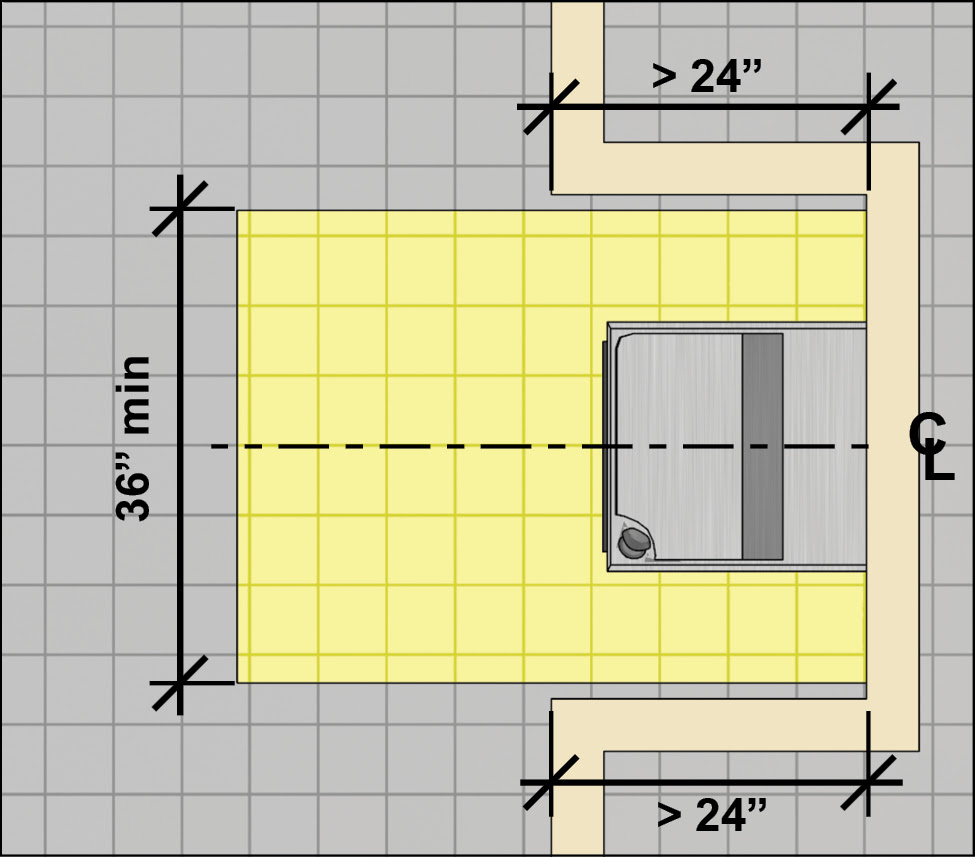
The drinking fountain shown above is an alcove and therefore the clear floor space must be 36″ min. wide
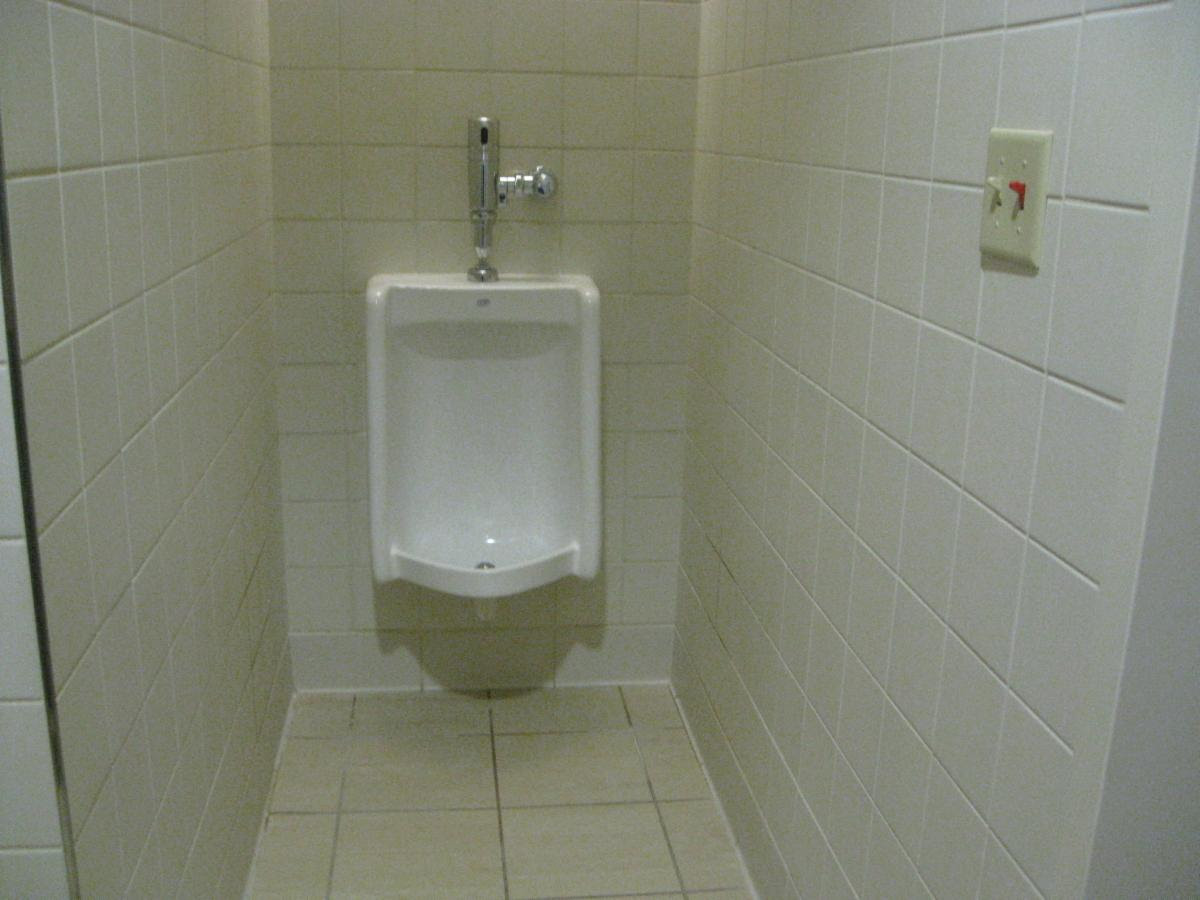
The urinal shown above is an alcove and therefore the clear floor space must be 36″ min. wide. The width was less than 36″
Wednesday, August 2nd, 2023
Cane detectable apron
Lately I have been observing during my ADA/TAS inspections that most drinking fountains for standing people will have a cane detectable apron. A cane detectable apron is an item that is offered by the drinking fountain manufacturer in order to make their drinking fountains detectable for persons who are visually impaired. Since the person cannot see, they need to “feel” their way around. A person who uses a white cane to detect their environment will only be able to detect objects mounted at 27″ a.f.f. or below.
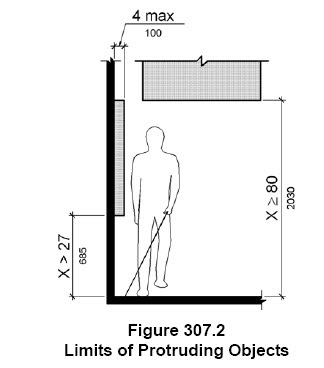
This ADA figure shows the extent of what is cane detectable
Keeping that in mind, if a drinking fountain is located in a circulation path where a person who is visually impaired would walk, it must either not project more than 4″ onto the path, or be mounted 27″ a.f.f. or lower so that they can “dectect” the object.
Since drinking fountain is required to have a knee and toe clearance for a forward approach so that a person in a wheelchair can use it, a minimum of 27″ a.f.f. below the drinking fountain will be required for the knee clearance, but it could be higher. Since it could be higher than 27″ a.f.f. it might be a possibility that it will not be cane detectable.
There is also a second requirement where an additional drinking fountain needs to be provided for standing persons. This requirement is for persons who have a disability where they cannot bend down and therefore the spout of the drinking fountain should be higher than that of a wheelchair. This drinking fountain does not require a knee and toe clearance, but most manufacturers have designed them to have one. When the drinking fountain is mounted so that a person who is standing can reach the spout, the bottom edge will be mounted higher than 27″ a.f.f.
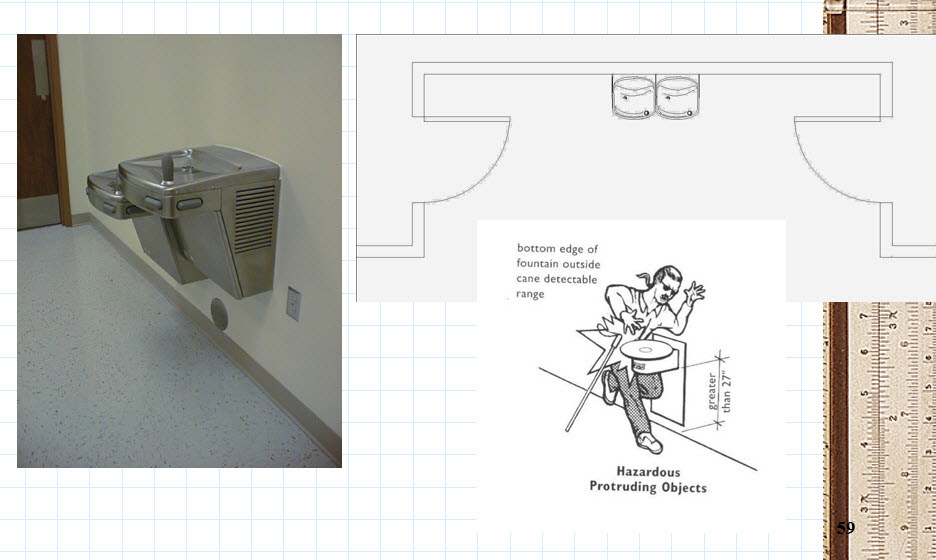
When is the apron needed?
When the drinking fountain is located along the circulation path and the bottom edge is higher than 27″ a.f.f. a cane detectable apron can be used to provide cane detection. The apron is typically mounted below the high drinking fountain (for standing pesons) because those are the ones that most of the time have their leading edge higher than 27″ a.f.f.
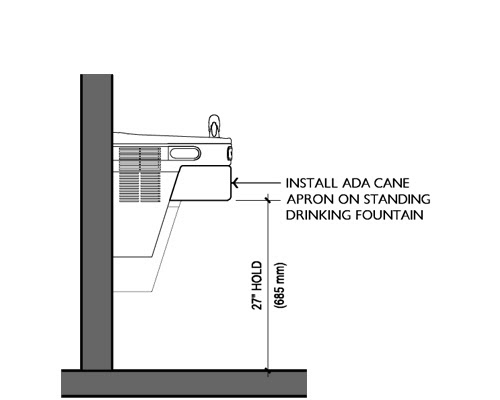
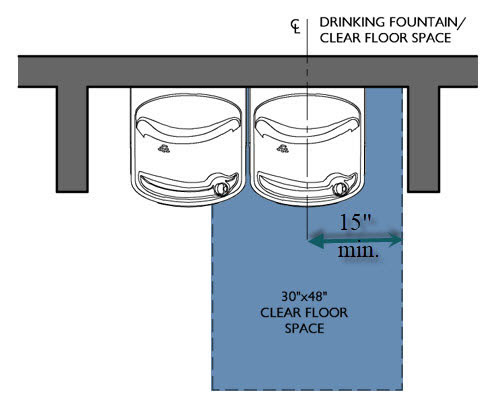
WBeware that there is a requirement that the clear floor space for the wheelchair accessible drinking fountain must be centered. This means that if the low drinking fountain is adjacent the high drinking fountain, half of the 30″ clear floor space will be located under the drinking fountain for standin persons.
If a cane detectable apron will be required at the high drinking fountain, it cannot be located lower than 27″ a.f.f. since it will also reduce the knee clearance for the low drinking fountain located adjacent to it.
“
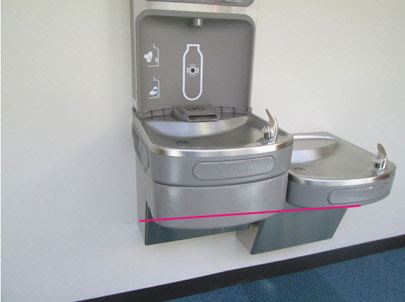
The cane detectable apron was lower than 27″ a.f.f. For standing persons this works since they don’t need a knee clearance, but for wheelchairs it does not work, because part of the knee space will be located below the apron
When is the apron NOT needed?
If the drinking fountains are already in an alcove, or a recess, then they will not need a cane detectable apron because the built in elements becomes the cane detection.
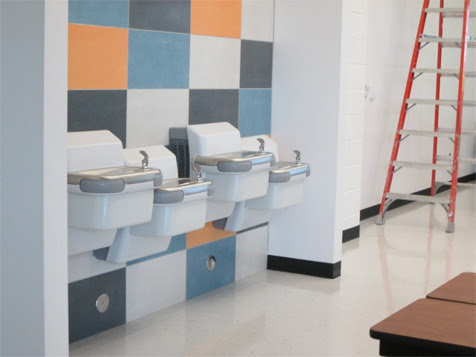
The cane detectable apron was not needed, sine they built walls to create an alcove where the drinking fountains would be mounted. These were not in a circulation path. In addition, they added the aprons to the low drinking fountain and reduced the knee space to less than 27″ a.f.f.
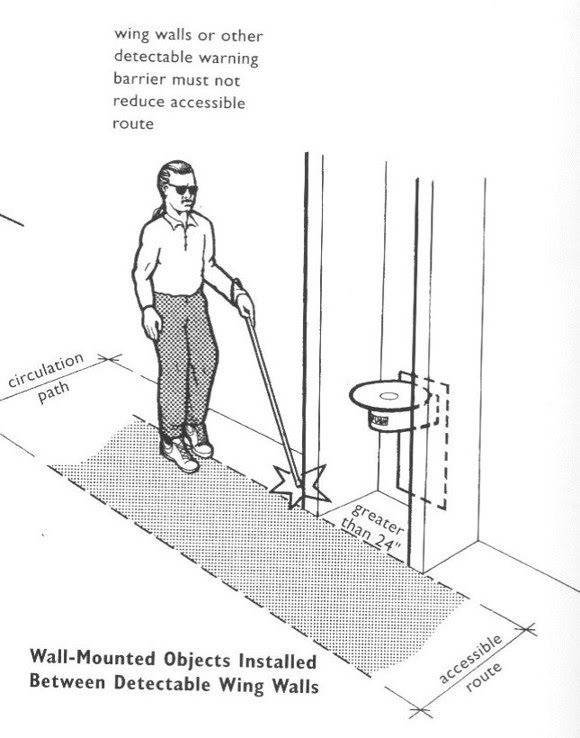
When there are misunderstanding
If I have seen many projects where cane detectable aprons are added when they are not needed.
- They are added at the drinking fountains for wheelchair users which then reduce the knee clearance
- They may be added when the drinking fountain is recessed
- They may be added lower than 27″ a.f.f. which reduces the knee clearance at the drinking fountain for wheelchair users adjacent.
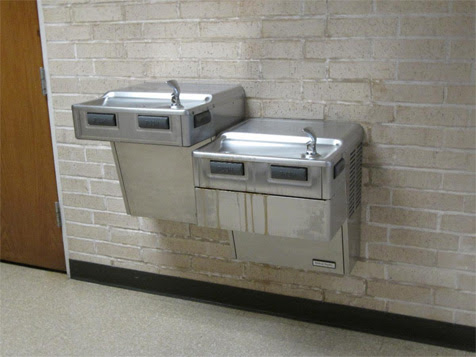
The cane detectable apron was mounted at the wheelchair accessible drinking fountain which reduced the knee clearance
Tuesday, August 1st, 2023
Introduction
There are times during inspections that I find some interesting cases of either violations to the ADA/TAS or some innovation in design that I sometimes share with my clients for them to learn for future projects.
Below are some examples:
But it is only finishes……
If you read my last newsletter (June: Alterations vs. Maintenance) I explained about alterations as defined by the ADA Standards as well as TAS. One of the still misunderstood projects that is considered alterations are flooring changes. The definition of alteration includes “re-surfacing of circulation paths”. A circulation path would include any flooring or ground surface where people walk or use their mobility devices on.
Alteration: A change to a building or facility that affects or could affect the usability of the building or facility or portion thereof. Alterations include, but are not limited to, remodeling, renovation, rehabilitation, reconstruction, historic restoration, resurfacing of circulation paths or vehicular ways,
changes or rearrangement of the structural parts or elements, and changes or rearrangement in the plan configuration of walls and full-height partitions.
Flooring changes, even if it is replacing a floor finish with the SAME floor finish (carpet with carpet) will be considered an alteration and the ADA standards and the TAS will have to be applied. So what sections would apply?
Section 302 which requires firm, stable and slip resistant flooring. No openings greater than 1/2″.
Section 303 no changes in level greater than 1/4″ without a bevel, 1/2″ with a bevel or ramp when greater than 1/2″
And if the flooring occurs in areas that are considered a primary function, it will also trigger compliance with section 202.4

Installing new flooring will be considered an alteration.
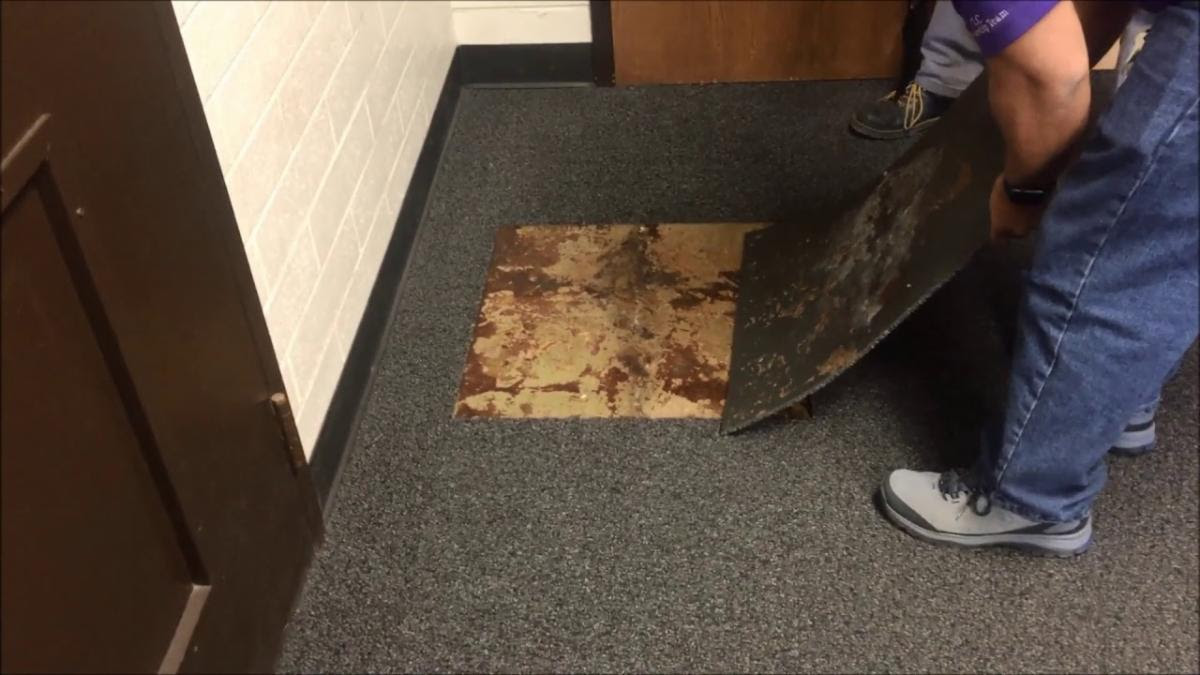
Replacing one or two damaged carpet tile would be considered maintenance. Replacing an entire carpet would be an alteration.
Handrail extensions
When you have a ramp along an accessible route (that is not a curb ramp), and if the ramp has a height of 6″ or more, then handrails on both sides of the ramp will have to be provided. And at the end of the ramp run, if the handrail is not continous, they must extend 12″ at the top and bottom of the ramp runs. And that extension must be
505.10 Handrail Extensions. Handrail gripping surfaces shall extend beyond and in the same direction of stair flights and ramp runs in accordance with 505.10.
505.10.1 Top and Bottom Extension at Ramps. Ramp handrails shall extend horizontally above the landing for 12 inches (305 mm) minimum beyond the top and bottom of ramp runs. Extensions shall return to a wall, guard, or the landing surface, or shall be continuous to the handrail of an adjacent ramp run.
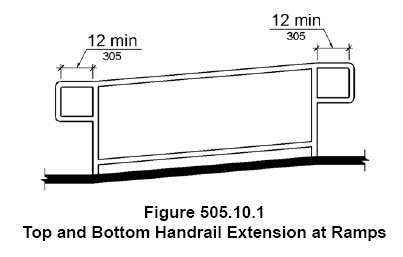
This figure shows the handrail extension that extends horizontally above the landing and returns to the post.
At several inspections recently, I have encountered handrails that rather than extending 12″ horizontally in the same direction of the ramp run beyond the top or bottom of the ramp run, they eiither turn 90 degrees, or don’t fully extend.
“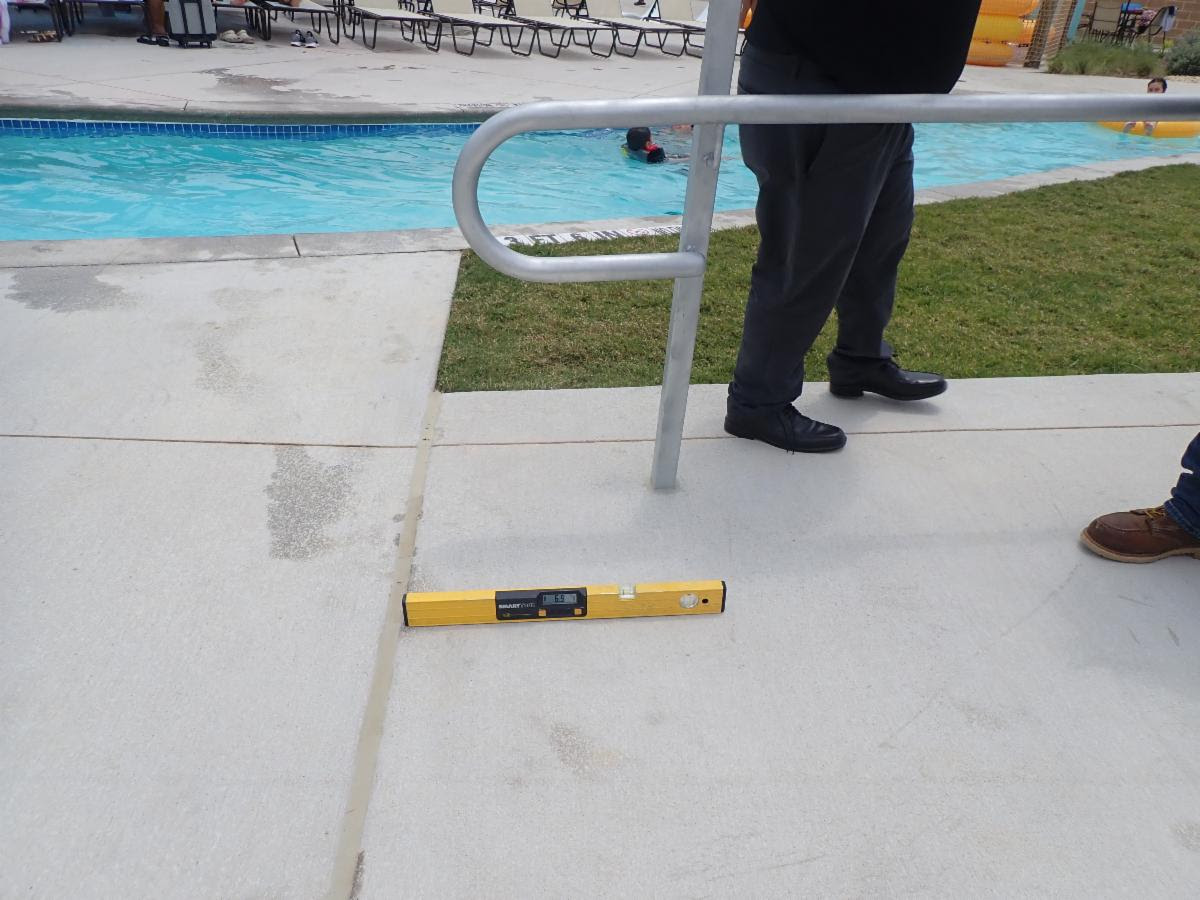
This photo above shows a handrail that did not extend 12″ beyond the bottom of the ramp run
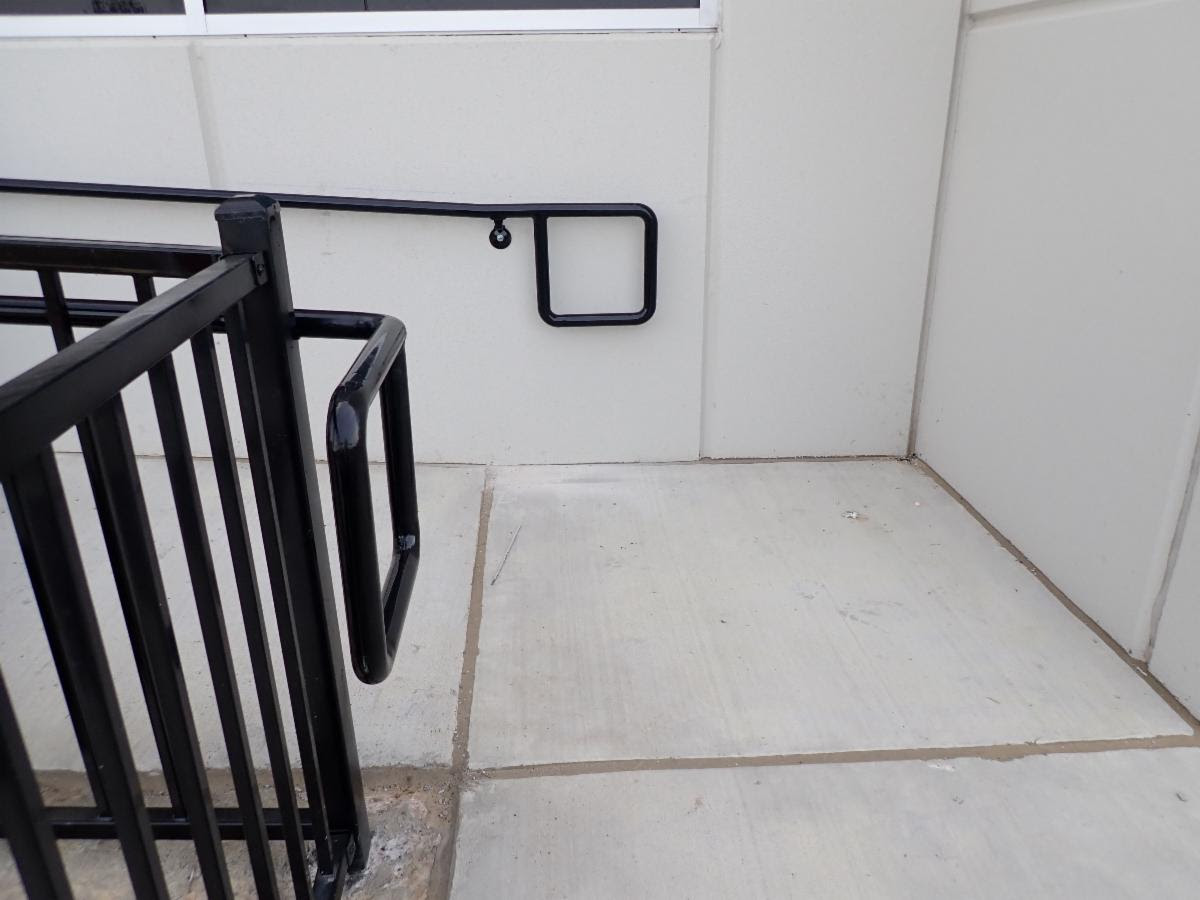
The handrail in the photo above did not extend 12″ in the same direction as the ramp run, but rather it turns 90 degrees which is not an extension and it is not allowed (unless the ramp was existing per excepton listed below)
There are a few exceptions for when handrails do not have to extend:
EXCEPTIONS:
1. Extensions shall not be required for continuous handrails at the inside turn of switchback or dogleg stairs and ramps.
2. In assembly areas, extensions shall not be required for ramp handrails in aisles serving seating where the handrails are discontinuous to provide access to seating and to permit crossovers within aisles.
3. In alterations, full extensions of handrails shall not be required where such extensions would be hazardous due to plan configuration.
Thursday, June 1st, 2023
I have had several projects latetly where my clients have asked me to write them a letter that explains that their project was excempted from having to be reviewed or inspected because they were not “alterations”. One of them said that all they were doing was MEP upgrades and “finishes”. That made me question their request….
- What finishes?
- Where are the MEP upgrades occurring?
- Were they just doing mechanical and electrical upgrades?
- or werer there also plumbing changes involved?
- Were they installing new lighting or light switches as part of the upgrades?
- What finishes? painting, flooring, new cabinetry?
The concept of “alterations” is a confusing concept for most of us. The basic confusion is what is an alteration? The answers to my questions above would have given me some clarity. In the ADA and TAS an “alteration” has a specific (not so specific) definition. And in the definition it also tells you what is NOT an alteration. I will put the definition below and then I will explain why the request was not able to be fulfilled.
Alteration: A change to a building or facility that affects or could affect the usability of the building or facility or portion thereof. Alterations include, but are not limited to, remodeling, renovation, rehabilitation, reconstruction, historic restoration, resurfacing of circulation paths or vehicular ways,
changes or rearrangement of the structural parts or elements, and changes or rearrangement in the plan configuration of walls and full-height partitions.
Below are some examples:
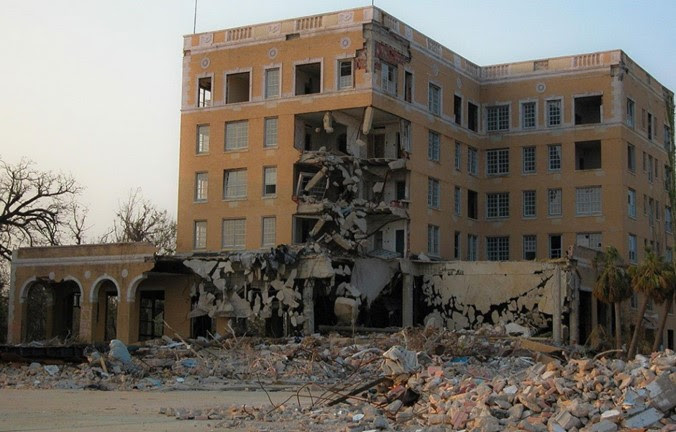
Reconstruction….even if it is demolishing something and re-building it EXACTLY IN THE SAME PLACE….or as my clients like to explain…BUILDING IT IN KIND….it is still an alteration.
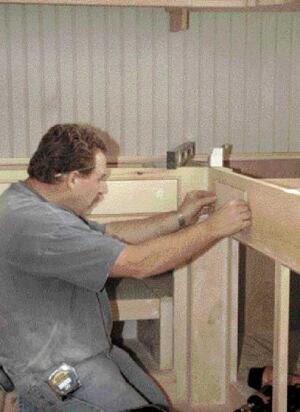
Reconstruction of a cabinet even it is going to be put back exactly where it was, will be considered an alteration.
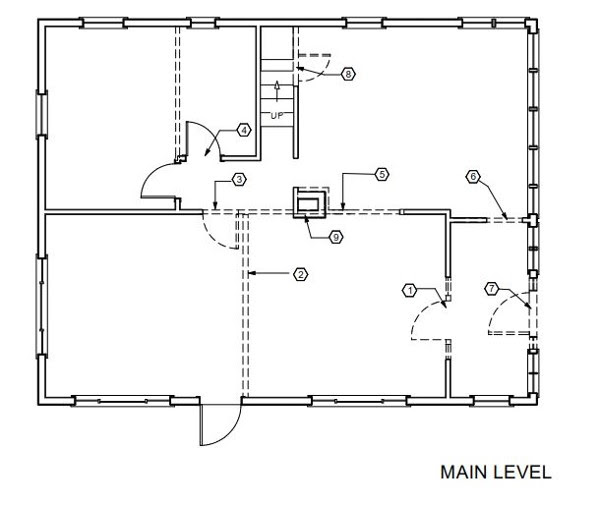
Reconfiguration of a floor plan, by either removing walls, adding or re-building walls, adding or re-building millwork (even if it was there before) is an alteration.
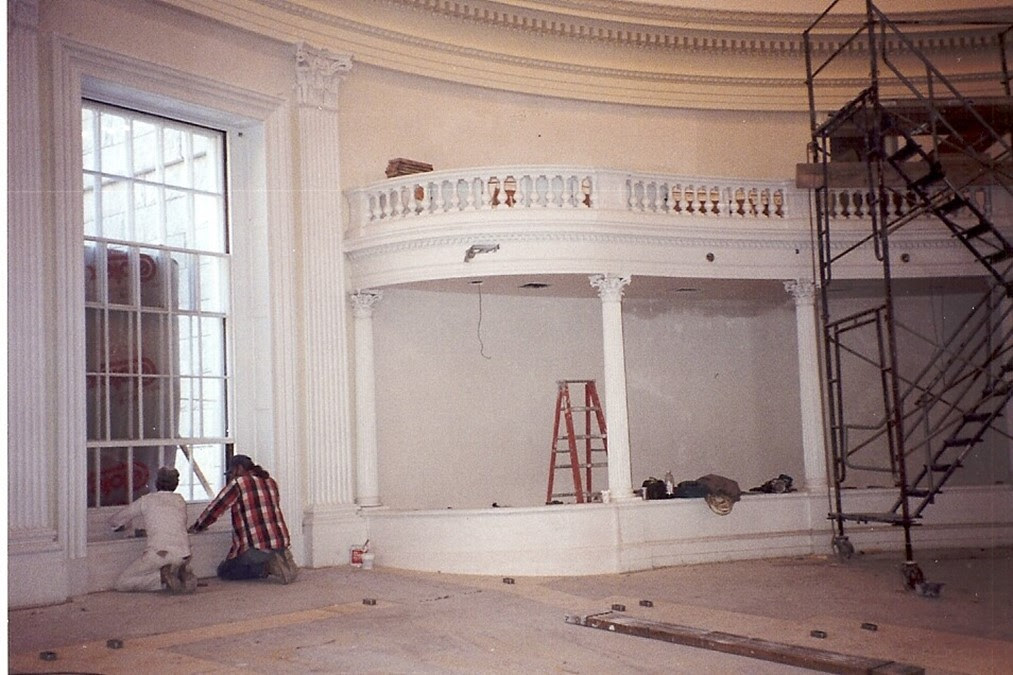
Historic Restoration, depending on what is being restored might be considered an alteration. If it happens in the vertical plane or the ceiling it may not because it may not affect the usabilitity.
“
The definition of alteration, includes “re-surfacing of circulation paths”. This would include flooring. Even if the flooring is being replaced “IN KIND” with the same material that was there before….it is an alteration.
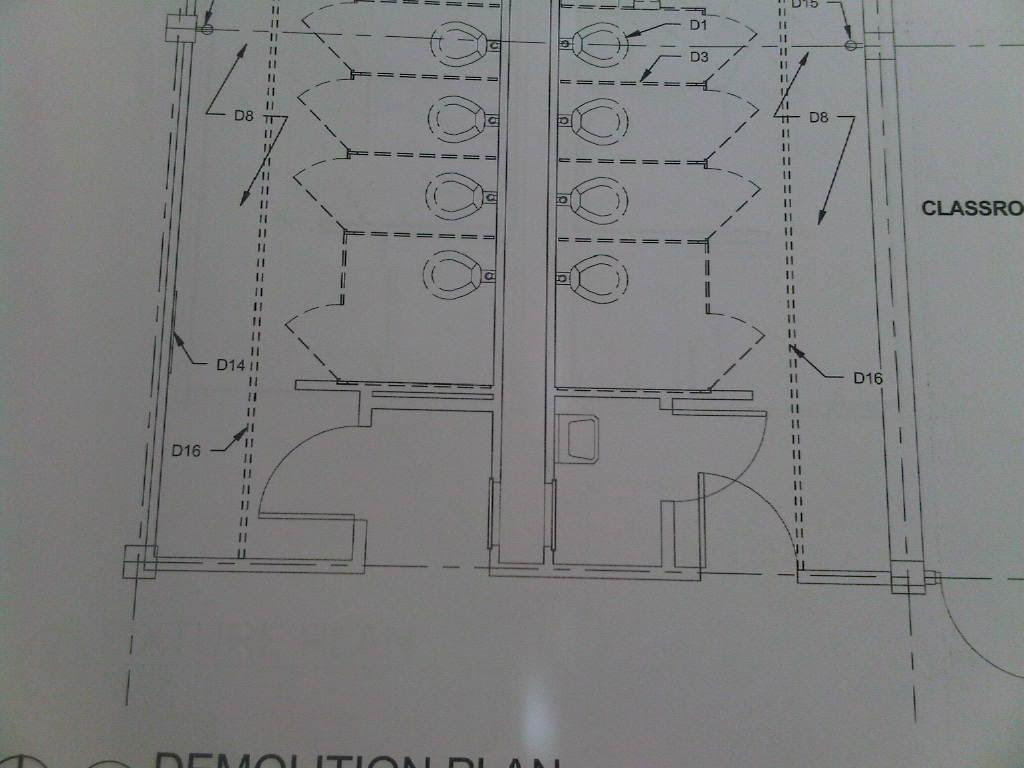
Removing toilet partitions and replacing them is an alteration. Be careful when re-installing them. If they were not compliant before, they will need to be compliant at the time of installantion.
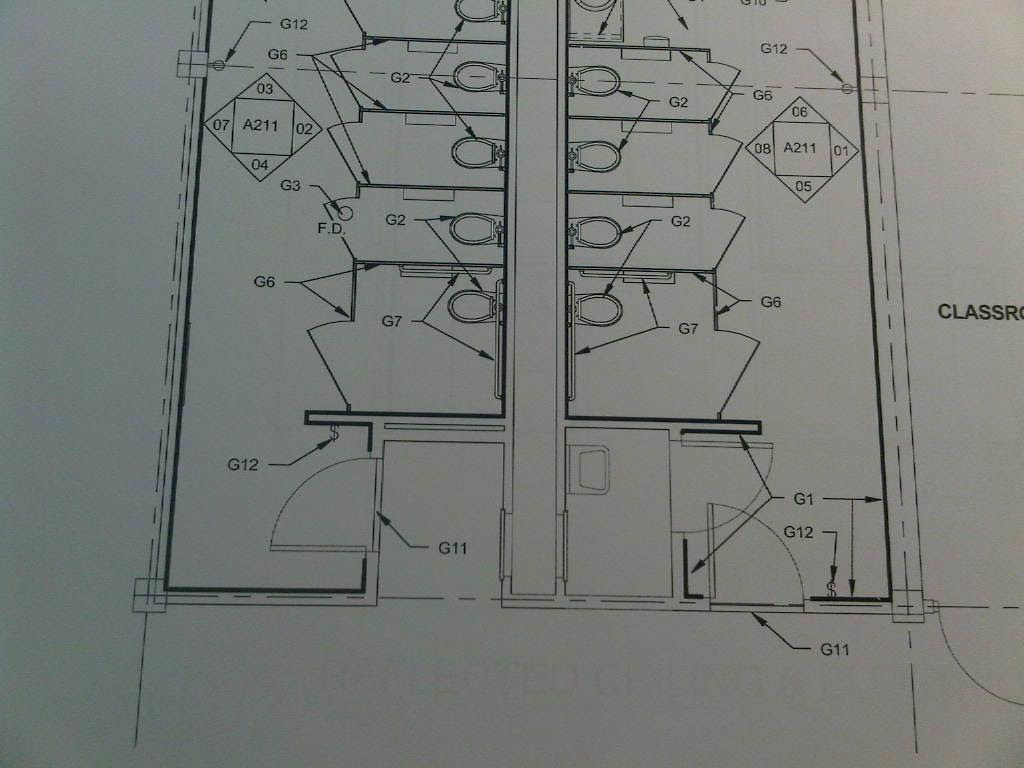
Rebuidling toilet compartments will require that they comply. Even if they were put back exactly where they were, it is an alteration. The wheelchair accessible toilet compartment will have to comply with the standards even if it did not originally. DON’T ASSUME THEY WERE COMPLIANT BEFORE
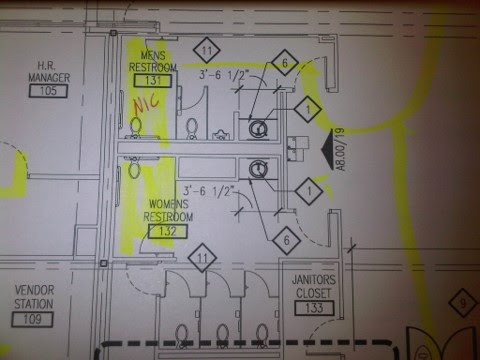
In an alteration, the standards only requires that the element that you are altering be compliant. In this project, they were only replacing the lavatory, therefore the lavatory is the only thing in the restroom that will need to comply at the end of the project.
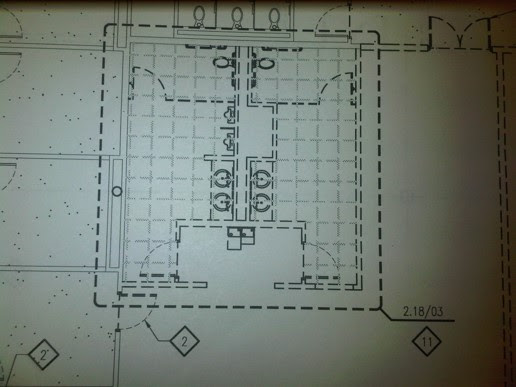
In this restroom, all the elements were removed and will be re-built. Even if they are all going back exactly where they were before, each new element will have to comply with the standards.
Therefore when alterations ocur based on the definition, it will trigger ADA and TAS to be applied. Everything that is newly installed will have to comply.
The definition continues with this clarification:
Normal maintenance, reroofing, painting or wallpapering, or changes to mechanical and electrical systems are not alterations unless they affect
the usability of the building or facility.
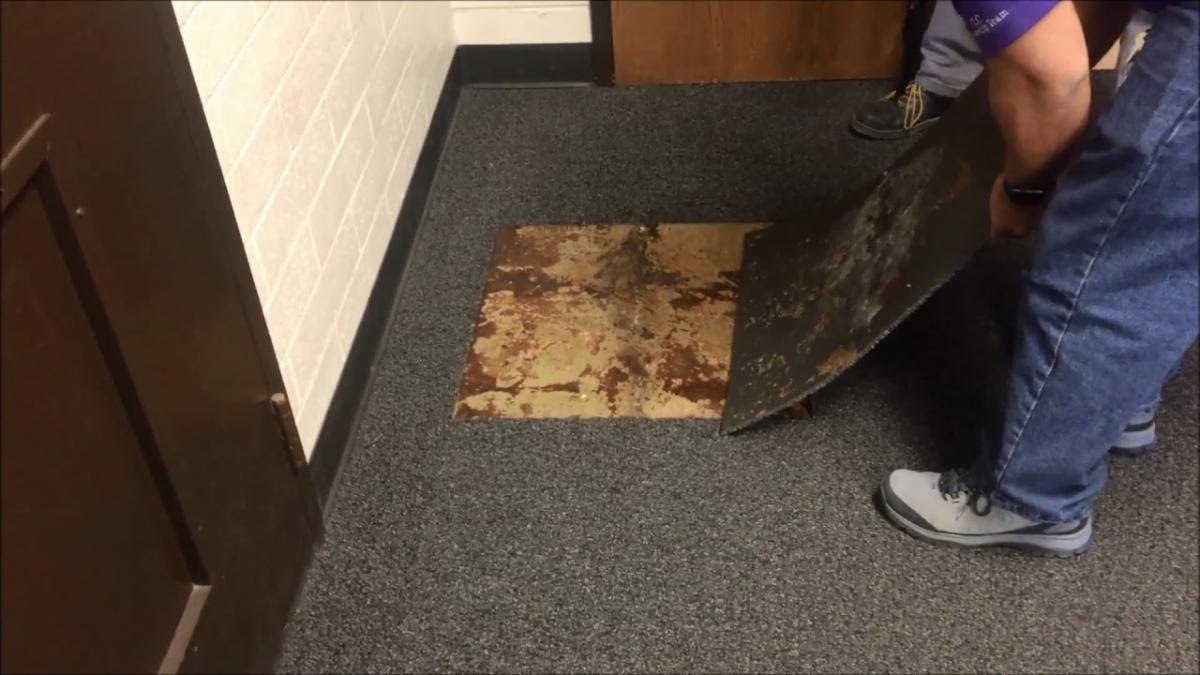
Replacing one or two damaged carpet tile would be considered maintenance. Replacing an entire carpet would an alteration.
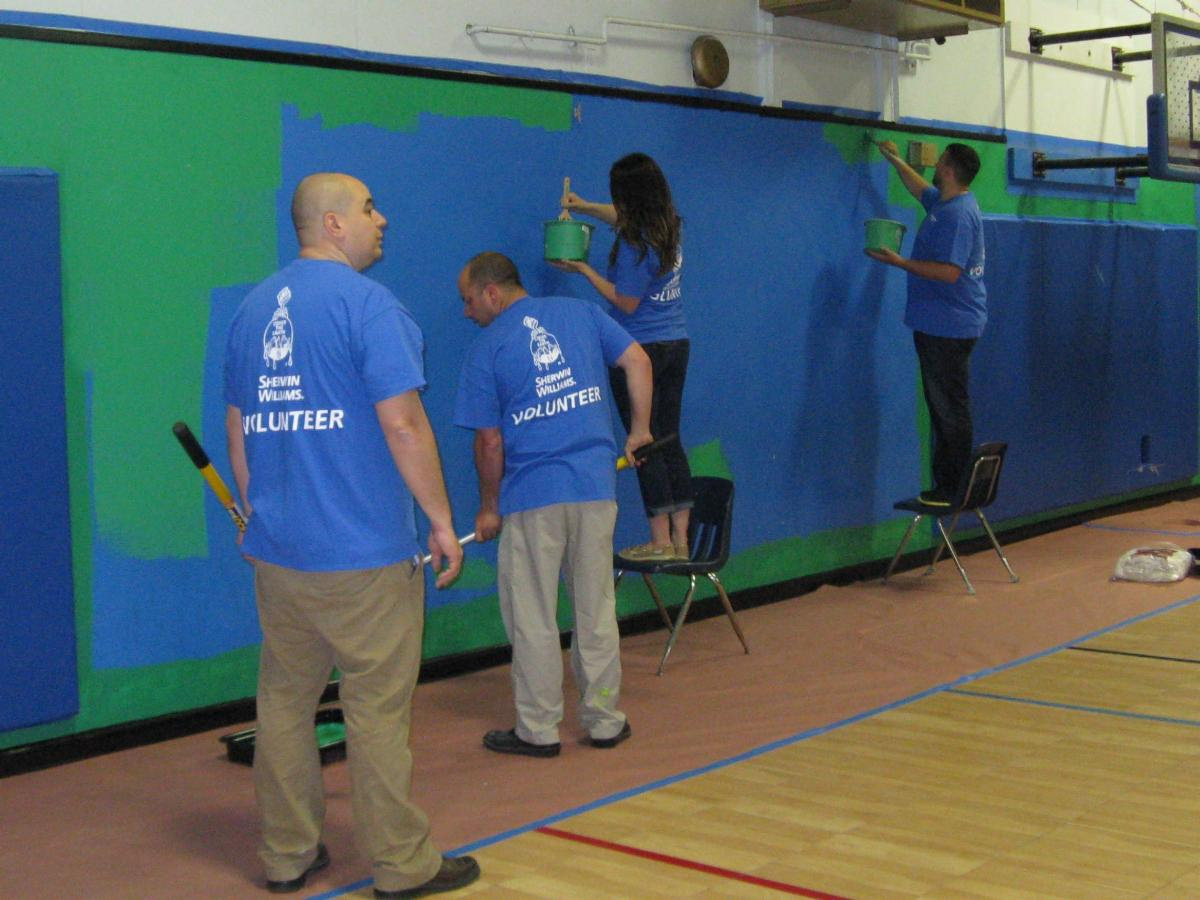
painting is not an alteration because it does not affect the usability of the building for persons with disabilities

changing ceilings is NOT an alteation becuase it does not affect the usability
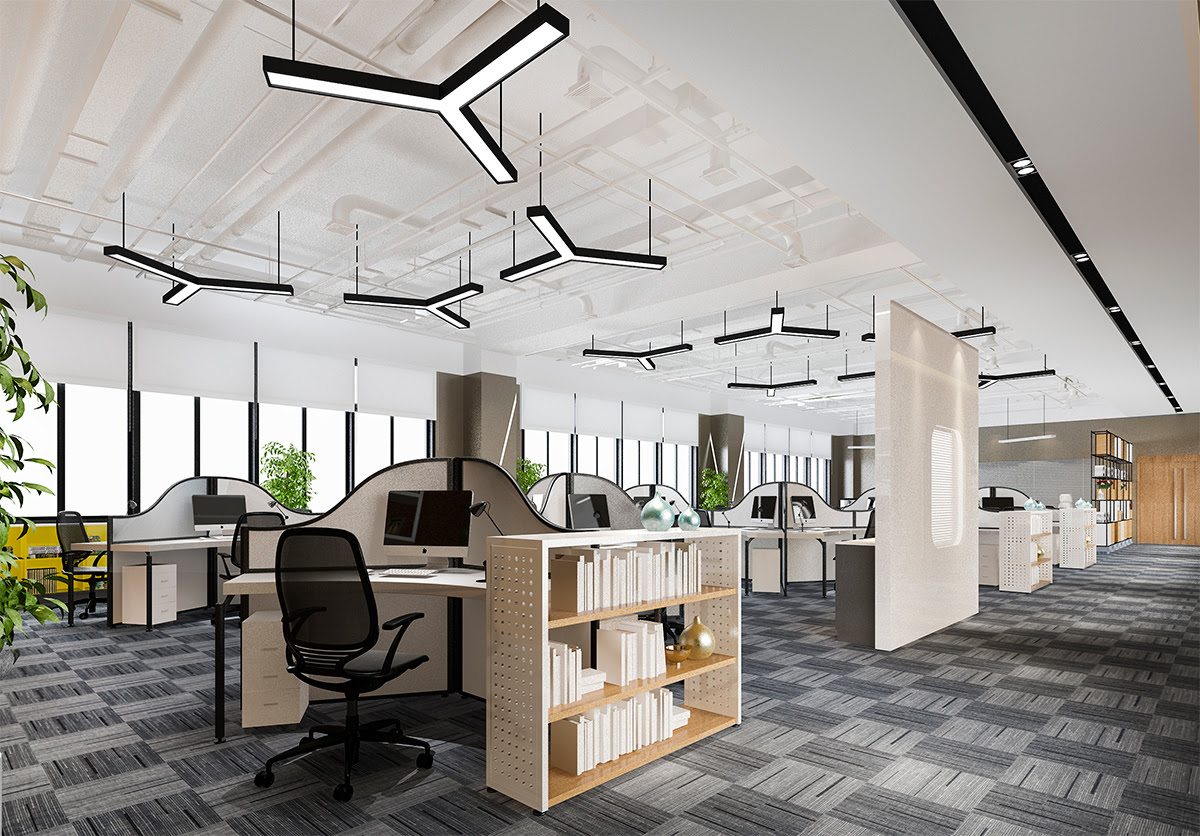
adding pendant light fixtures could affect the usability, therefore adding them to an existing space will be an alteration.
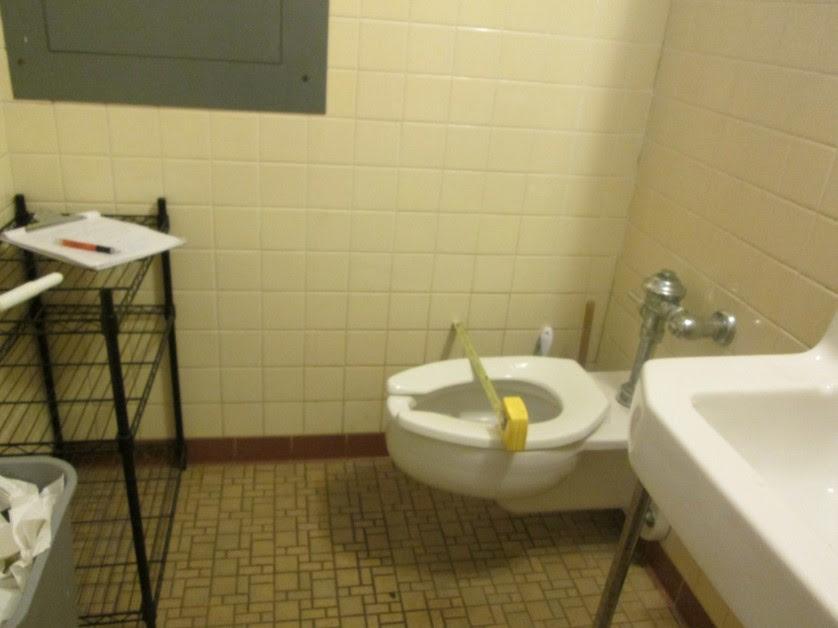
replacing a broken toilet, may be considered “maintenance” if it does not require a permit and other elements are being altered. This will need to be evaluated on a case by case basis.
Alterations in Areas that contain a Primary Function:
Once you determine that your project is an alteration, then we have to explore where it happens? Is it located inside an area of your facility that is considered to have a function that is a major activity to the facility? This area would be considered a “primary function” according to the ADA and TAS
Definition of: Primary Function. A major activity for which the facility is intended. Areas that contain a primary function include, but are not limited to, the customer services lobby of a bank, the dining area of a cafeteria, the meeting rooms in a conference center, as well as offices and other work areas in which the activities of the public accommodation or other private entity using the facility are carried out.
If the area you are altering is considered a primary function, then Section 202.4 will apply:
202.4 Alterations Affecting Primary Function Areas. In addition to the requirements of 202.3, an alteration that affects or could affect the usability of or access to an area containing a primary function shall be made so as to ensure that, to the maximum extent feasible, the path of travel to the altered
area, including the parking areas, rest rooms, telephones, and drinking fountains (and in Texas they added parking) serving the altered area, are readily accessible to and usable by individuals with disabilities, unless such alterations are disproportionate to the overall alterations in terms of cost and scope.
Mechanical rooms, boiler rooms, supply storage rooms, employee lounges or locker rooms, janitorial closets, entrances, corridors, and restrooms are not areas containing a primary function.
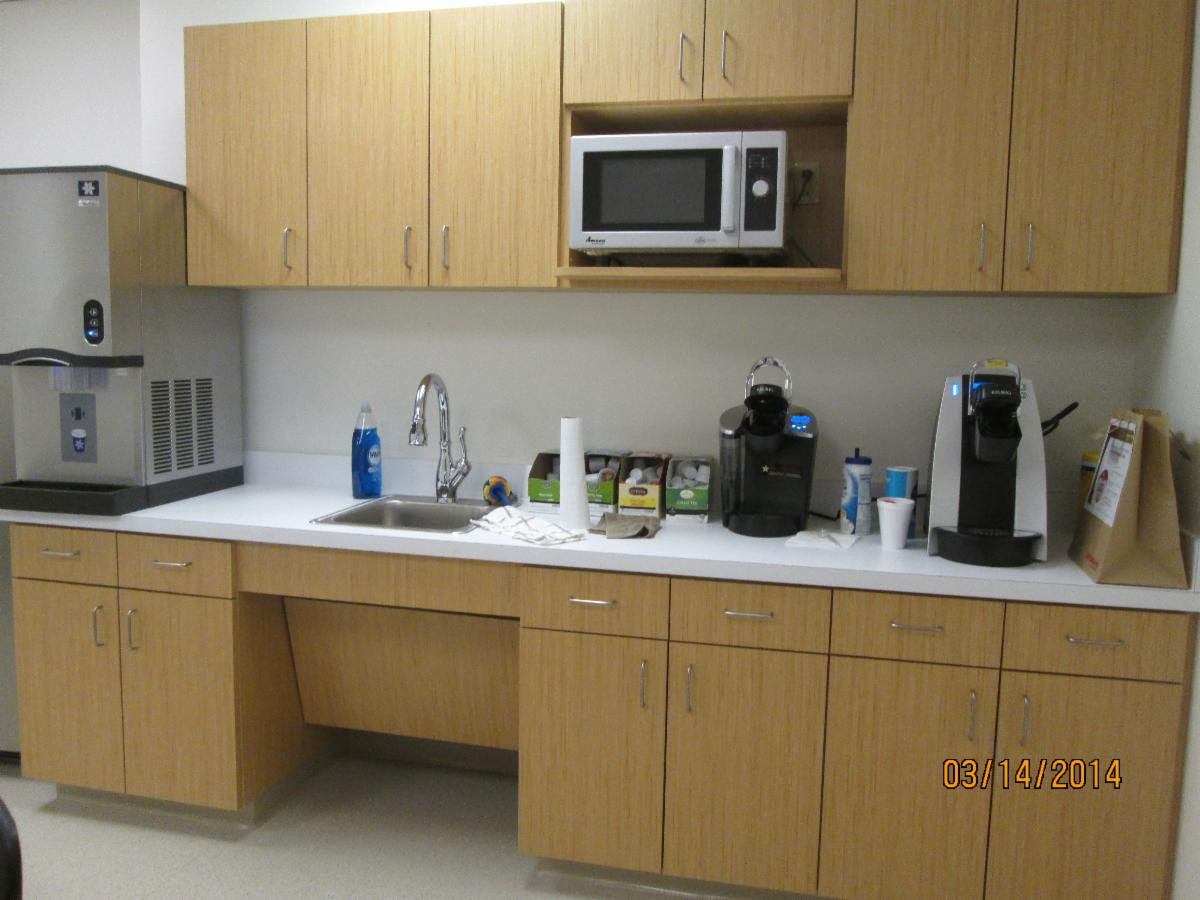
break rooms are not considered a “primary function”. If any renovation occurs inside the break room, it will not trigger the “path of travel” elements to be in compliance
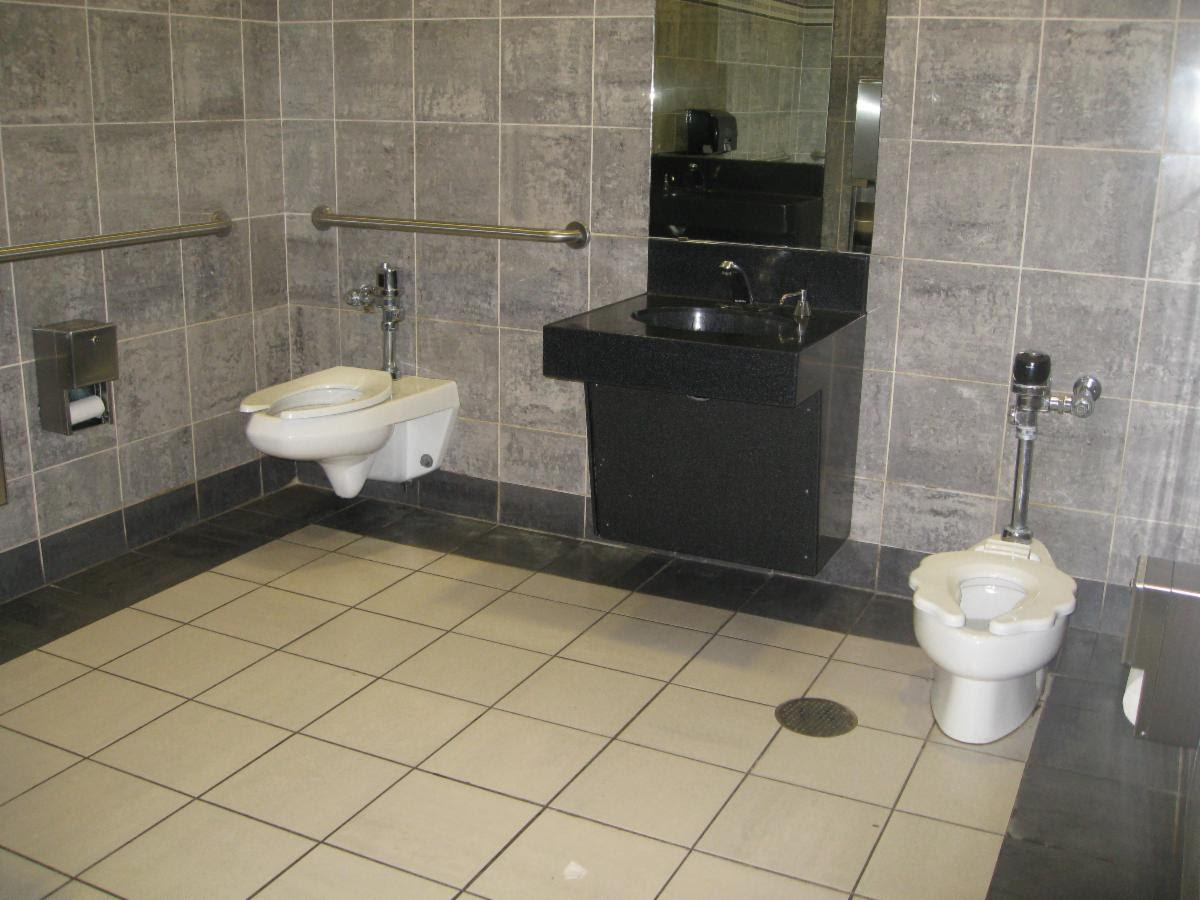
restrooms are not considered a “primary function” except in rest stops. If any renovation occurs inside the restrooms (other than at rest stops), it will not trigger the “path of travel” elements to be in compliance
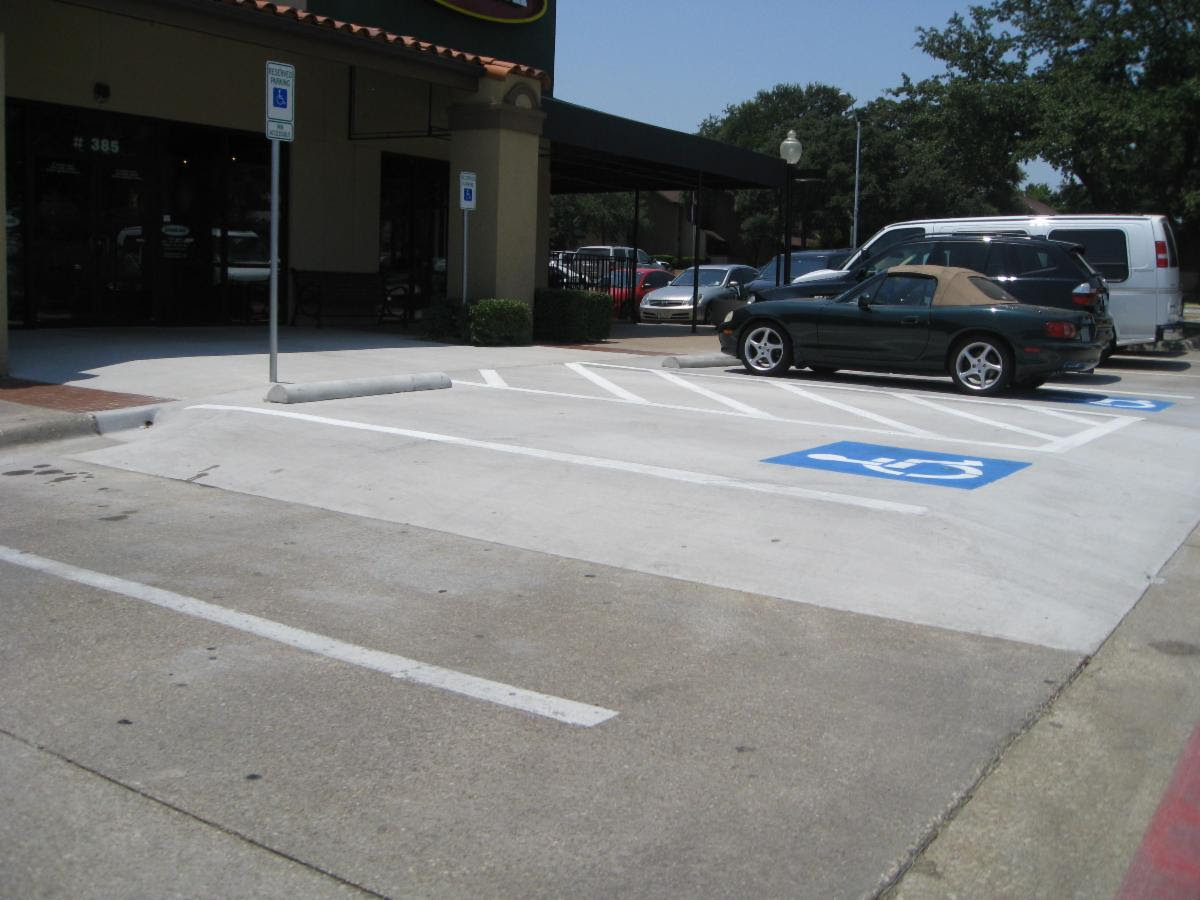
parking is not the “primary function” of a facilty and therefore will not trigger compliance with the path of travel elements.
Alterations that affect the usability of or access to an area containing a primary function include, but are not limited to:
(i) Remodeling merchandise display areas or employee work areas in a department store;
(ii) Replacing an inaccessible floor surface in the customer service or employee work areas of a
(iii) Redesigning the assembly line area of a factory; or
(iv) Installing a computer center in an accounting firm.
For the purposes of this section, alterations to windows, hardware, controls, electrical outlets, and signage shall not be deemed to be alterations that affect the usability of or access to an area containing a primary function.
Then the existing elements located within the path of travel will have to comply. This requirement comes from the alteration section 202.4
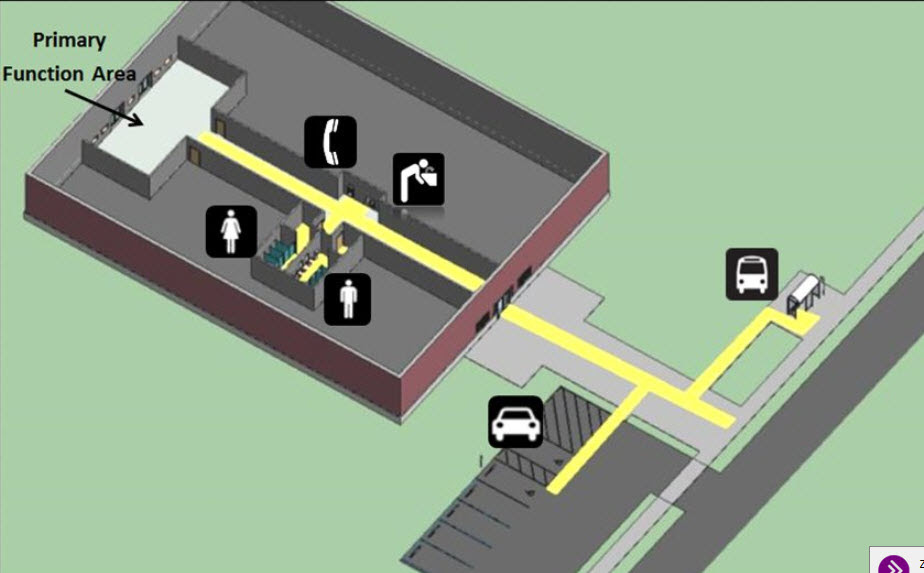
The figure above shows a visual of the “path of travel” elements. The existing path of travel to the altered area will have to comply in this project (EVEN IF IT IS NOT PART OF THE ORIGINAL SCOPE OF WORK) because it serves the altered area which occurs in an area that contains a primary function. The ADA and TAS requires that at least 20% of the construction budget is used for barrier removal and ADA upgrades.
I hope this newsletter made some of these items a bit more clear. This topic is very confusing and frustrating…if you have more questions, feel free to reach out.
Monday, May 1st, 2023
Introduction:
The Fair Housing Design Manual as well as the ICC ANSI A117.1 has a requirement for clearances between counter and appliances. They also have clearance requirements between kitchen counters and walls. But when the kitchen counter is next to a wall that is not part of the kitchen it gets a bit confusing how to apply the standards. This newsletter will give you some examples and will explain the difference in the requirements.
Clear width along the accessible route vs. Clearance between counters
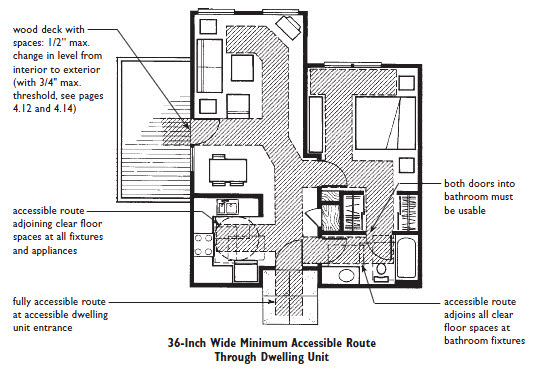
In the fair housing design manual Requirement 4: Accessible route into and through the covered unit, the clear width of the accessible route must be a minimum of 36″ wide. Keep in mind that the clear width through the unit is measured from finished wall to finished wall (including base boards)
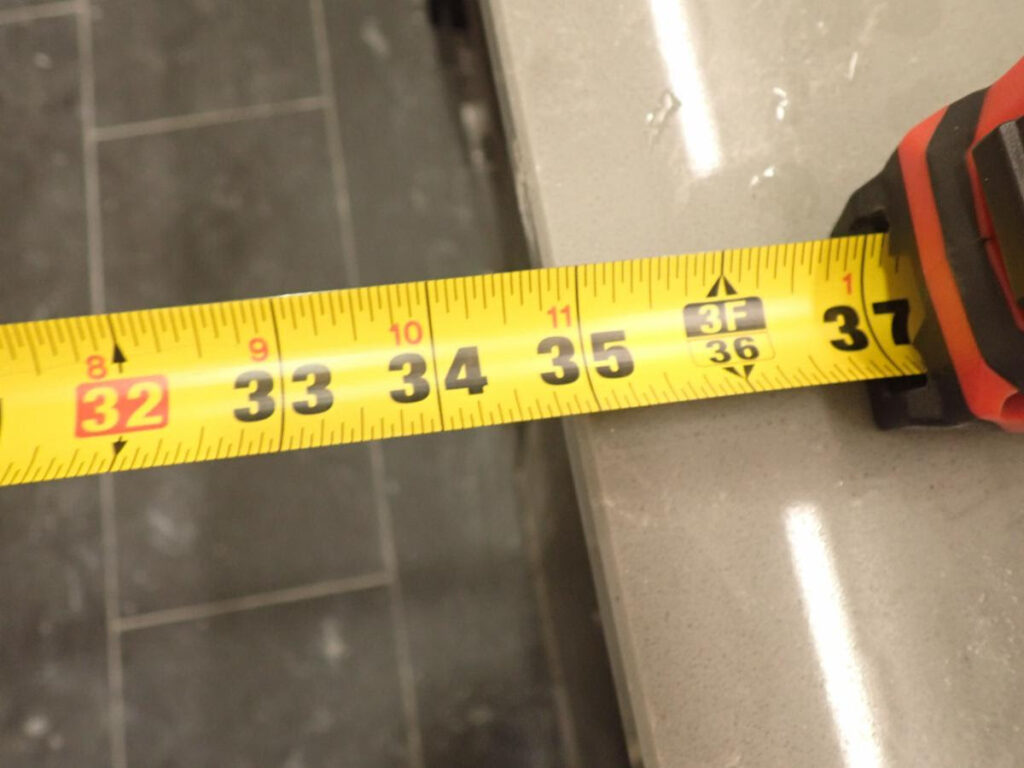
“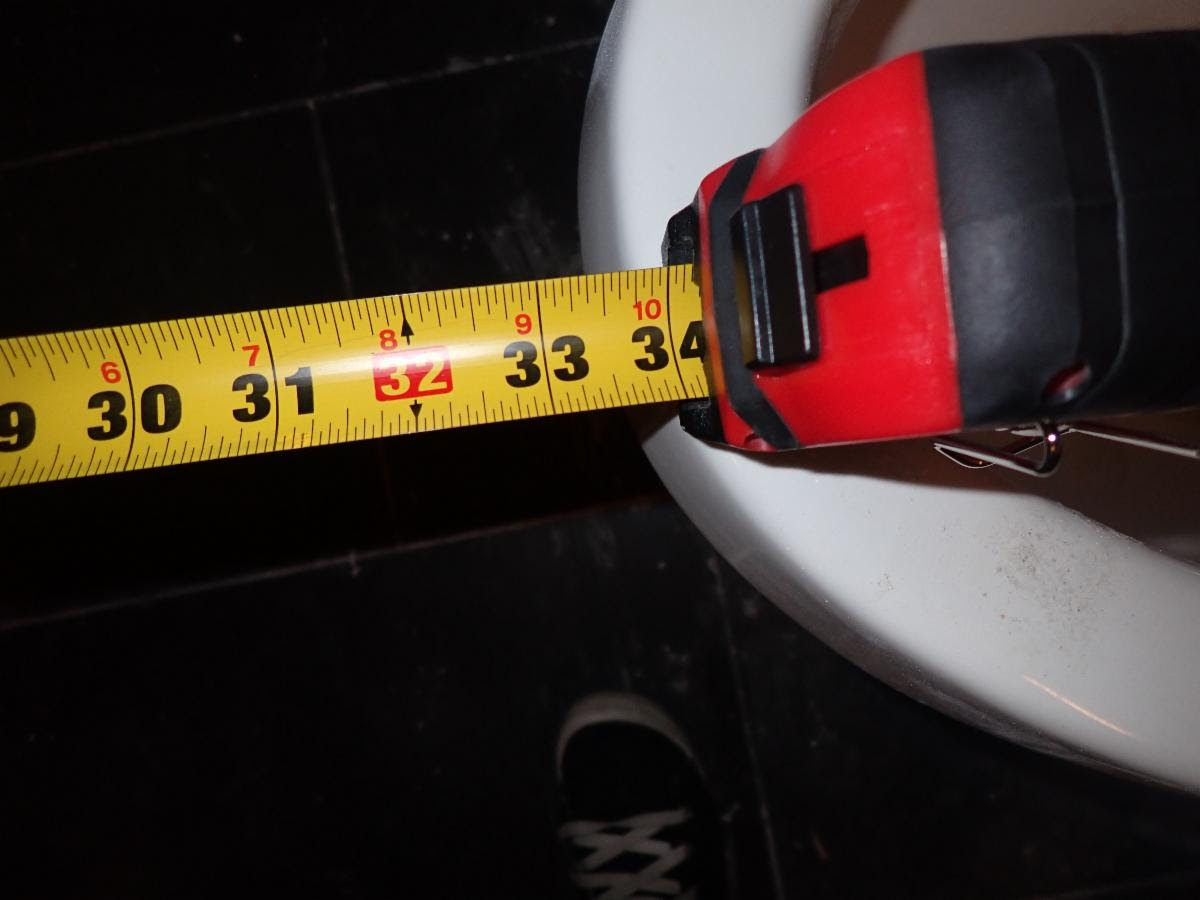
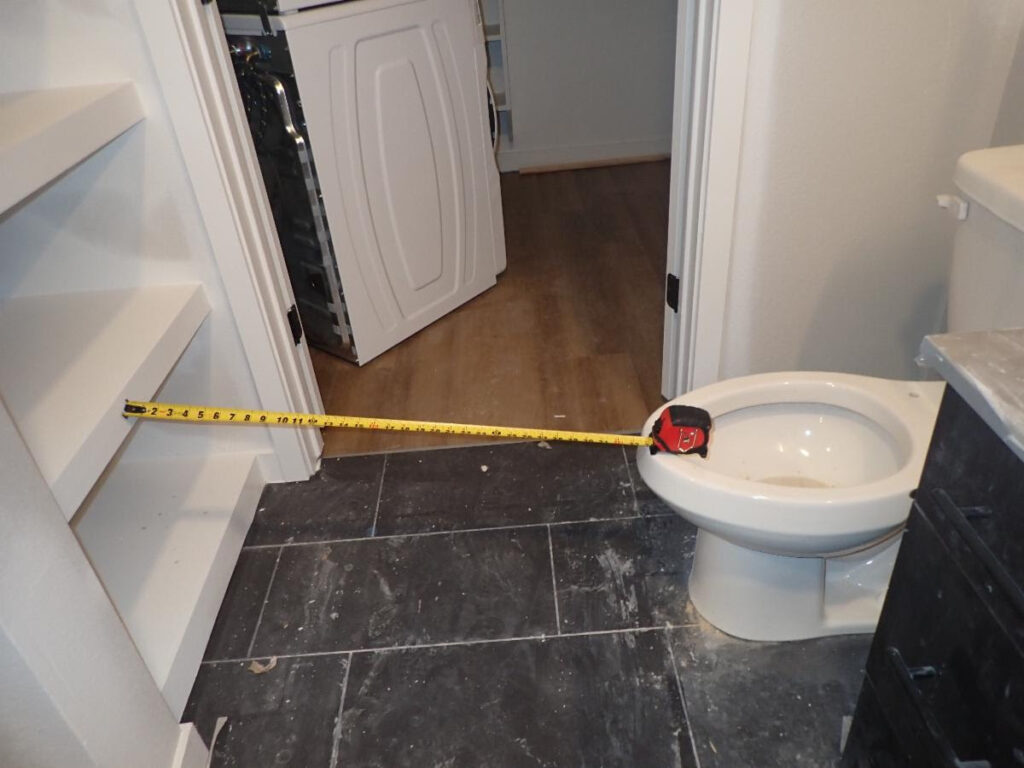
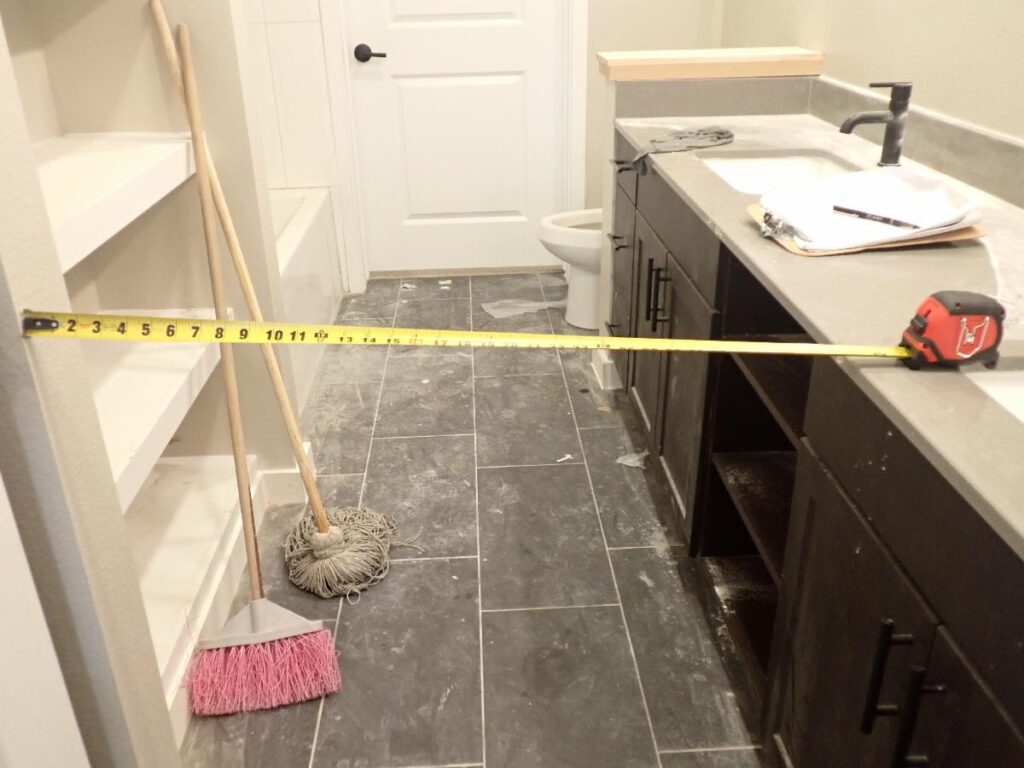
The accessible route inside this bathroom was less than 36″ wide. The lavatory counter and toilet reduced the clear width of the path to the closet
When designing kitchens using the Fair Housing (and even ANSI and ADA) there is a requirement to have a minimum clearance between counters and even kitchen walls and counter that is wider than the accessible route. Requirement 7: Usable Kitchens provides guidance on clearance between counters:
(1) Usable Kitchens. Usable kitchens would meet section
100.205(c) (3)(iv) if:
(b) Clearance between counters and all opposing base cabinets, countertops, appliances or walls is at least 40 inches.
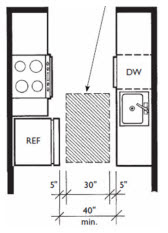
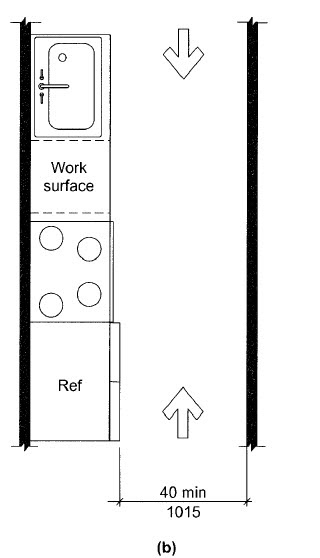
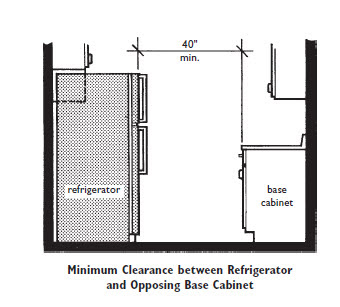
The figures above show the required distance between counters and between counters and kitchen walls. The Design manual also gives us information that the distance is between counters and appliances can be taken without the handle of the appliance. The figure above shows the refrigerator handle inside the clearance.
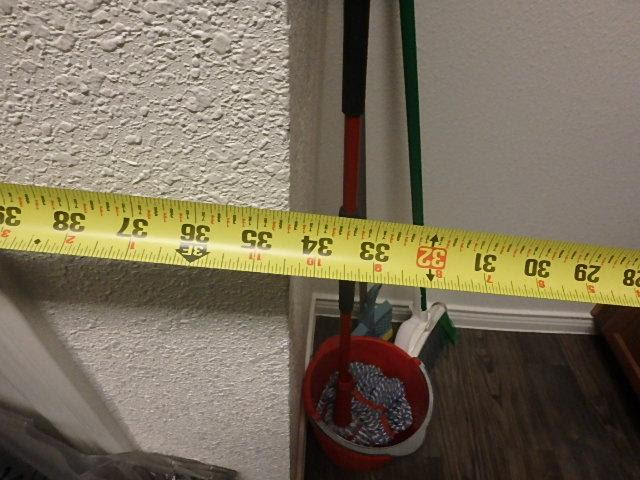
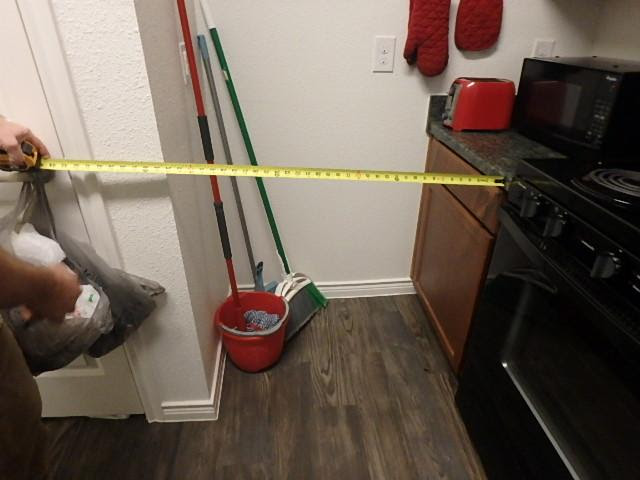
The pictures above shows a kitchen counter facing the pantry wall that is less than 40″ clearance
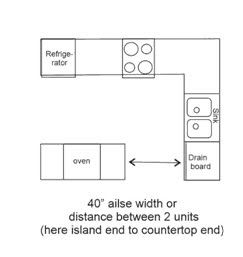
counters and walls that are associated with the ktichen must be 40″ away from the facing counter or wall in a pass through or galley kitchen
Requirement 7 continues:
(c) In U-shape kitchens with sink or range or cooktop at the base of the “U”, a 60 inch turning radius is provided to allow parallel approach, or base cabinets are removable at the location to allow knee space for a forward approach.
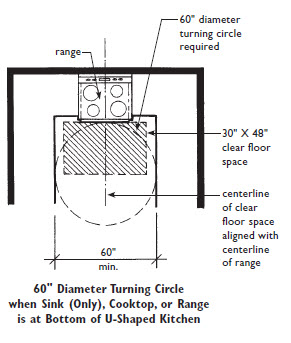
There are a couple of exceptions in the Fair Housing depending on where the sink is located. See the figure below
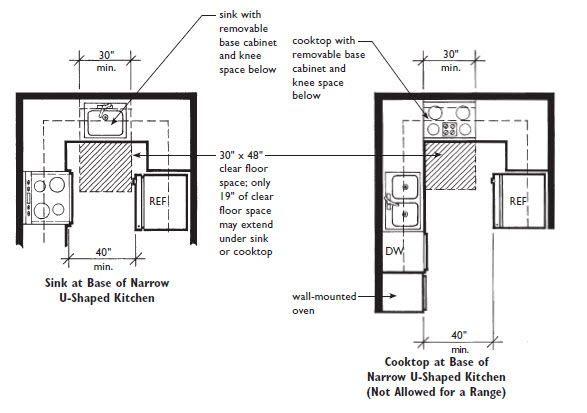
The figure above shows two Fair Housing exceptions when there is a sink at the end of the “U”, a 40” clearance is allowed.
The ADA has a different interpretation of a “U-Shape” kitchen and when there is a dead end/galley but no pass through, it will also require a 60” clearance
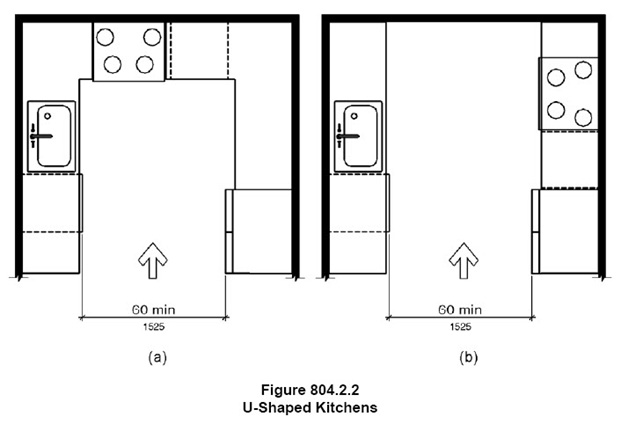
This is the ADA figure showing that kitchens require a turning space, therefore when it is not a pass through galley kitchen layout, it will require a minimum of 60” from counter to counter.
The ANSI A117.1 Standards shows a similar galley type kitchen that is not a pass through and might create a “U-Shape” but it does not require a wider space.
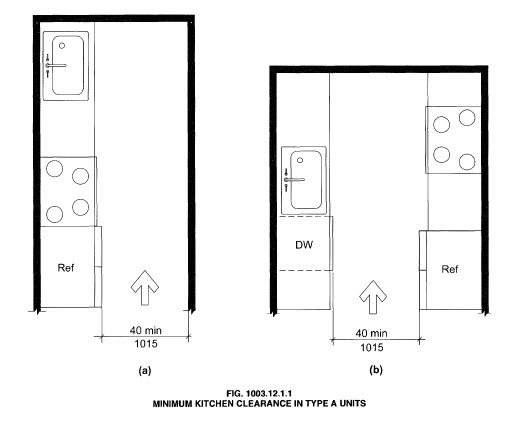
The figure above is of the ANSI A117.1 Standards for Type A unit kitchen. Type B is similar.
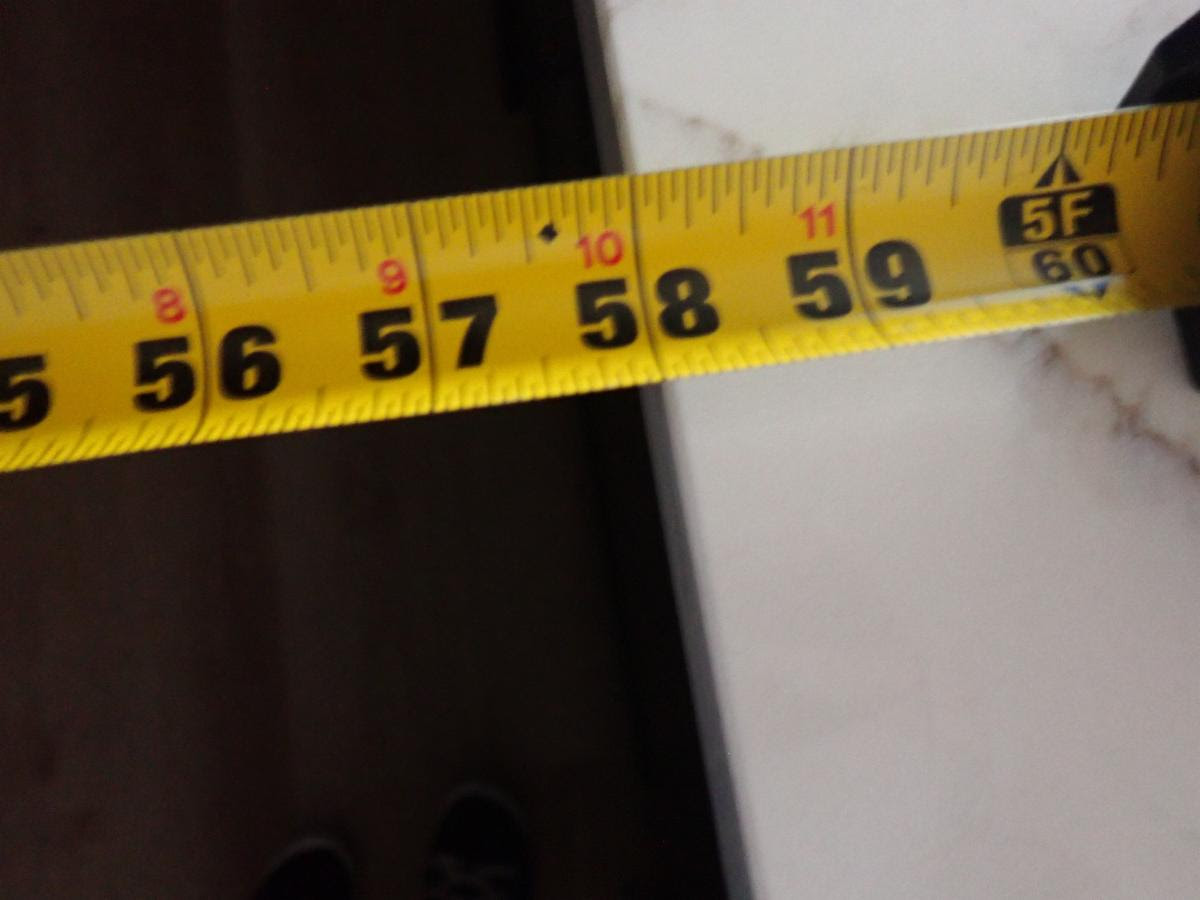
This kitchen had U-shape counters but the clearance was less than 60″ wide
What is you have a kitchen next to an accessible route? Is the wall that is part of the accessible route but next to the kitchen considered part of the kitchen? That is the confusing part. When in doubt you can use the 40″ clearance since the accessible route is just a minimum. But below are some examples of when the walls adjacent to a a kitchen may be considered the accessible route and only require 36″ clear width.
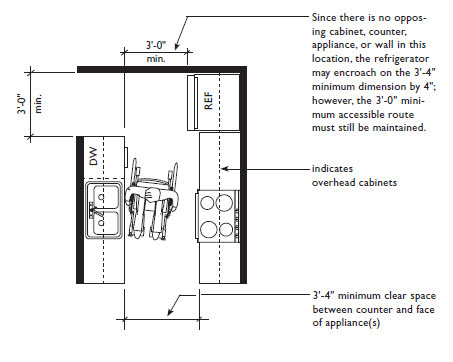
This graphic shows the minimum clear width at the accessible route to ENTER the kitche which must be a minimum of 36″ wide, AND the minimum 40″ clearance between counters INSIDE the kitchen.
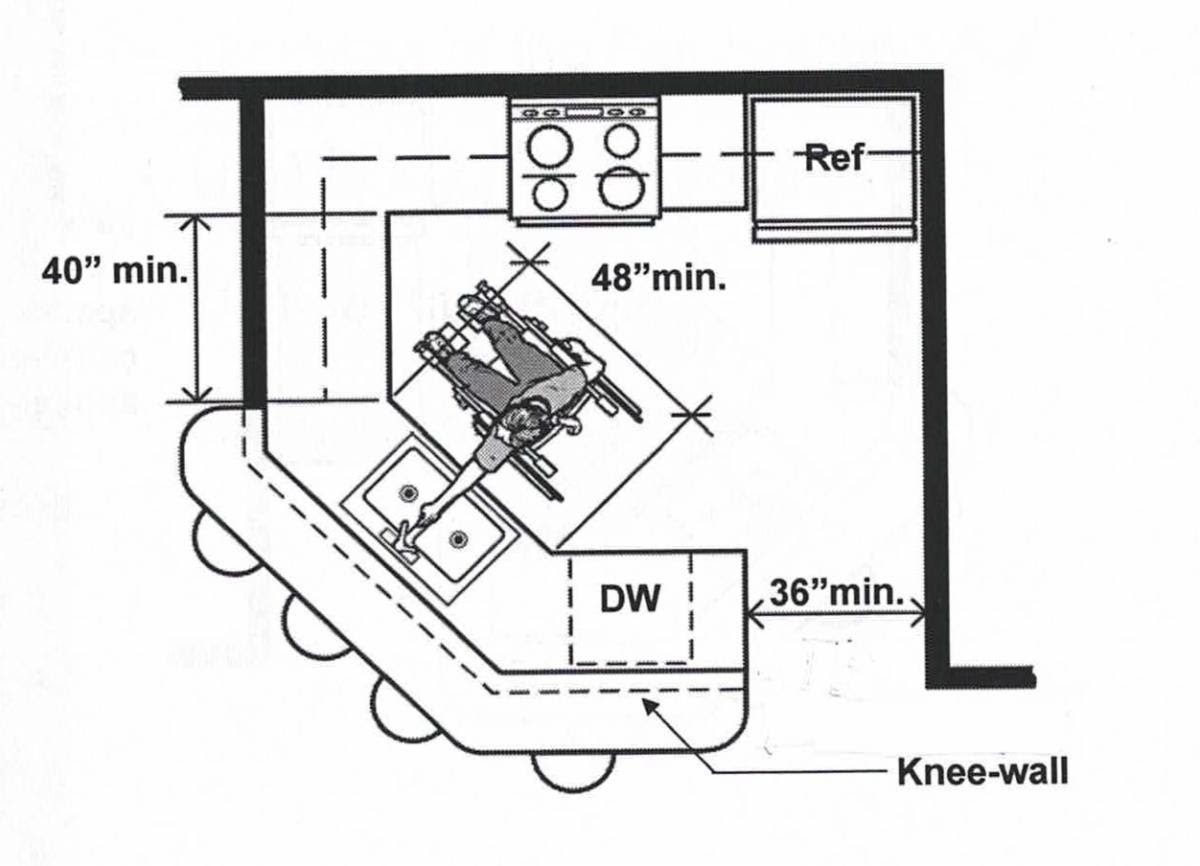
This graphic shows a peninsula counter. The wall next to the end counter is the entrance to the kitchen and can be 36″ minimum clear width
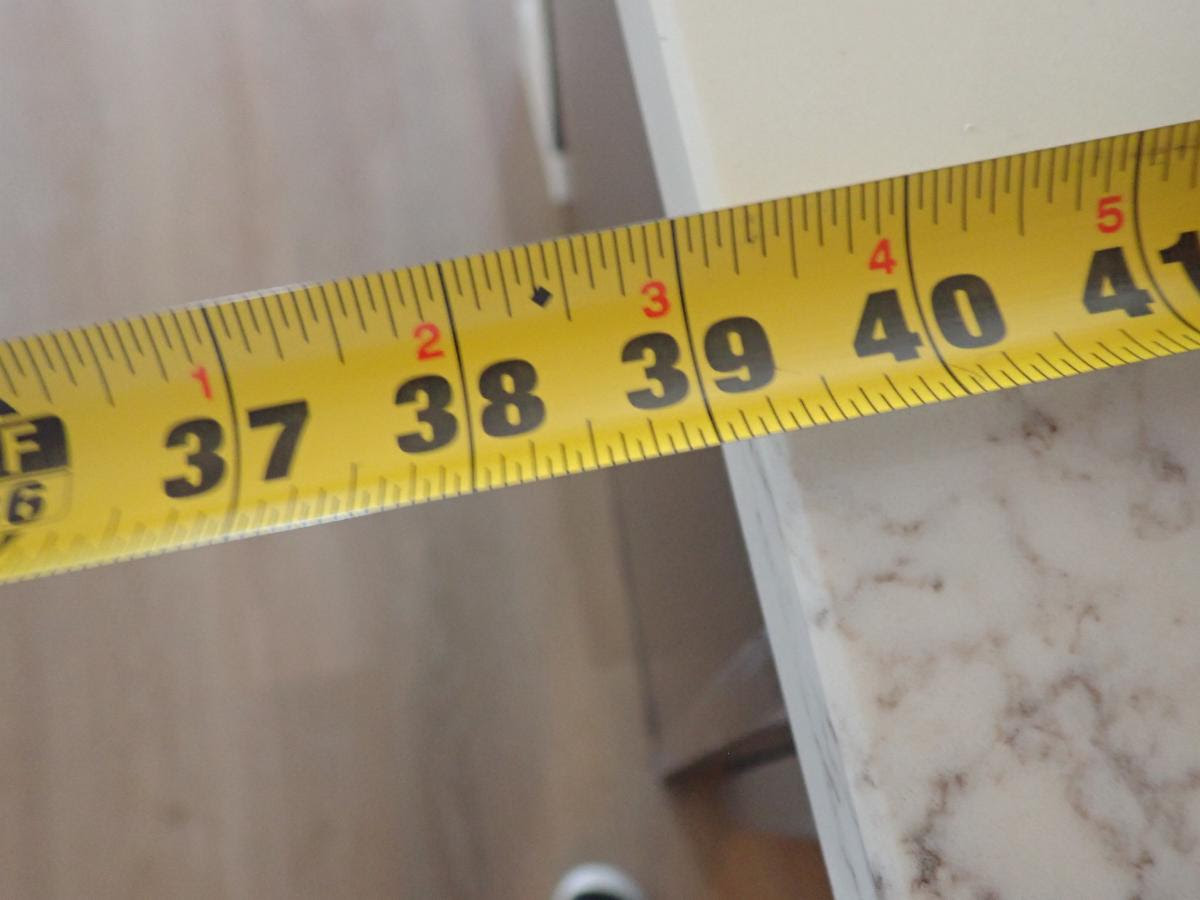
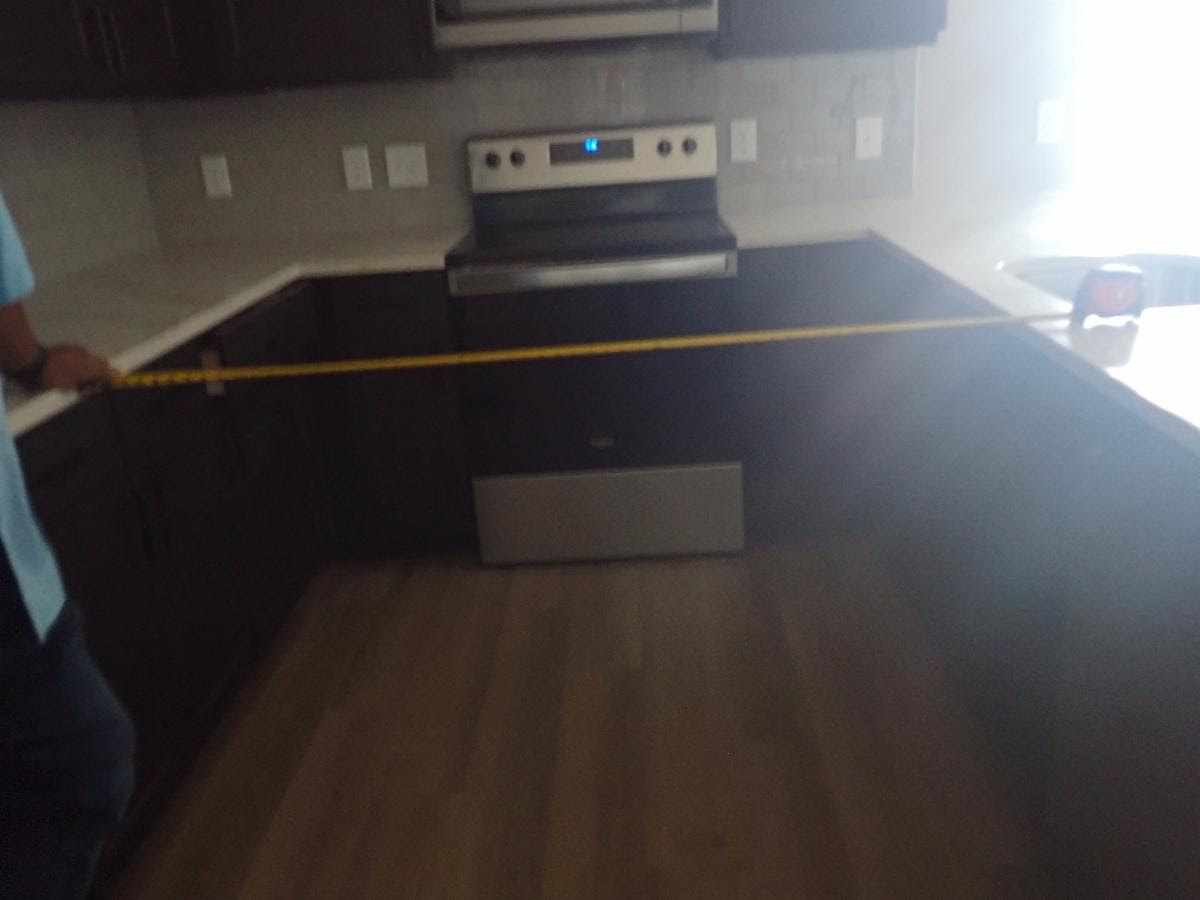
This is a kitchen counter next to a wall that is not in the kitchen. That clearance only has to be a minimum of 36″ clear width because that is part of the accessible route through the unit.
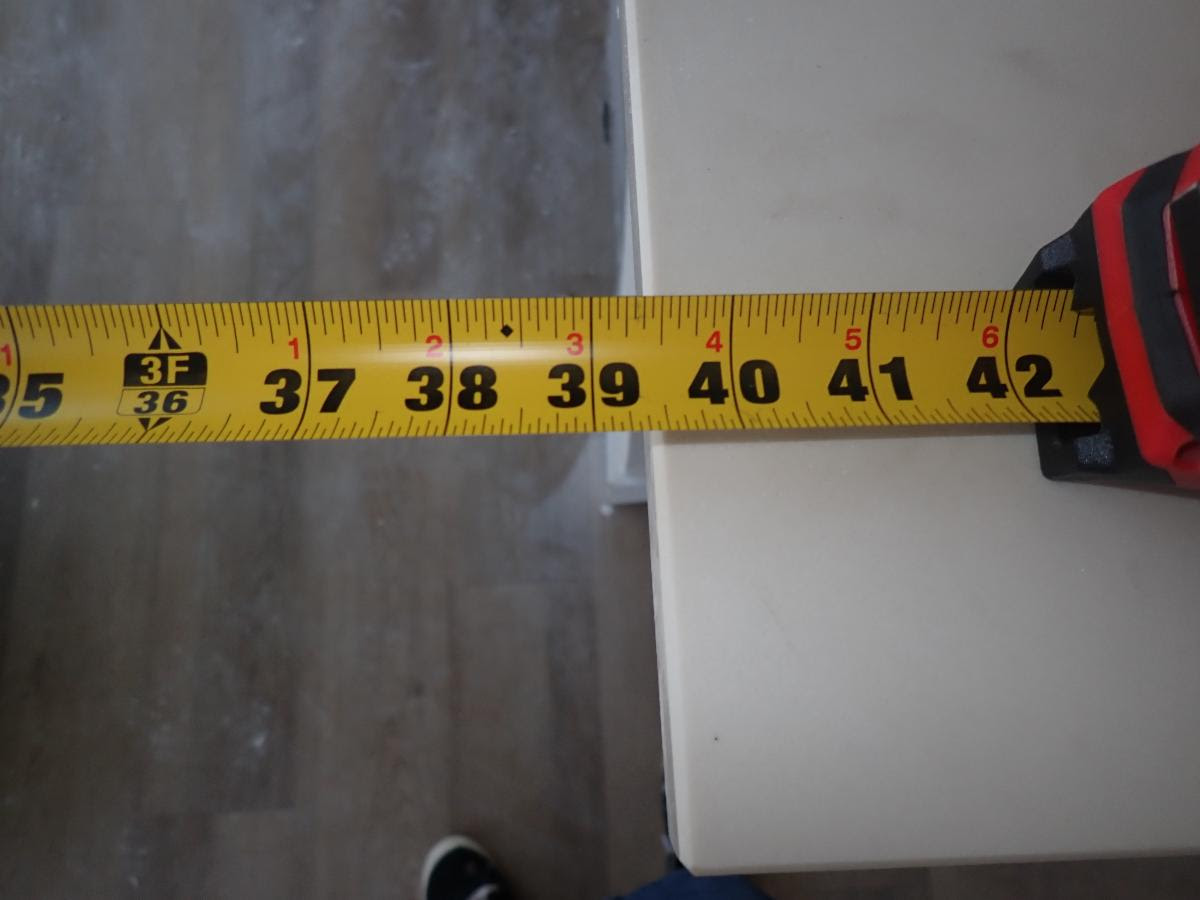
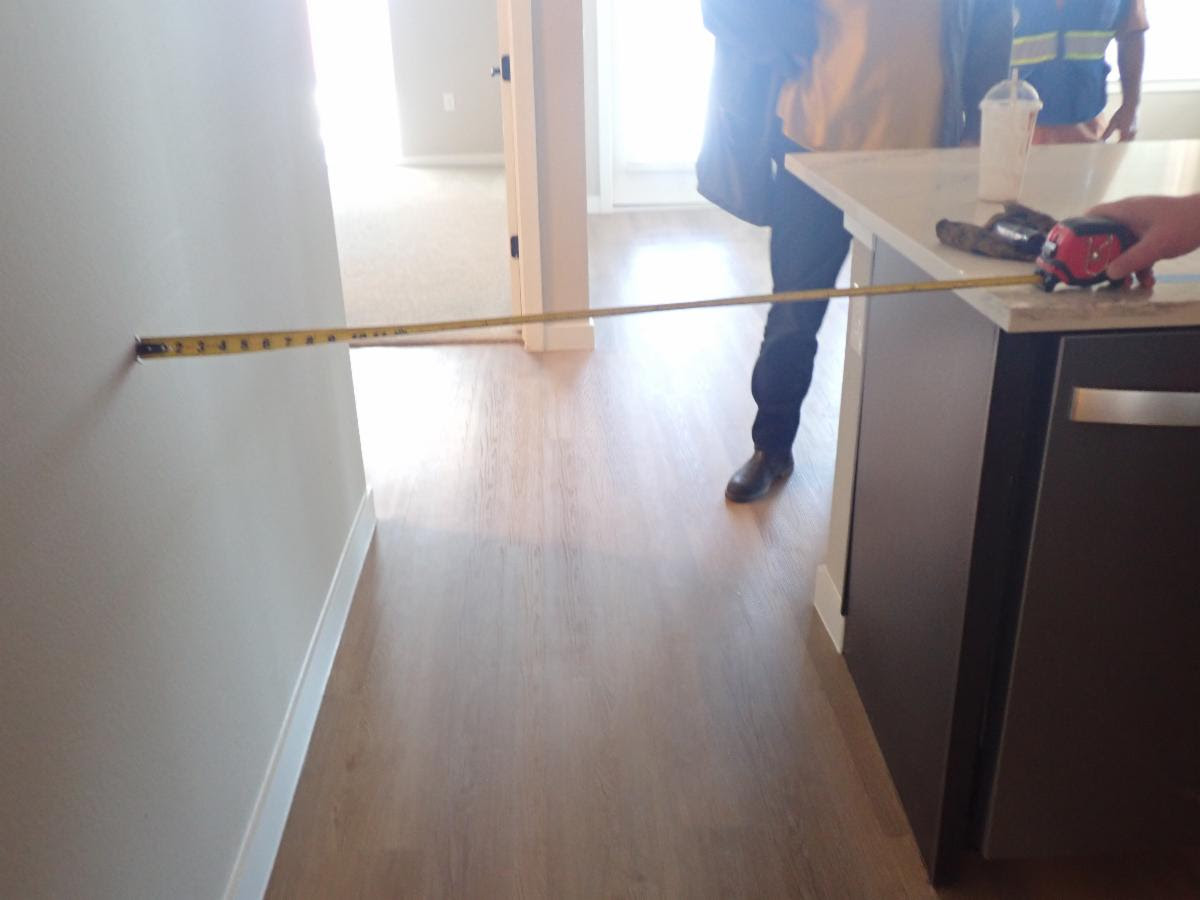
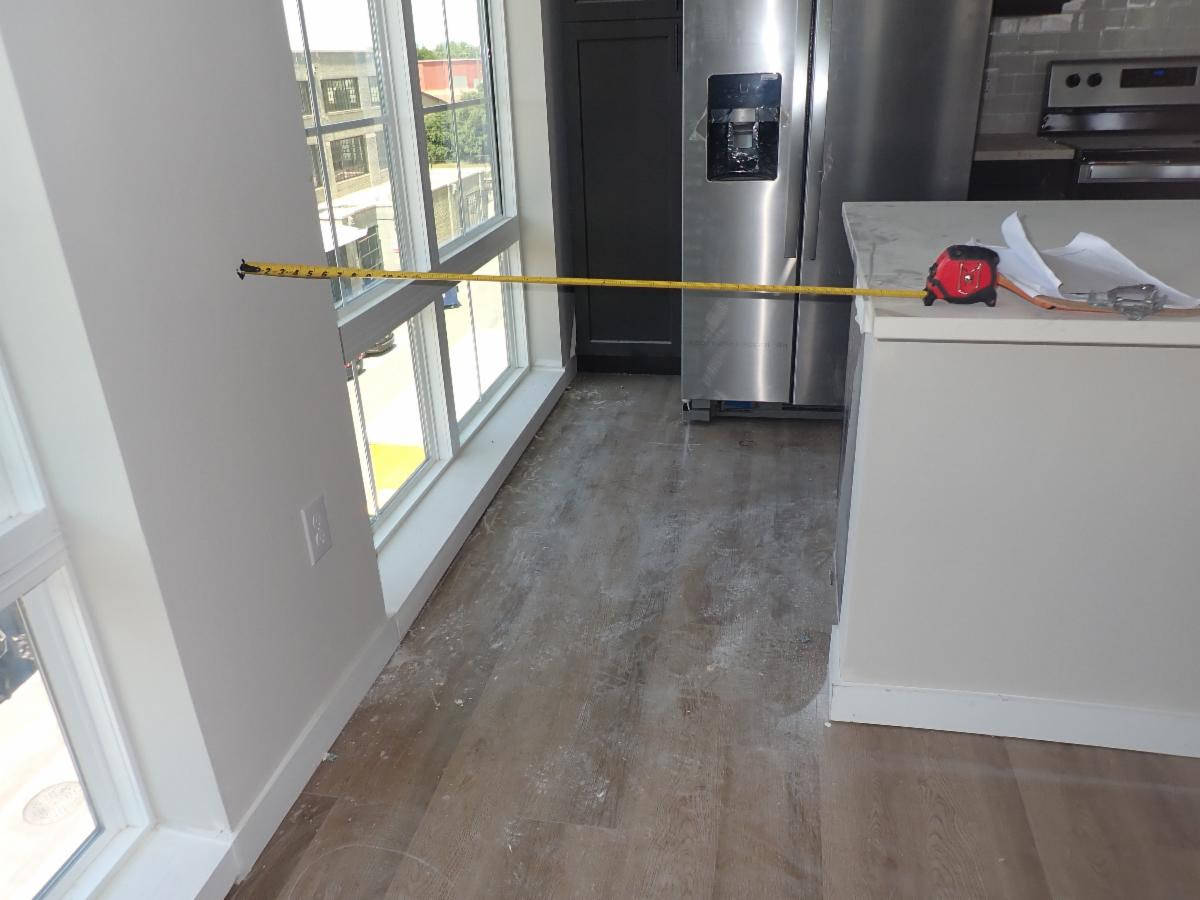
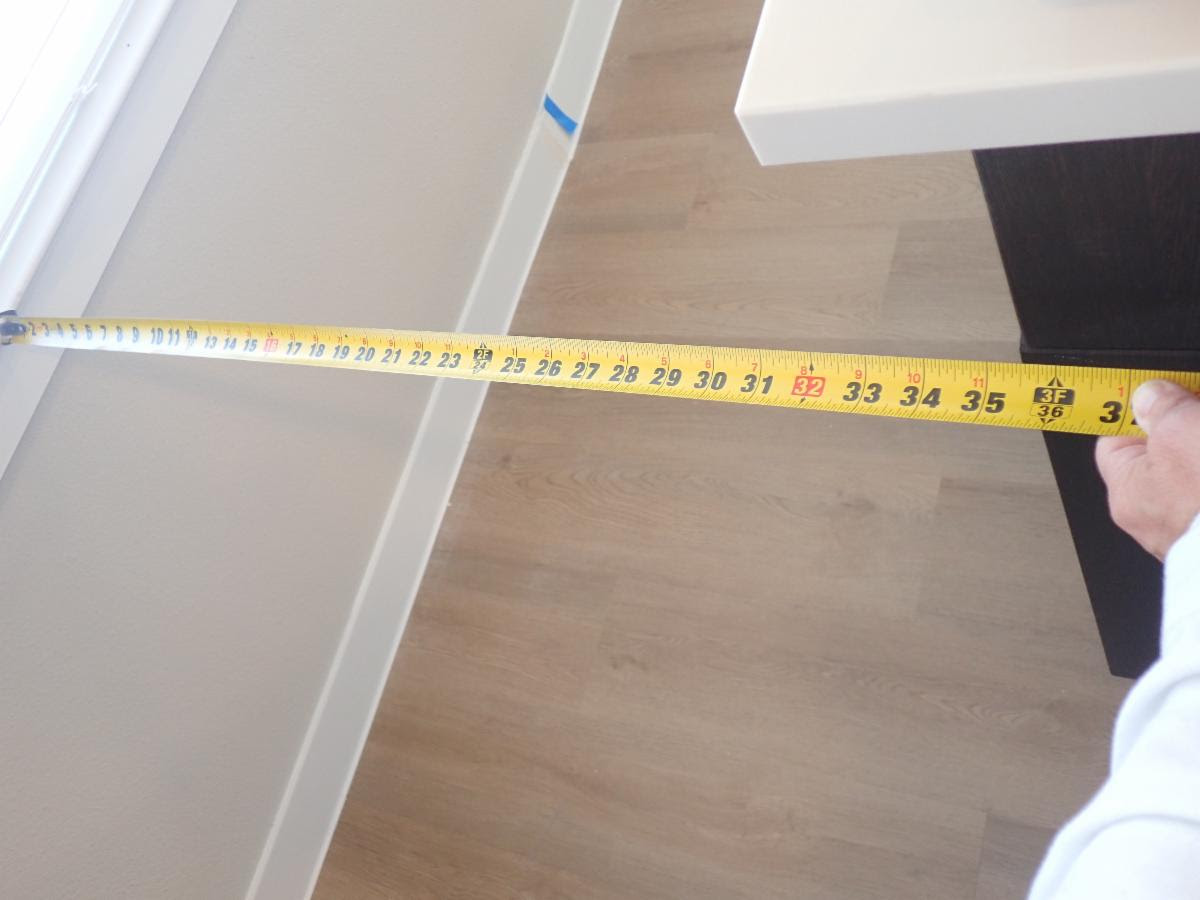
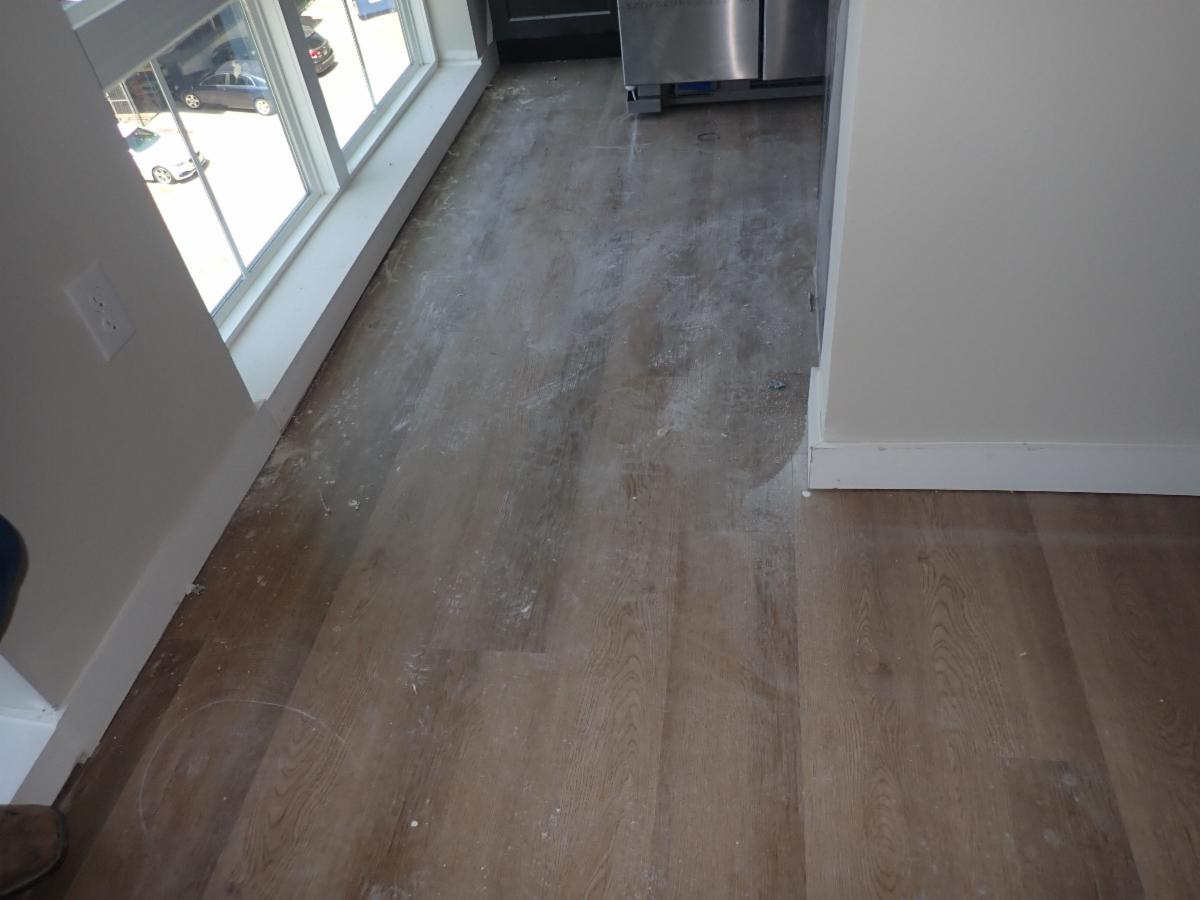
Even though the island counter is part of the kitchen the aisle between the window and the island is considered the accessible route into the kitchen. That clearance can be 36″ minimum. This clearance was 39″ which is acceptable.
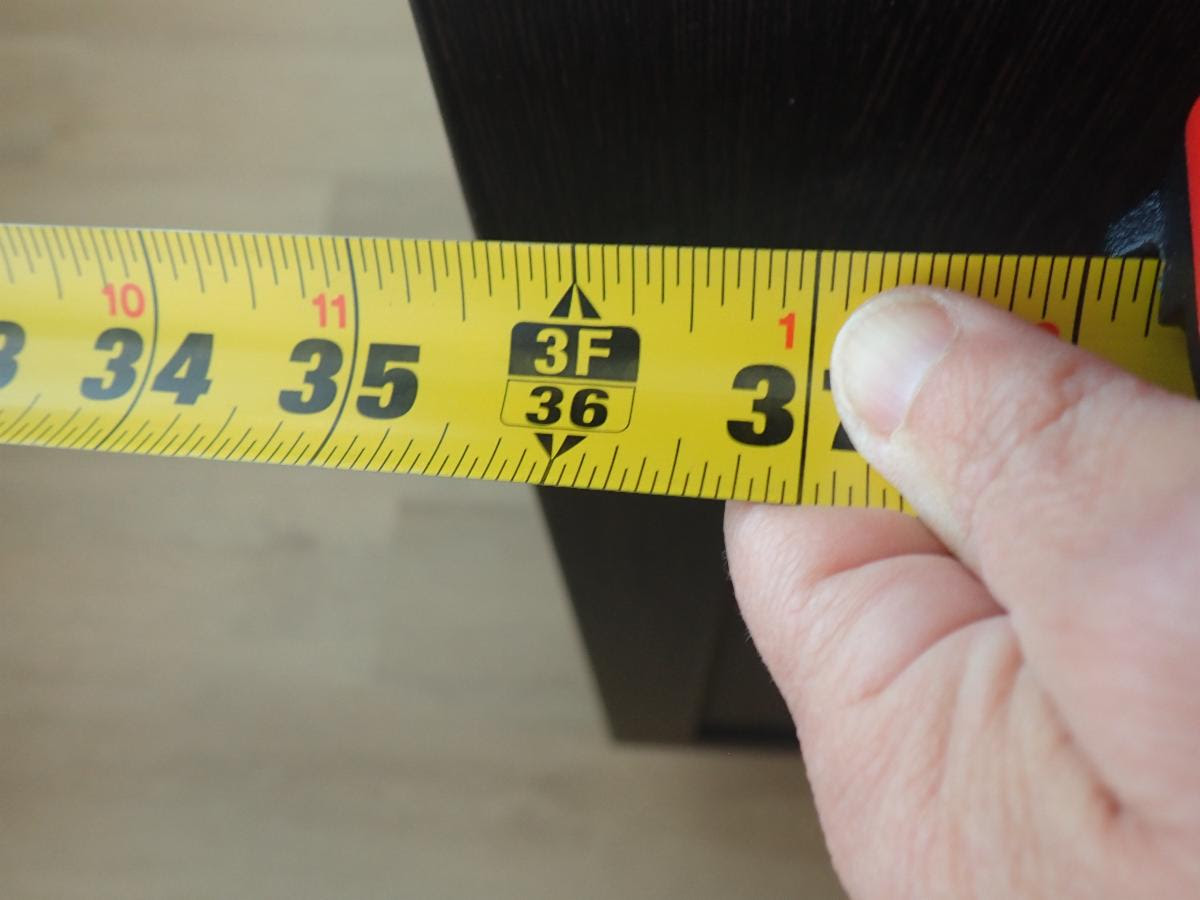
This kitchen island located next to a “corridor” to enter the kitchen had a base cabinet ALMOST 36″ from the adjacent wall, but the counter itself had an overhang and it was only 30″ from the adjacent wall which narrows the clear width to less than 36″ wide
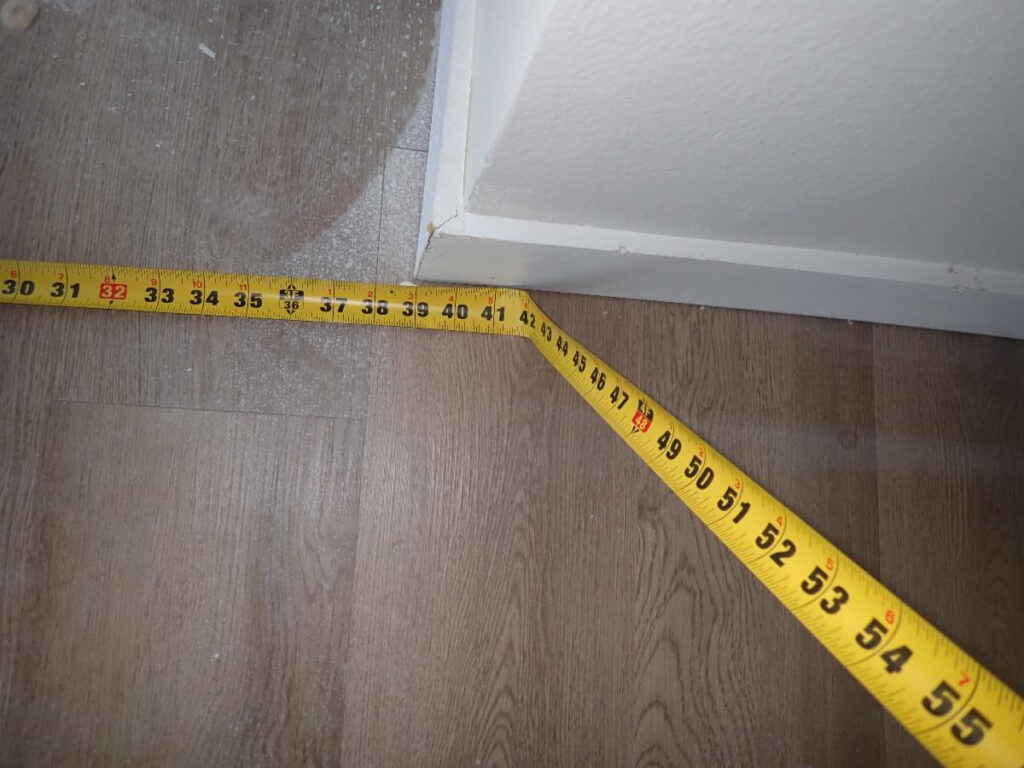
When measuring the clear with we measure it to the narrowest points. The base boards in dwelling units might reduce the clear with. Make sure you allow for tile thickness, base board thickness or overhangs when you design to ensure that your end result will yield a MINIMUM of 36″ clear width
Monday, April 3rd, 2023
Accessible signage can be a very confusing topic. Even after all these years of practicing my accessibility consulting, I am still learning a thing or two. Sadly they can even be confusing to signage manufacturers and installers.
Accessible signs require the following things:
- Raised and Brailled Characters
- Contrasting background
- San Serif Fonts
- Height and location
- If using Pictogram, there are requirements
- If depicting accessible spaces the use of the ISA (International Symbol of Access)
This newsletter will focus on a few common errors I encounter during my inspections mainly about Raised and Braille characters, contrasting background and location
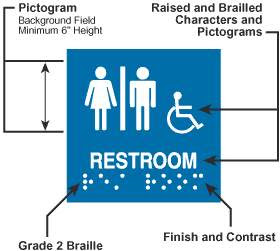
Raised Characters
The accessible signage will require that the characters describing the space whether it be a number or letters, must be raised. They should be at least 1/32″ above the surface of the sign.
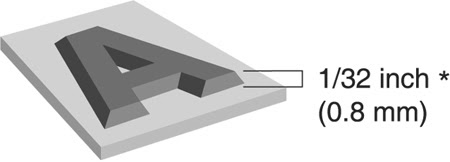
This graphic shows the minimum requirement for the raised characters of a sign.
There should also be Braille below the words that states the same words that are provided. So all words and numbers should be duplicated by Braille
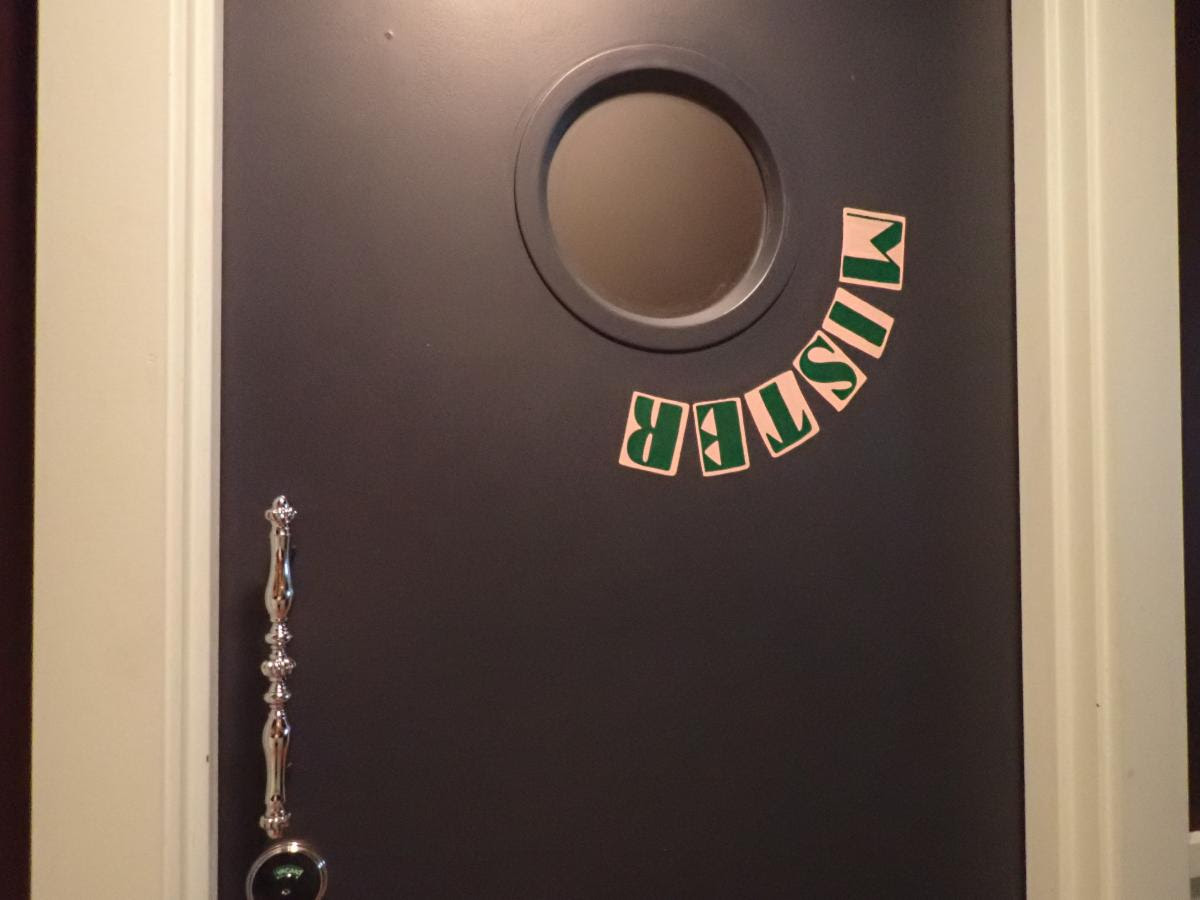
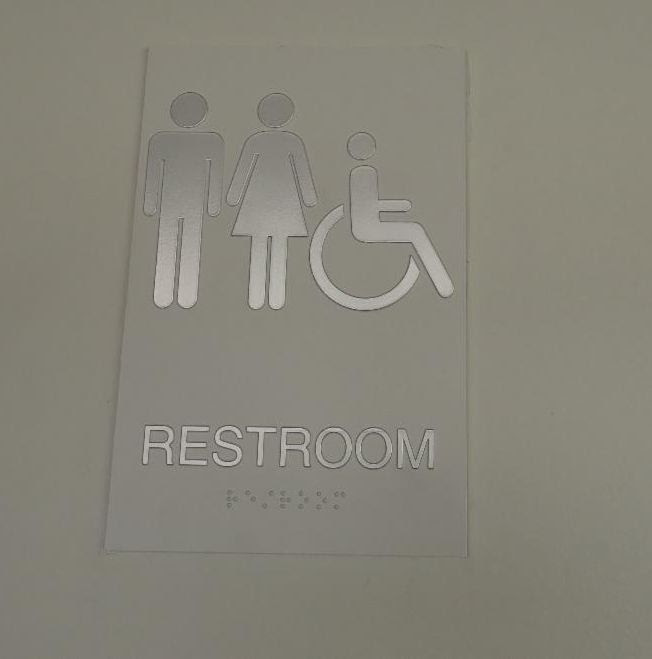
The restroom had a painted sign on the door but the characters were not raised and it did not have brailled as a duplicate. This is not compliant
This restroom has more than six toilets and urinals combined, therefore one compartment should be for wheelchairs and one compartment should be for other mobility devices (ambulatory)
Contrasting Background
At one of my inspections I encountered some signs that were all white. The raised characters were white as well as the background. The raised characters and the background were too similar in color and therefore there was no adequate contrast.
The requirement for contrasting color is intended for people with low vision. The sign would be too difficult to read without contrast.
The sign shown above did not have the required contrast between the raised characters and the background
Location
Signage that identify permanent rooms must be located on the latch side of the door or as close as possible on the latch side of the door. It must be located between 48″-60″ to the bottom of the raised characters and there must be a floor space of 18″x18″
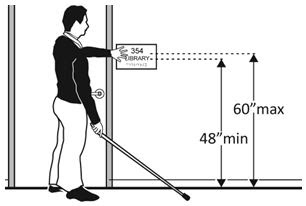
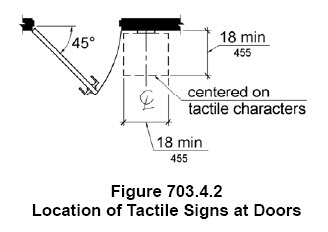
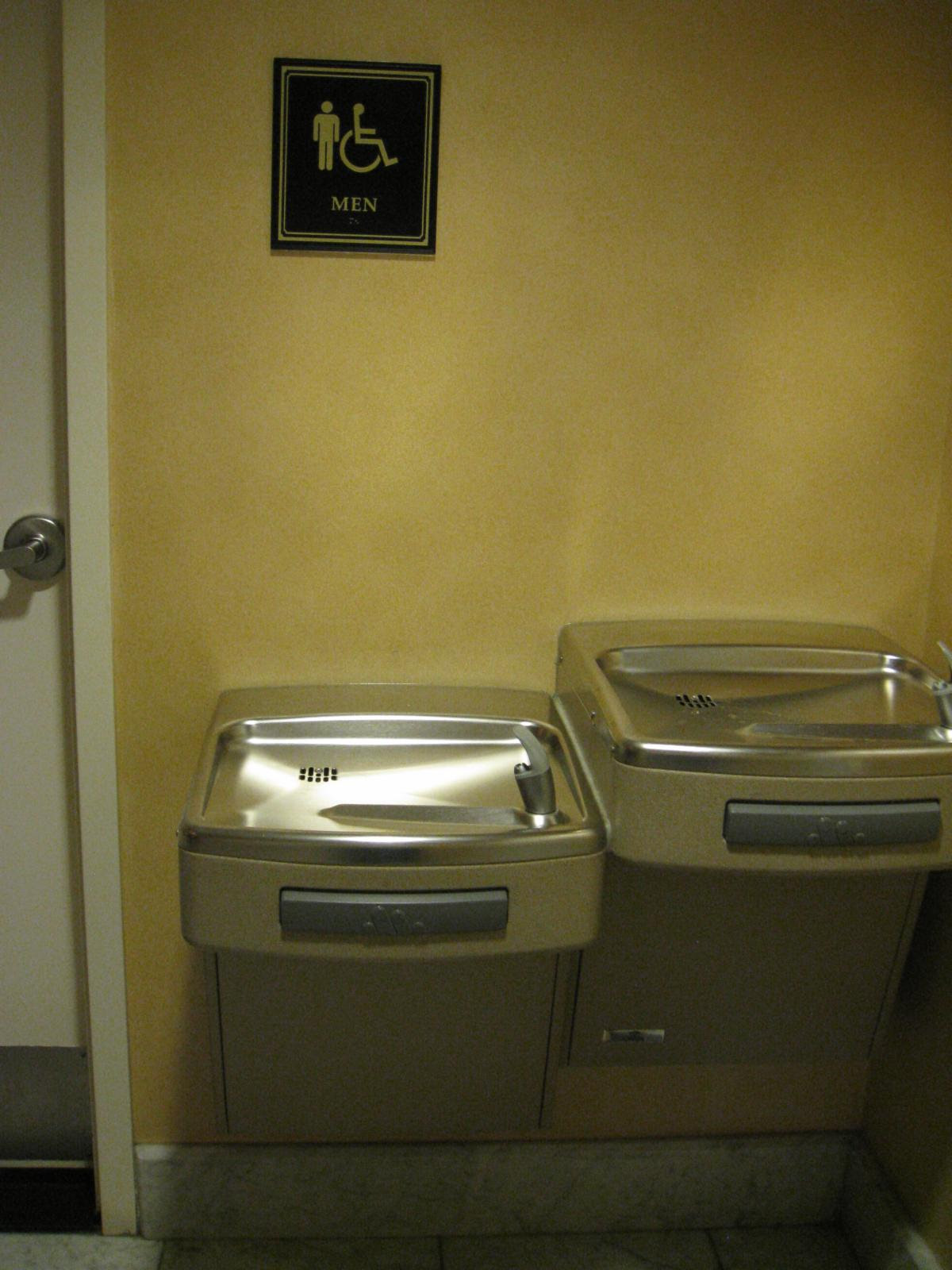
The sign shown above did had a drinking fountain at the floor area and did not have a clear 18″x18″ at the floor in front of the sign
In addition to permanent rooms, signage with Braille and raised characters must also be located at Exit Stair, Exit Passage Way and Door
ADA Section 216.4.1 Exit Doors. Doors at exit passageways, exit discharge, and exit stairways shall be identified by tactile signs complying with 703.1, 703.2, and 703.5.
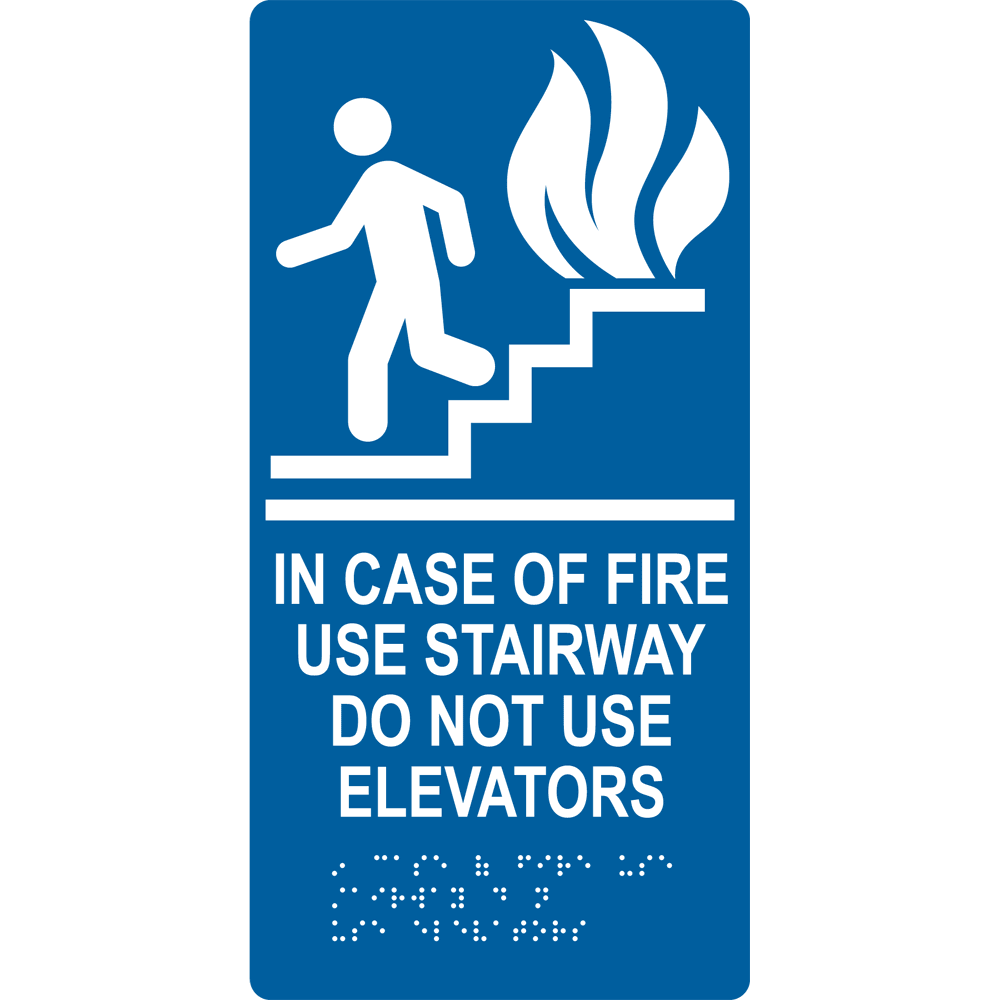
In addition to permanent rooms, signage with Braille and raised characters must also be located at Exit Stair, Exit Passage Way and Door
ADA Section 216.4.1 Exit Doors. Doors at exit passageways, exit discharge, and exit stairways shall be identified by tactile signs complying with 703.1, 703.2, and 703.5.
When are accessible signs NOT required?
Not all signs have to meet the accessibility guidelines. Here are the ones that do not required raised characters, brailled etc.
1. Building directories, menus, seat and row designations in assembly areas, occupant names, building addresses, and company names and logos shall not be required to comply with 216.2.
2. In parking facilities, signs shall not be required to comply with 216.2, 216.3, and 216.6 through 216.12.3.
3. Temporary, 7 days or less, signs shall not be required to comply with 216.4. In detention and correctional facilities, signs not located in public use areas shall not be required to comply with 216
Wednesday, March 1st, 2023
One of my clients inspired me to write this newsletter. She asked me how many toilets needed to be accessible by the 2010 ADA/2012 TAS. This newsletter will cover multi-user restrooms, single user restrooms and restrooms that could be used for both adults and children.
Multi-User Restrooms
In a multi-user (Gang restroom) one of the toilet compartments must have an accessible toilet used for wheelchairs. The size depends on whether the toilet is wall hung or floor mounted. Also if you are designing for children and they will be the primary user, then the size will be similar to having a floor mounted toilet even if you use a wall mounted. See the figure below
The ADA and TAS has an advisory describing what is a toilet compartment:
Advisory 213.3.1 Toilet Compartments. A toilet compartment is a partitioned space that is located within a toilet room, and that normally contains no more than one water closet. A toilet compartment may also contain a lavatory. A lavatory is a sink provided for hand washing. Full-height partitions and door assemblies can comprise toilet compartments where the minimum required spaces are provided within the compartment.
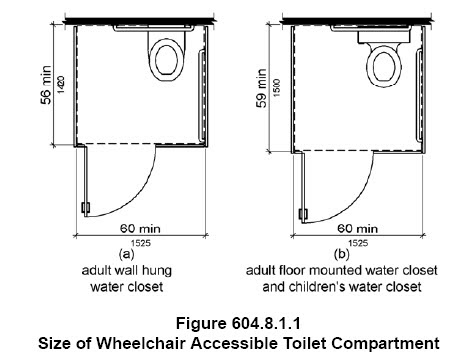
This is the figure found in the 2010 ADA and the 2012 TAS that shows the size of the wheelchair toiilet compartment.
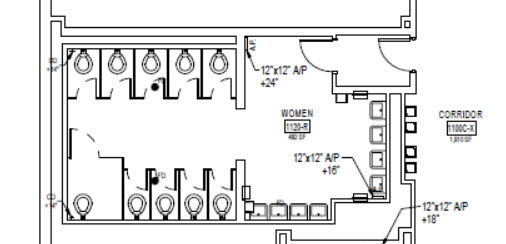
This photo shows mulitple toilet compartments. Only one compartment will have to be provided for wheelchair users. And there are more than six toilet compartments which also requires an ambulatory compartment.
What is an Ambulatory compartment?
If the restroom has six or more waterclosets/toilets and urinals then the ADA and TAS requires that an ambulatory toilet compartment be provided IN ADDITION TO the wheelchair toilet compartment. These are for people who use other mobility devices such as walkers, crutches, etc.
2010 ADA 213.3.1 Toilet Compartments. Where toilet compartments are provided, at least one toilet compartment shall comply with 604.8.1. In addition to the compartment required to comply with 604.8.1, at least one compartment shall comply with 604.8.2 where six or more toilet compartments are provided, or where the combination of urinals and water closets totals six or more fixtures.
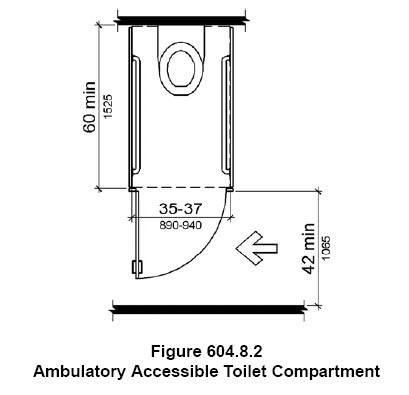
This figure shows the requirements for ambulatory toilet compartments. Notice the depth. Even though the wheelchair toilet compartment allows a 56″ depth, the ambulatory requries a minimum of 60″.
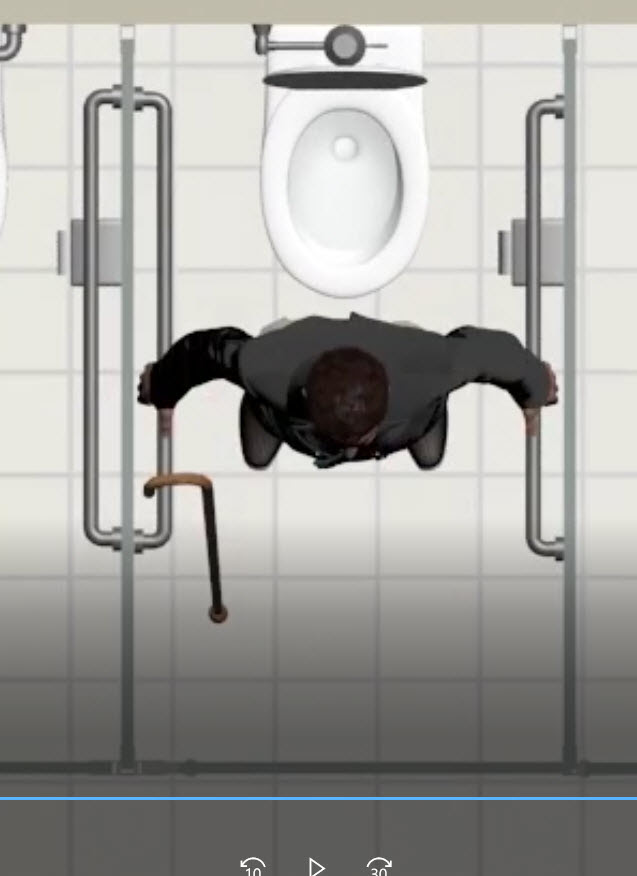
This figure shows a person that uses a cane using the ambulatory toilet compartment.
This restroom has more than six toilets and urinals combined, therefore one compartment should be for wheelchairs and one compartment should be for other mobility devices (ambulatory)
Single User Toilet Rooms
The ADA and TAs both require that EVERY toilet room provided be accessible.
213.2 Toilet Rooms and Bathing Rooms. Where toilet rooms are provided, each toilet room shall comply with 603.
There are several exceptions to this:
EXCEPTIONS:
1. In alterations where it is technically infeasible to comply with 603, altering existing toilet or bathing rooms shall not be required where a single unisex toilet room or bathing room complying with 213.2.1 is provided and located in the same area and on the same floor as existing inaccessible toilet or bathing rooms.
2. Where exceptions for alterations to qualified historic buildings or facilities are permitted by 202.5, no fewer than one toilet room for each sex complying with 603 or one unisex toilet room complying with 213.2.1 shall be provided.
3. Where multiple single user portable toilet or bathing units are clustered at a single location, no more than 5 percent of the toilet units and bathing units at each cluster shall be required to comply with 603. Portable toilet units and bathing units complying with 603 shall be identified by the International Symbol of Accessibility complying with 703.7.2.1.
4. Where multiple single user toilet rooms are clustered at a single location, no more than 50 percent of the single user toilet rooms for each use at each cluster shall be required to comply with 603.
Based on exception 4, when you have single user restrooms in a cluster, then only 50% are required to be accessible. Make sure you round up to the nearest whole number (so if you have three restrooms in a cluster, you would need two accessible ones)
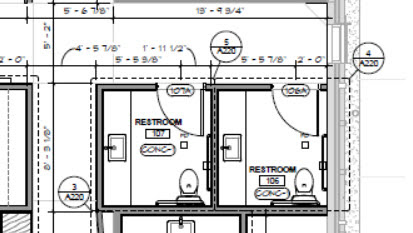
This image shows two single user restrooms in a cluster and only one would have to comply. They opted not to take the exception, but they could have.
In a single user restrooms is provided with one toilet, then that one toilet must be accessible. If the single user restroom has two toilets, again only one of the toilets is required to be accessible.
213.3.2 Water Closets. Where water closets are provided, at least one shall comply with 604.213.3.3
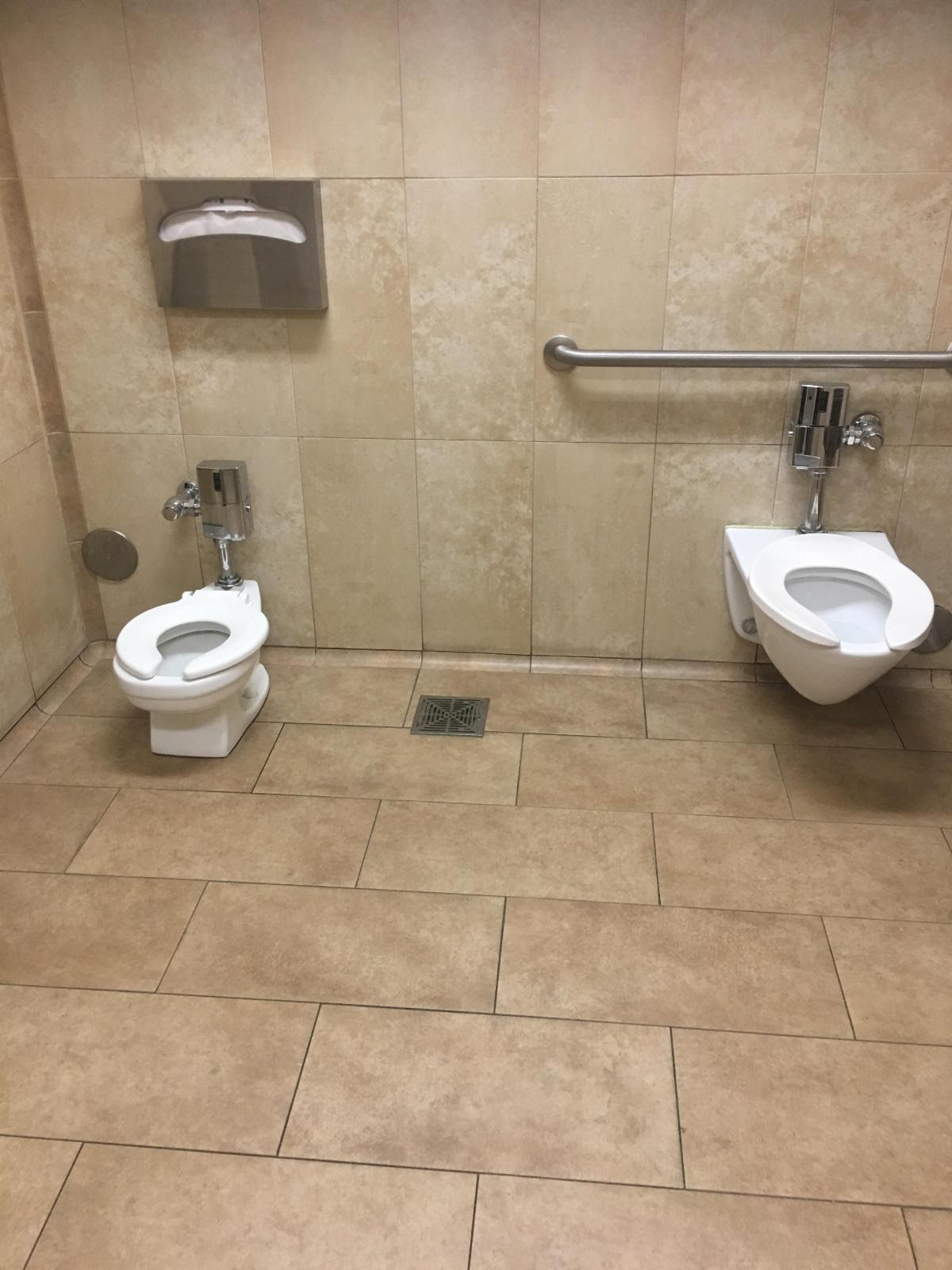
This restroom shows two toilets. Even though one is for adults and one is for children, the ADA only requires that one be accessible. Of course this is a minimum requirement and would be a good idea to have both be accessible since they will be used by different people.
Wednesday, February 1st, 2023
Electrical Vehicles are very popular and the need for Electrical Vehicle Charging Stations (EV) has been on the rise. Even though there were electrical vehicles before the ADA Standards were published and there were Electrical Vehicle Charging Stations (EV), the ADA did not have requirements for accessible electrical vehicle parking or charging stations. The US Department of Energy did issue a directive on work place EV stations, but it has not been adopted as part of the ADA.
“As the U.S. Department of Justice has not issued formal accessibility guidelines addressing electric vehicle charging stations, the Texas Department of Licensing and Regulation issues the following technical clarifications until such time as federal standards become available and are adopted”.The Texas Department of Licensing and Regulation (TDLR) issued Technical Memo TM 2012-01 which gives the requirments for the electrical vehicle charging parking spaces and this newsletter will explain and give examples.
Electrical Vehicle Charging Stations
Per TM 2012-01: “If electric charging stations are provided in new or existing parking lots, parking garages or other location containing parking spaces, twenty percent (20%) but not less than one, of each type of charging station in each cluster on a site shall meet the following criteria:
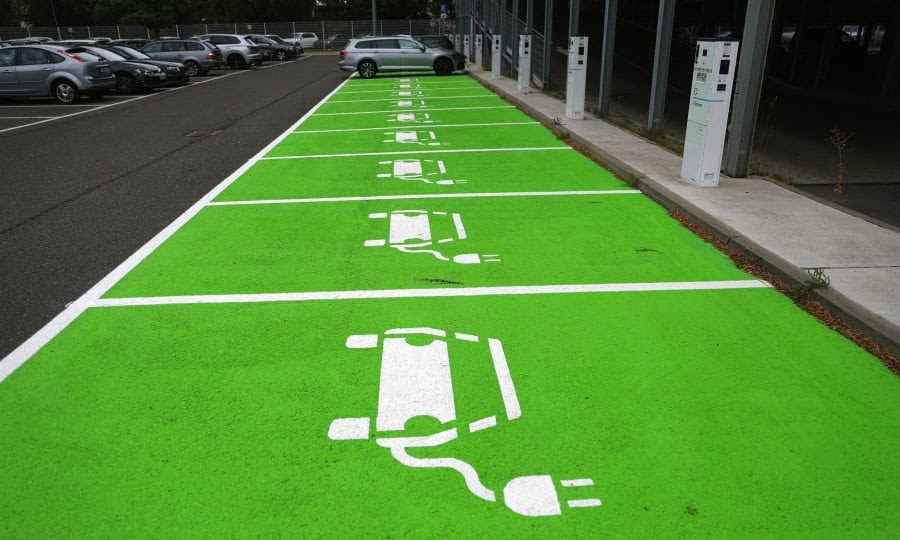
In the photo above, there are no accessible EV stations. 20% but not less than one of these electrical vehicle charging stations are required to be provided for persons with disabilities.
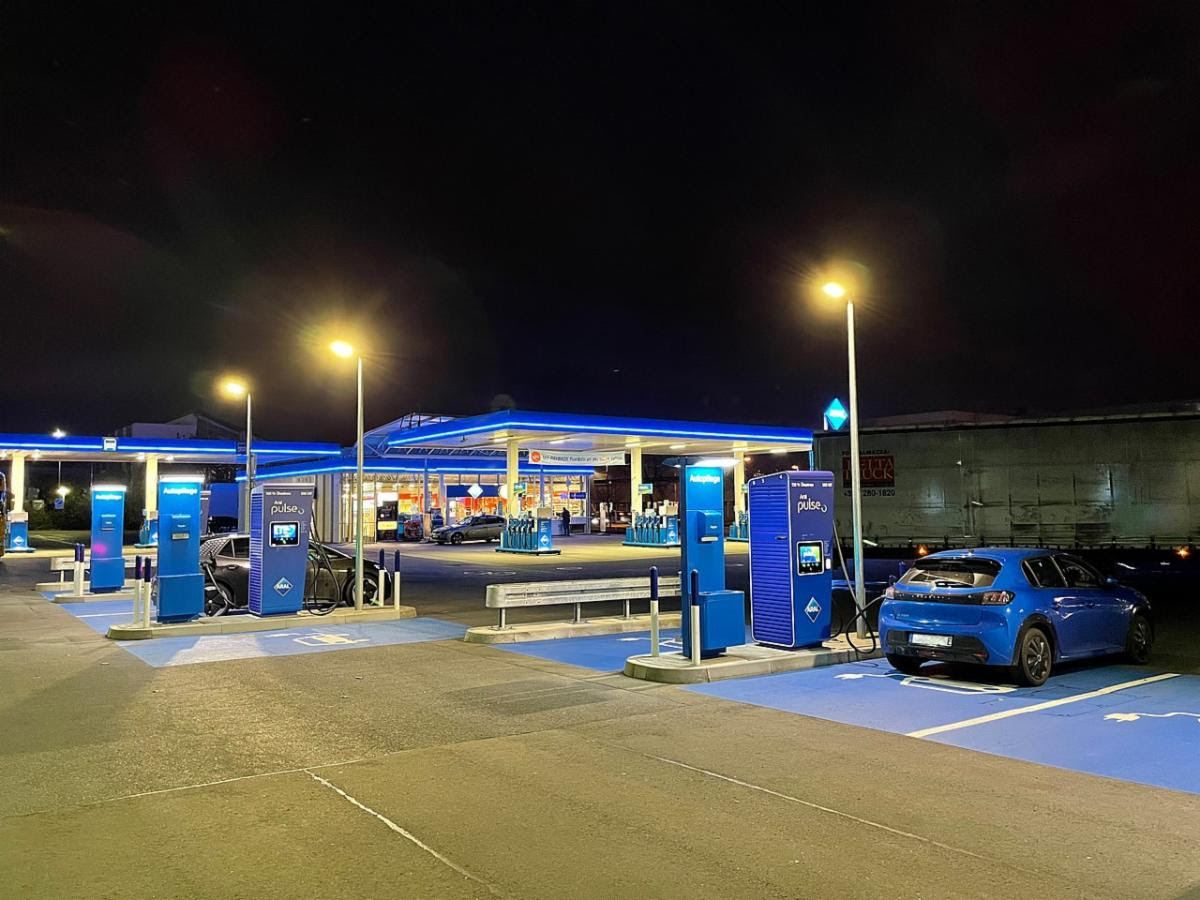
Each cluster of electrical vehicle charging spaces will have to comply with the 20% rule.
Controls:
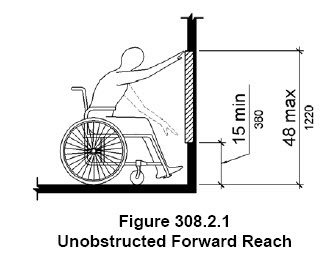
Controls and operating mechanisms for the accessible charging station shall comply with TAS 309 and shall be within the forward reach ranges specified in TAS 308.2;
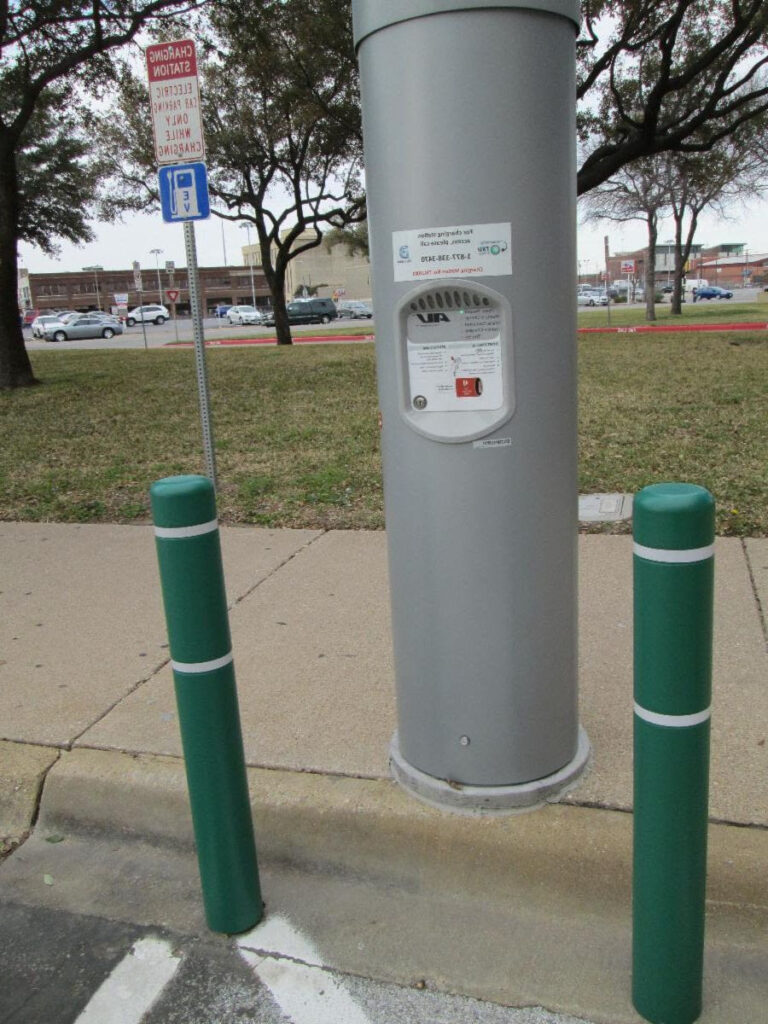
Charging stations must have a clear floor space measuring 30″x48″ minimum so a person in a wheelchair can approach it and use it. That clear floor space, must have a slope of 2% in all directions.
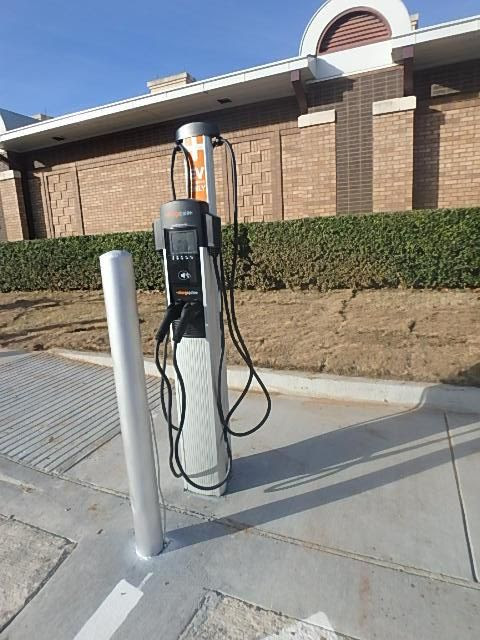
There is a bollard in the way of the controls at this EV station
Charging stations controls should be within reach range for either a forward or side approach depending on the space allowed. The controls in the photo above shows it far from the edge and higher than 48″ a.f.f. which appears to not be within reach.
Size of Vehicle spaces and access aisle
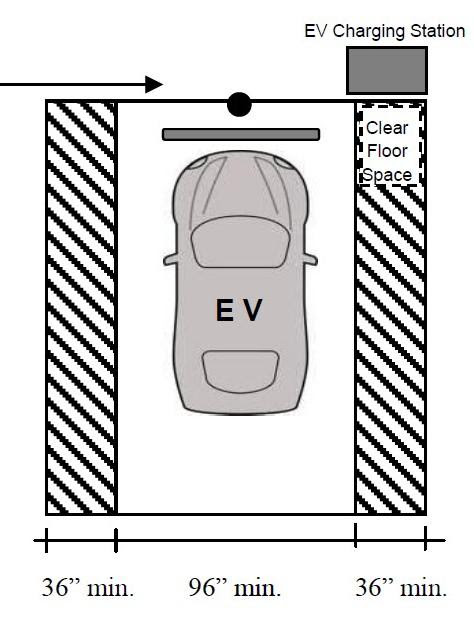
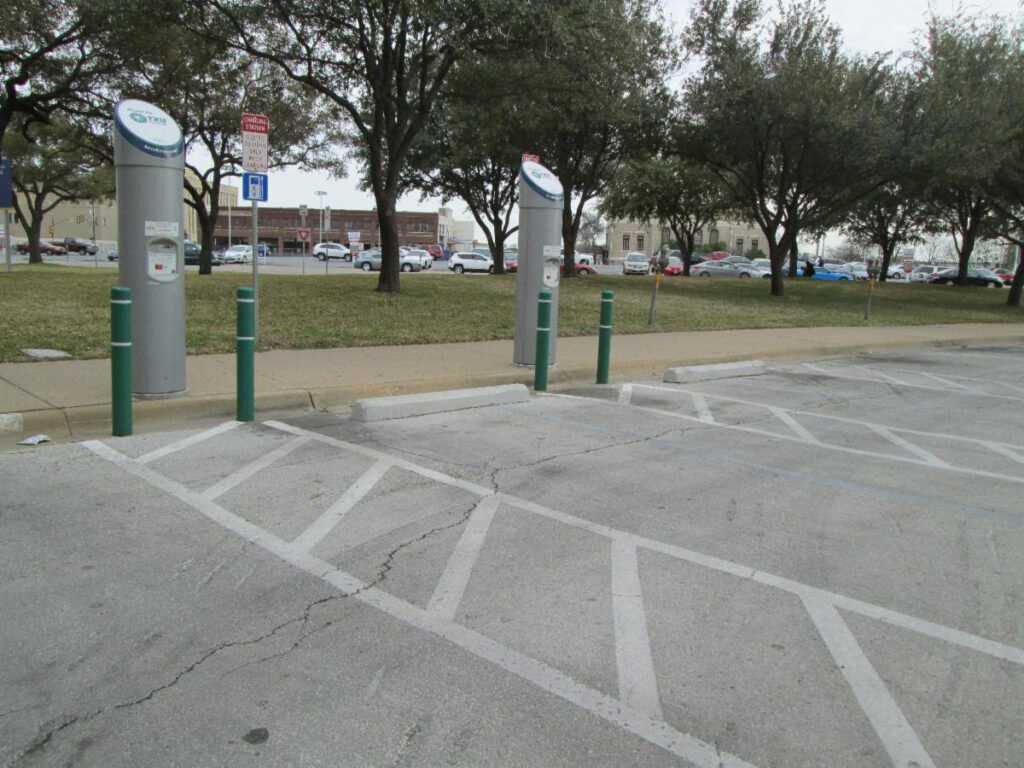
Per TM 2012-01: The vehicle space(s) with the accessible charging station shall be at least 96 inches wide and shall provide a 36 inch wide (minimum) accessible route complying with TAS 402 on both sides of the vehicle space to allow the user adequate space to exit their vehicle and access both sides of the vehicle.
The charging stations in the photo above shows the two 36″ aisle on both sides of the space.
Signage:
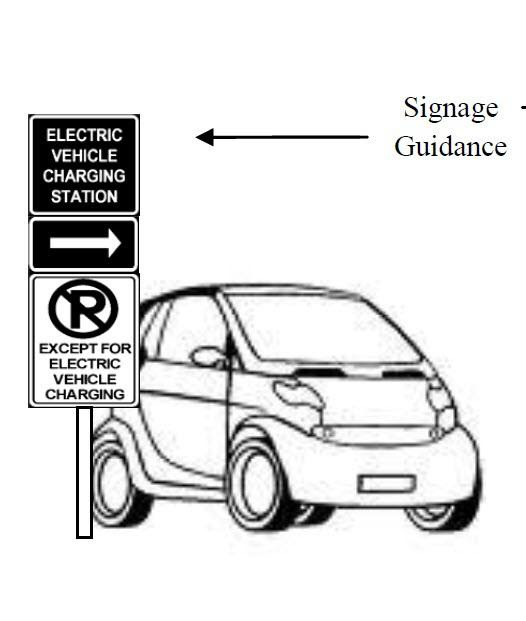
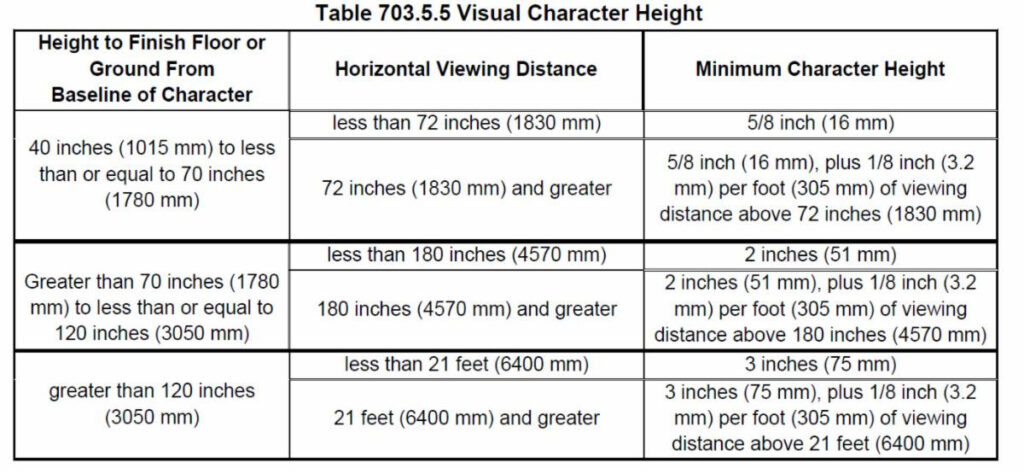
Directional and informational signage complying with TAS 216.3/703.5 shall designate the location of the accessible charging stations.
If not all EV stations are accessible, there needs to be a directional signage that shows a person with disabilities where it is located.
Some recommendations: NOT MANDATORY
Striping of the accessible routes is recommended but not required.
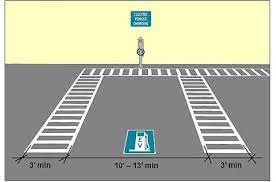
The striping at the accessible route is not required, but it is advisory to provide it. This is an image from the California code
The symbol of accessibility is recommended but not required.
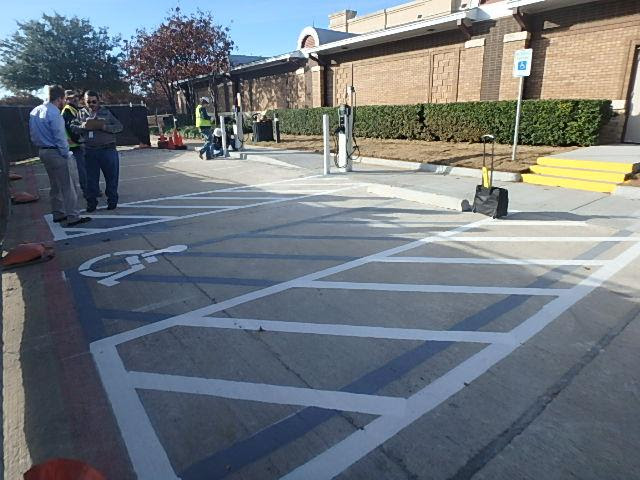
The International Symbol of Accessibility shown in the photo above is for the accessible parking space which is also being used as the accessible EV station. The accessible EV station may not be the accessible parking for non-electrical vehicles. They must have its own separate parking spaces.
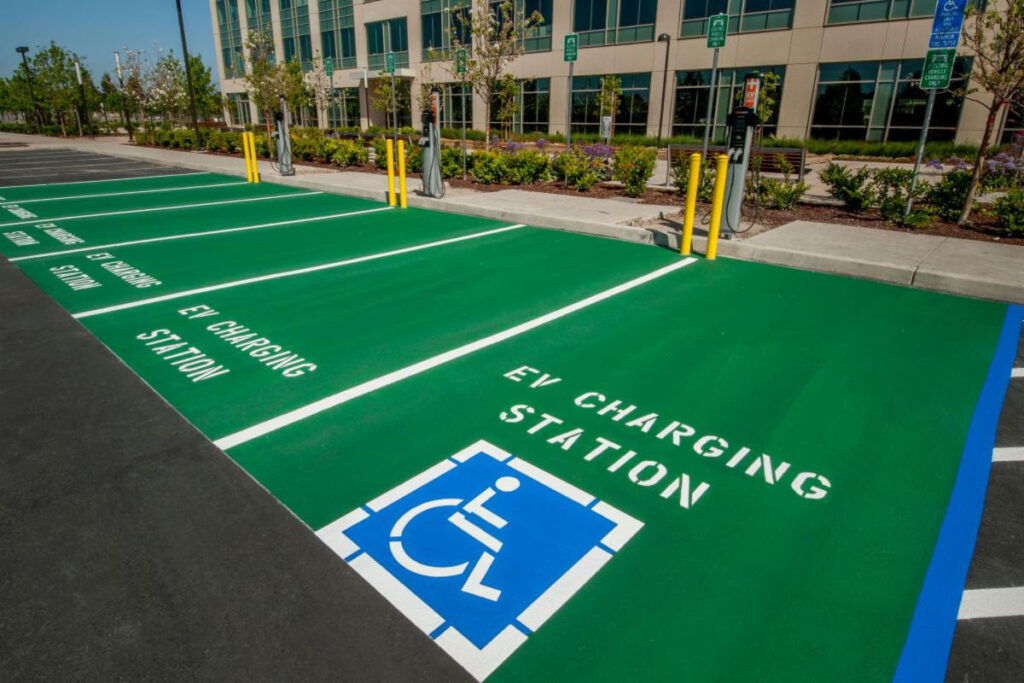
The International Symbol of Accessibility shown in the accessible electrical vehicle charging station parking space is not rerquired. The photo above shows the symbol, but it does not meet the minimum requirements in Texas or California
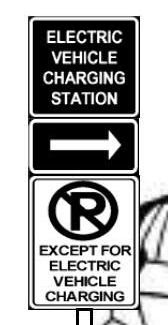
The signs above are examples and layout of signage. They are for illustrative purposes only and are not intended to imply that there are no other options available.
 Abadi
Abadi