
.
Thank you to Abadi Accessibility News for asking me to weigh in with my opinion as we approach the 20th Anniversary of the Americans with Disabilities Act. My name is Bob Borson and I can typically be found at the helm of my own blog, Life of an Architect .
On July 26, 1990, the Americans with Disabilities Act (ADA) was signed into law by then President George. H. W. Bush. It was a momentous occasion and it would change the lives of millions of people, mostly for the better. So here we are 20 years later, well into living and working with the rules and regulations associated with the ADA, but how are we as architects doing implementing these rules? As architects we are probably doing okay because you can’t work on a project without implementing the requirements of the ADA. For example, this act was signed into law before I even graduated from college so it has existed all of my professional life. That having been said, how are our clients doing with it and are we helping them?
On occasion, when I tell people that some portion of their project doesn’t currently meet code or when I try and explain why the bathrooms are as large as I have shown them, I get puzzled, sometimes irritated responses:
Client: “I was in a restaurant the other day and their toilet room wasn’t anywhere near this big.”
Me: “Well that doesn’t make it right, besides, it is possible that their toilet rooms were permitted before ADA was a requirement.”
Client: “And why is that space behind the cashier so large – make it smaller..”
Me: “I can’t, that is another ADA requirement. Someone who works back there might be in a wheelchair and they need to be able to turn around and maneuver properly.”
Client: “It’s too big, I just won’t hire someone in a wheelchair.”
Me: “It’s not called the Americans in Wheelchairs Act, there are other disabilities. You do realize that you are now practicing a type of discrimination and trying to break a federal law?”
Client: “No one else seems to have to do it…now whose being discriminated against?”
I am embarrassed to have to say that I have had this exact conversation or some form just like it several times and I am always shocked that people don’t even realize that they are practicing discrimination. I like to think I have smart clients but I have had a few tell me (after I pointed out what they were asking for) tell me that they don’t discriminate, that they like people from all races and backgrounds.
Errr…that would be racism and something entirely different. Holy gorilla’s armpit – you have got to be kidding me………
I have to be honest with you, I mostly do residential work and my knowledge of the intricacies of the rules and regulations associated with the ADA are pedestrian at best. I can handle looking things up in the rule book and coming to my own conclusions but what it really comes down to is having a Registered Accessibility Specialist, or RAS, who is there to help guide you. When I start a project, and I try to sit down with all the people who will be working with me and I have a conversation about how we are all on the same team and that we all have the same goals. See, the very nature of how most contracts are set up, adversarial relationships between architect and contractor are established from the very beginning. Another relationship that can be a bit…well maybe not adversarial but difficult at times is between the architect and their RAS. Sometimes, and I mean this with begrudging respect, RAS tend to be rule followers of the highest order. This “rule following” mentality can actually serve the architect well when trying to navigate the labyrinth that is the ADA rulebook. But I am not interested in just rule followers, I want my RAS to interpret how the rules might actually apply specifically to my project. And that’s where my particular RAS consultant specialist comes in.
When I was asked to write this post, I was more than happy to do it. The type of RAS consultant I like to work with typically has an architectural background. Having a RAS who thinks like an architect while interpreting the rules and regulations associated with ADA, brings me that much closer to achieving a successful project while getting everyone working on the project on the same side and with the same ultimate goal. I don’t think that some people think about the type of role that a RAS can perform – if you get the right one. It is my intention to go beyond just “doing the right thing”, disabled persons should have their actions and challenges taken into consideration. Trying to be a rule breaker, or even a rule bender, holds no allure for me as a architect and designer. But just as I have to interpret the projects programs, I want a RAS consultant who will help me work within the guidelines established and to achieve all our common goals – a happy client. Incorporating ADA requirements into your projects is an indication on how far we as a society have come, how inclusive we can be. It should be more about what we can do, not what we have to do.
Below are ten tips that I’ve given to my clients to assist them in designing for accessibility.
1. CODE RESEARCH
Before you begin your design, make sure you are aware which code you are required to follow based on the City you are designing in. (for example, some Municipalities requires ANSI vs. ADA) Click here to see which Code has been adopted by State. Remember that you have to use the most stringent between ADA and whatever other code/guidelines your municipality is using.
2. HAVE A CHECKLIST
It is smart to have a checklist so you don’t forget some part of the puzzle. The ADA has a checklist that you can follow for assessments and design process.
3. HAVE TOLERANCES
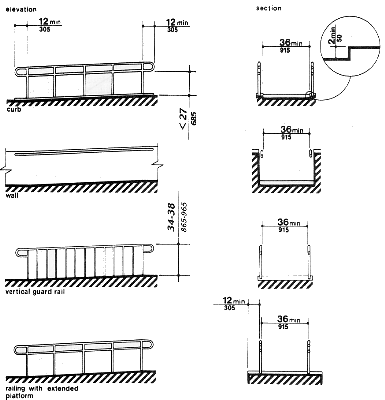
When given a range, don’t use the lowest or tallest number. Give yourself some tolerances for construction imperfections. For example, a handrail can be between 34” and 38”, so a 36” tall handrail is acceptable.
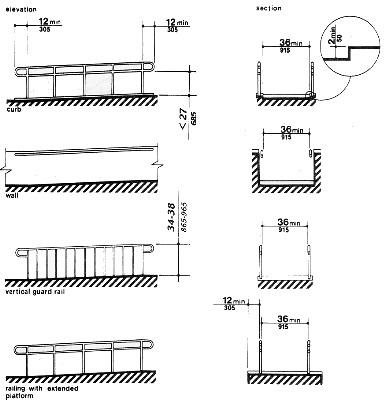
4. GIVE YOURSELF WIGGLE ROOM
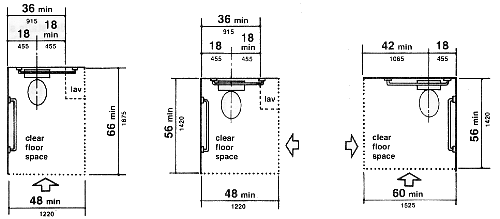
When designing toilet rooms, keep in mind what finishes will be on the wall. If the water closet must be 18” away from the finished wall, ceramic tile is sometimes 3/8” thick which can throw off the required clearances.
5. CHECK DOOR SWINGS
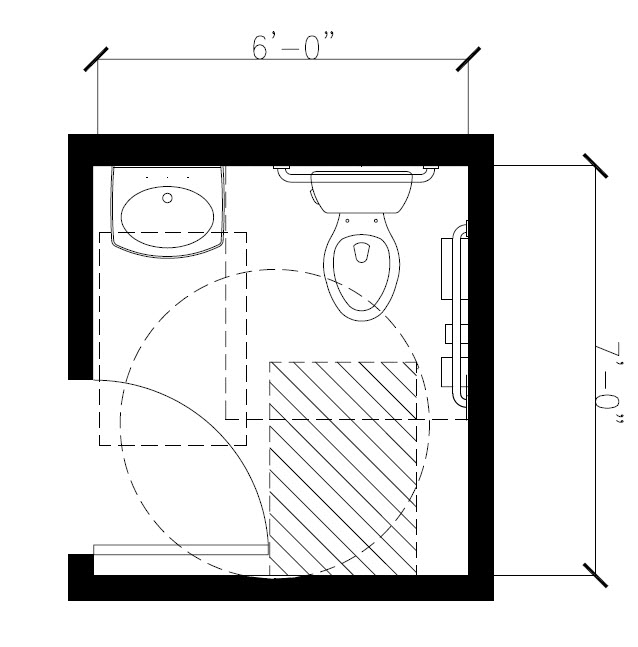
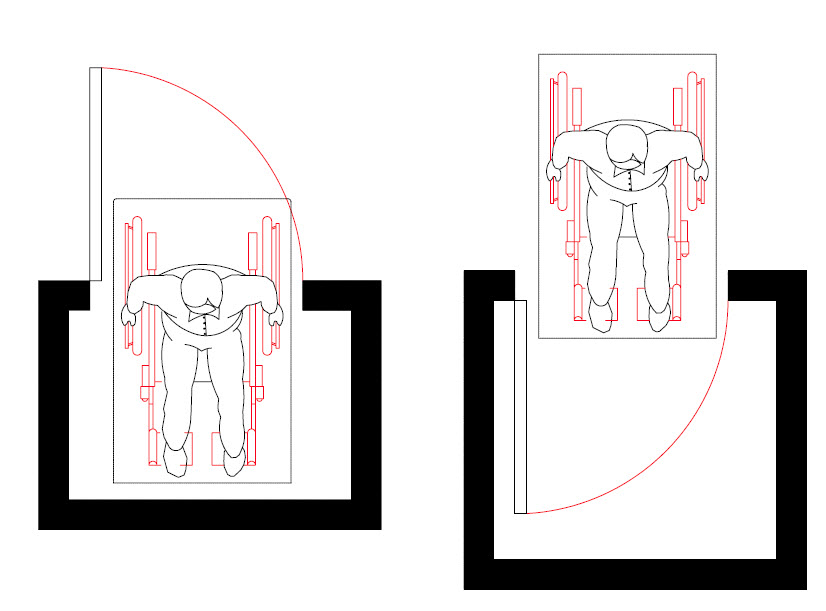
Remember that in a toilet room, a door cannot swing into the clear floor space of an accessible fixture, but clear floor spaces of fixtures can overlap each other. And the door swing can overlap the required turning space. There is an exception given in Texas and in ANSI for single user restrooms. Click here for the Technical Memo
6. KEEP IN MIND THE USERS
When designing storage rooms, keep in mind that if a person in a wheel chair can enter the room and close the door behind them, then they must be able to turn around and go back out. In cases where the storage room is 48” deep (allowing a wheel chair front access), try to either swing the door in so they can’t close it once they are inside; or create shelving that will make the room shallower and therefore will not create the ability to stay stuck inside.

7. UNDERSTAND COMMON USES
Most places in a facility that are used by more than one employee at a time, or by patrons or visitors to the facility are required to be accessible and meet the requirements of the Guidelines. This includes employee non-work areas like storage closets, restrooms, and break rooms. The mistake I see often is that most people believe that the ADA is only for non-employees. In reality, common use spaces that are also accessed by employees must comply.
8. DEFINE WORK AREAS
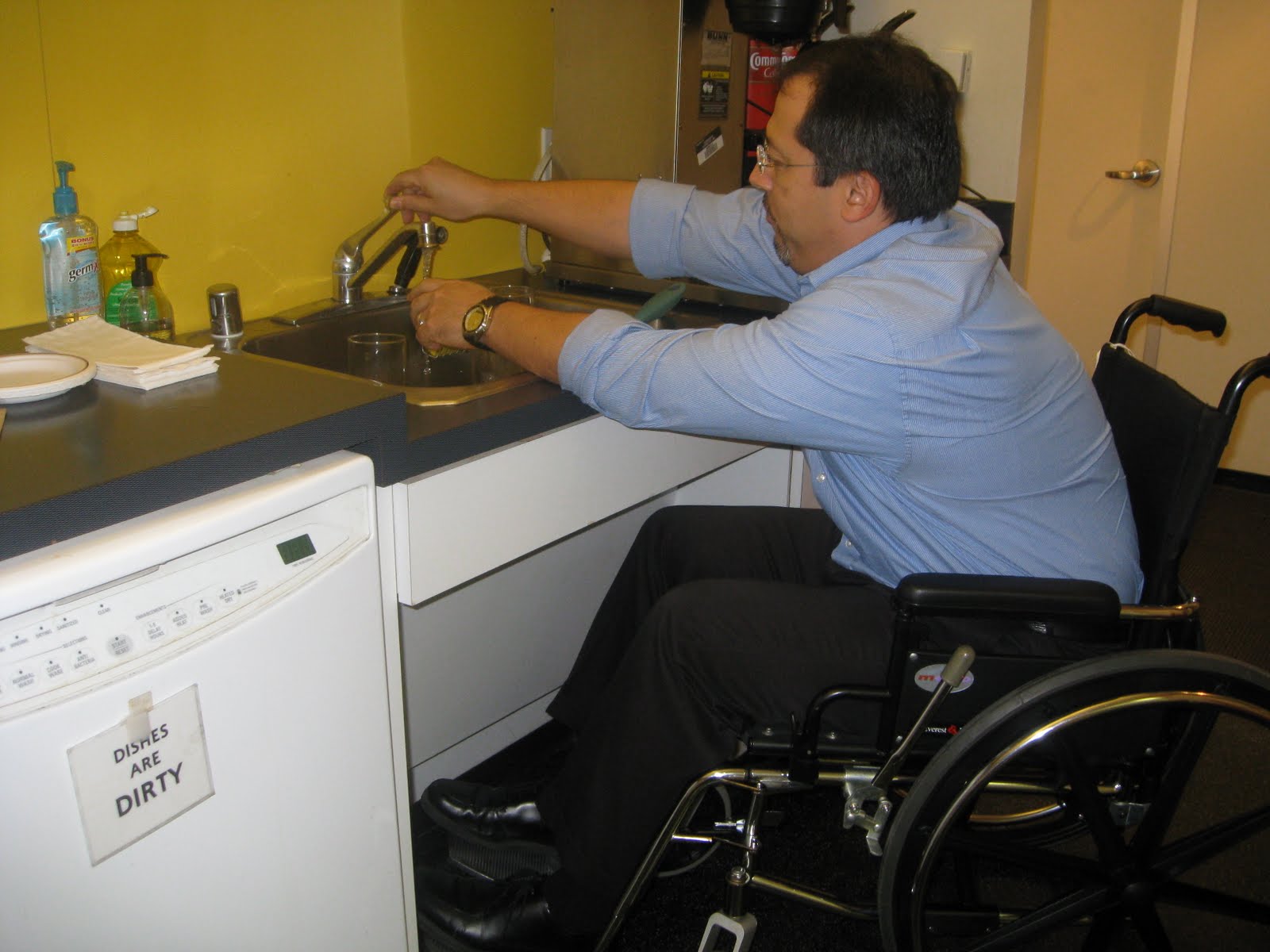
Employee work areas only have the requirement to be able to be approached, entered and exited. Everything else within the work area are exempted. For example sinks that are in work areas (per ADA 4.1.3) are not required to have knee clearances for wheel chairs. Break Rooms are not considered work areas, therefore do require the knee clearance. Sinks and Lavatories have different requirements for knee clearances. Be aware that the knee clearance below sinks is 27” and below lavatories is 29” below their respective aprons.
Break rooms are not considered work areas (that is where you take a “break” from work, therefore do require the knee clearance.
9. WATCH OUT FOR HAZARDS
In Texas, TAS does not allow any person to wheel themselves behind parked cars. When possible, allow for an accessible route in front of the cars. A person in a wheelchair is lower than the driver’s visual range and if they are wheeling behind a parked car, the driver may not see them if they are backing up.
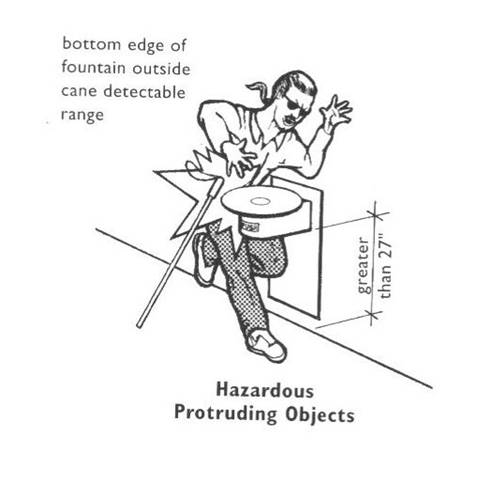
Also, if there are any objects that are along the circulation path that are placed higher than 27″ above the ground, they must not project more than 4″ from the wall into the circulation path. Visually impaired people will not detect the object and could hurt themselves.
10. MAKE SURE EXISTING CONDITIONS COMPLY
In an alteration of an area containing a primary function the existing parking, accessible route, restrooms, drinking fountains and telephones must be brought up to compliance with ADA. This is not always part of the scope of work of the remodel, but nevertheless must become part of the total scope if it’s not already compliant
Note: ADA has a 20% rule, which allows a deference of compliance if the amount of money required to fix the non-compliance items exceeds the total cost of the project by 20%.
“I would rather fall than have my friends think I have a grab bar!”
Those words changed the world of Abbie Sladick, sending her on a fantastic journey of creativity and innovation in a seemingly dull industry.
For over eight years, Abbie had been making dreams come true by designing and remodeling extraordinary bathrooms for her clients. She used products from all over the world for her projects but when one of her clients refused to use a grab bar – Abbie was stumped.
How could she create a beautifully bathroom with an ugly grab bar?
Never to be discouraged, Abbie decided if she couldn’t buy a stylish grab bar… then she would design one. The company’s signature Wave bar was the result. Now Abbie and the Great Grabz team look towards the future redefining safety in the bathroom by creating stylish products that allow people of all ages and abilities to maintain their dignity and independence.
http://www.greatgrabz.com/
 Abadi
Abadi 



![Reblog this post [with Zemanta]](http://img.zemanta.com/reblog_e.png?x-id=9d205146-c550-4fce-9685-87802f83bed9 "Ten Tips for Accessibility Design 8")
